Micro communities for the homeless sprout in US cities eager for small, quick and cheap solutions
Advertisement
Read this article for free:
or
Already have an account? Log in here »
To continue reading, please subscribe:

Digital Subscription
One year of digital access for only $205*
- Enjoy unlimited reading on winnipegfreepress.com
- Read the E-Edition, our digital replica newspaper
- Access News Break, our award-winning app
- Play interactive puzzles
*First annual payment billed as $205.00 + GST for one year. This annual subscription will automatically renew at $233.00 + GST every 52 weeks (10% off the regular annual price of $259.35). Offer available to new and qualified returning subscribers only. Cancel any time.
To continue reading, please subscribe:
Add Free Press access to your Brandon Sun subscription for only an additional
$1 for the first 4 weeks*
- Enjoy unlimited reading on winnipegfreepress.com
- Read the E-Edition, our digital replica newspaper
- Access News Break, our award-winning app
- Play interactive puzzles
*Your next Brandon Sun subscription payment will increase by $1.00 and you will be charged $17.95 plus GST for four weeks. After four weeks, your payment will increase to $24.95 plus GST every four weeks.
Read unlimited articles for free today:
or
Already have an account? Log in here »
Hey there, time traveller!
This article was published 13/06/2024 (809 days ago), so information in it may no longer be current.
ATLANTA (AP) — In a dreary part of downtown Atlanta, shipping containers have been transformed into an oasis for dozens of previously unsheltered people who now proudly call a former parking lot home.
The gated micro community known as “The Melody” doesn’t look like a parking lot anymore. Artificial turf is spread across the asphalt. Potted plants and red Adirondack chairs abound. There’s even a dog park.
The shipping containers have been divided into 40 insulated studio apartments that include a single bed, HVAC unit, desk, microwave, small refrigerator, TV, sink and bathroom. On a recent afternoon, a half-dozen residents were chatting around a table in The Melody’s smoking area.
“I’m just so grateful,” said Cynthia Diamond, a 61-year-old former line cook who uses a wheelchair and used to be chronically homeless. “I have my own door key. I ain’t got to worry about nobody knocking on my door, telling me when to eat, sleep or do anything. I’m going to stay here as long as the Lord allows me to stay here.”
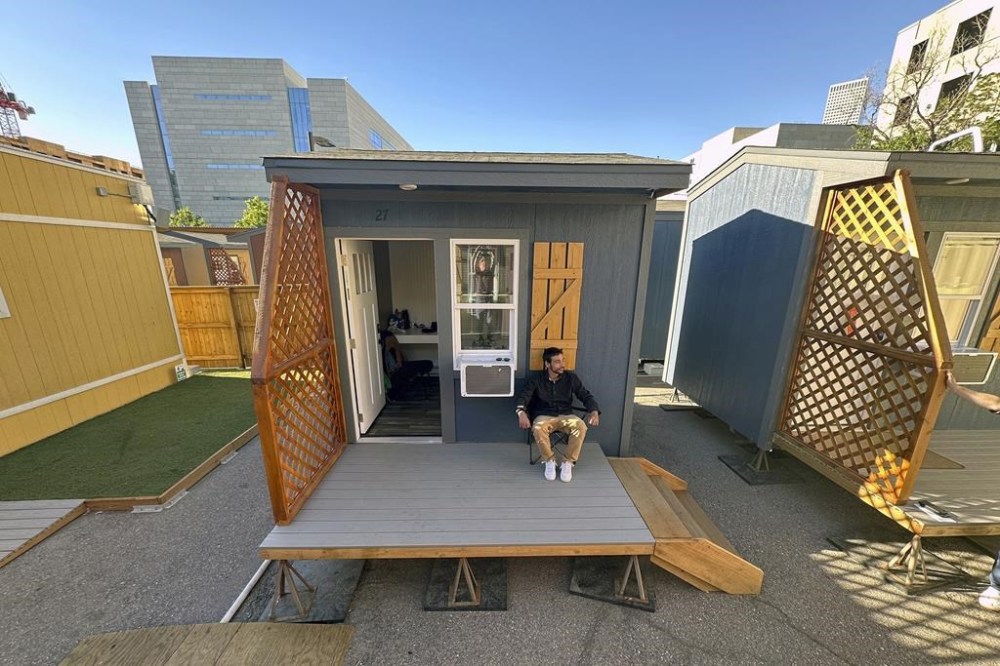
Faced with years of rising homelessness rates and failed solutions, city officials across the U.S. have been embracing rapid housing options emphasizing three factors: small, quick and cheap. Officials believe micro communities, unlike shelters, offer stability that, when combined with wraparound services, can more effectively put residents on the path to secure housing.
Denver has opened three micro communities and converted another five hotels for people who used to be homeless. In Austin, Texas, there are three villages of “tiny homes.” In Los Angeles, a 232-unit complex features two three-floor buildings of stacked shipping containers.
“Housing is a ladder. You start with the very first rung. Folks that are literally sleeping on the ground aren’t even on the first rung,” said Denver Mayor Mike Johnston, sitting in one of the city’s new micro communities that offer tiny, transitional homes for that first rung.
More than 1,500 people have been moved indoors through the program, with over 80% still in the housing as of last month, according to city data. The inexpensive units are particularly a boon for cities with high housing costs, where moving that many people directly into apartments wouldn’t be financially feasible.
Both Atlanta’s and Denver’s program act as a stepping stone as they work to get people jobs and more permanent housing, with Denver aiming to move people out within six months.
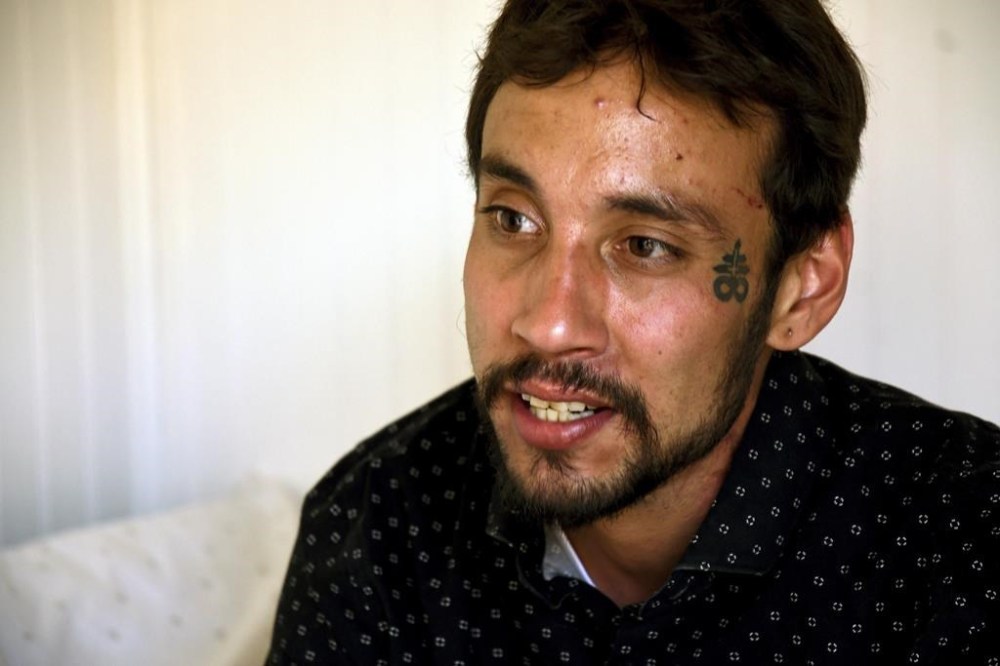
That includes Eric Martinez, 28, who has been in limbo between the street and the bottom rung for most of his life. At birth Martinez was flung into the revolving door of foster care, and he’s wrestled with substance use while surfing couches and pitching tents.
“It’s kind of demeaning, it makes me feel less of a person,” said Martinez, his eyes downcast. “I had to get out of it and look out for myself at that point: It’s fight or flight, and I flew.”
Martinez’s Denver tent encampment was swept and he along with the others were directed into the micro communities of small cabin-like structures with a twin bed, desk and closet. The city built three such communities with nearly 160 units total in about six months, at roughly $25,000 per unit, said Johnston. The 1,000 converted hotel units cost about $100,000 each.
On site at the micro community are bathrooms, showers, washing machines, small dog parks and kitchens, though the Salvation Army delivers meals.
The program represents an about-face from policies that for years focused on short-term group shelters and the ceaseless shuffle of encampments from one city block to the next. That system made it difficult to keep people who were scattered through the city connected to services and on the path to permanent housing.
Those services in Denver’s and Atlanta’s micro communities are largely centralized. They offer residents case management, counseling, mental health and substance abuse therapy, housing guidance and assistance obtaining anything from vocational skills training to a new pair of dentures.
“We’re able to meet every level of the hierarchy of needs — from security and shelter, all the way up to self-actualization and the sense of community,” said Peter Cumiskey, the Atlanta site clinician.
The Melody, and projects like it, are a “very promising, feasible and cost-effective way” to tackle homelessness, said Michael Rich, an Emory University political science professor who studies housing policy. Rich noted that transitional housing is still just the first step toward permanent housing.
The programs in Denver and Atlanta, taking inspiration from similar ones in cities like Columbia, South Carolina, and Savannah, Georgia, offer a degree of privacy and security not found in congregate shelters or encampments.
Giving each resident their own bathroom and kitchen is a crucial feature that helps set The Melody apart, said Cathryn Vassell, whose nonprofit, Partners For Home, oversees the micro community. Aside from a prohibition on overnight guests, staff emphasize the tenants are treated as independent residents.
Vassell acknowledged it’s unclear how long the containers will last — she’s hoping 20 years. But, she said, they were the right choice for The Melody because they were relatively inexpensive and already had handicap-accessible bathrooms since many were used by Georgia hospitals during the COVID-19 pandemic.
The project, which took only about four months to complete, cost about $125,000 per unit — not “tremendously inexpensive,” Vassell said, but less than traditional construction, and much quicker. Staffing and security operations cost about $900,000 a year.
The Melody is the first part of Atlanta Mayor Andre Dickens’ target of supplying 500 units of rapid housing on city-owned land by December 2025. A 2023 “point-in-time” count found there were 738 unsheltered people in Atlanta, far fewer than many cities, but still an increase over the previous year.
“We need more Melodies as fast as possible,” said Courtney English, the mayor’s chief policy officer.
Few objected when The Melody was announced last year, but as city officials seek to expand the rapid-housing footprint, they know local pushback is likely. That’s what Denver faced.
Mayor Johnston said he attended at least 60 town halls in six months as Denver tried to identify locations for the new communities and faced pushback from local residents worried about trash and safety.
“What they are worried about is their current experience of unsheltered homelessness,” Johnston said. “We had to get them to see not the world as it used to exist, but the world as it could exist, and now we have the proof points of what that could be.”
The scars of life on the street still stick with Martinez. All his belongings are prepped for a move at a moment’s notice, even though he feels secure in his tiny home alongside his cat, Appa.
The community has been “very uplifting and supporting,” he said, pausing. “You don’t get that a lot.”
On his wall is a calendar with a job orientation penciled in. The next step is working with staff to get a housing voucher for an apartment.

“I’m always looking down on myself for some reason,” he said. But “I feel like I’ve been doing a pretty good job. Everyone is pretty proud of me.”
___
Bedayn reported from Denver.
____
Bedayn is a corps member for the Associated Press/Report for America Statehouse News Initiative. Report for America is a nonprofit national service program that places journalists in local newsrooms to report on undercovered issues.