Paris Olympics food donations seek to help needy, contribute to sustainability and set an example
Advertisement
Read this article for free:
or
Already have an account? Log in here »
To continue reading, please subscribe:

Digital Subscription
One year of digital access for only $205*
- Enjoy unlimited reading on winnipegfreepress.com
- Read the E-Edition, our digital replica newspaper
- Access News Break, our award-winning app
- Play interactive puzzles
*First annual payment billed as $205.00 + GST for one year. This annual subscription will automatically renew at $233.00 + GST every 52 weeks (10% off the regular annual price of $259.35). Offer available to new and qualified returning subscribers only. Cancel any time.
To continue reading, please subscribe:
Add Free Press access to your Brandon Sun subscription for only an additional
$1 for the first 4 weeks*
- Enjoy unlimited reading on winnipegfreepress.com
- Read the E-Edition, our digital replica newspaper
- Access News Break, our award-winning app
- Play interactive puzzles
*Your next Brandon Sun subscription payment will increase by $1.00 and you will be charged $17.95 plus GST for four weeks. After four weeks, your payment will increase to $24.95 plus GST every four weeks.
Read unlimited articles for free today:
or
Already have an account? Log in here »
Hey there, time traveller!
This article was published 07/08/2024 (795 days ago), so information in it may no longer be current.
PARIS (AP) — It is quite literally the food of champions. Paris Olympics organizers are determined that it not go to waste.
Food that goes uneaten at the Games — by the athletes, the spectators and the workers — is helping those in need around the French capital, part of an effort to cut down on waste and contribute to organizers’ commitment to sustainability.
Paris 2024 organizers have long said the Games would be more environmentally friendly, including reusable dishes in the main restaurant at the athletes’ village, greener construction and seats in venues made from recycled materials. In addition to helping those in need, organizers also hope the food donations will set an example for other Olympics and major events to follow.

“This is part of the legacy that we’ve been working on since the beginning,” said Georgina Grenon, who oversees the Paris Games’ effort to reduce its carbon footprint by half compared to London in 2012 and Rio in 2016. “We’ve been working to try to change the way in which these Games are organized, both for us but also for other events. And food waste is one of those things.”
Food waste is a source of greenhouse gas emissions worldwide and even though it’s not a huge source of emissions for the Olympics, Grenon said organizers “thought it was important to be particularly exemplary on this and lead the way on showing how to do it and showing it is possible.”
They’ve tried to reduce food waste both preventively, when the menus were being drawn up, and during the Games — signing an agreement with three groups so that uneaten food is collected and redistributed.
About 40,000 meals are served each day during the Games to thousands of athletes from more than 200 countries and territories in the Olympic village. While a few have complained publicly, others have raved about the food, including about the fact that it’s all free. Organizers have said they quickly addressed complaints about the lack of some foods.
Valerie de Margerie is president of Le Chainon Manquant, which translates to The Missing Link, one of the groups that is receiving food from the Olympic sites. She said the donations help address a pressing need because there are 10 million people in France who don’t have enough to eat. At the same time, she said, the country wastes 10 million tons of food each year.
“That’s the challenge, it’s to say that we cannot continue to allow our trash cans overflow with quality products while there are people nearby who are unable to feed themselves adequately,” she said.
Her organization has collected uneaten food from the Roland Garros tennis stadium since 2014, and since expanded that to other sites — including Bercy Arena, Stade de France, and other sites now being used for the Olympics. The logistics of collecting the food can be a bit complicated, particularly because many items are perishable and need to be consumed within days — or sometimes even the same day.
With 100 volunteers taken on to help during the Games, de Margerie’s group goes to Olympic sites at 6 a.m. and then, within hours, gets the food to other charities that distribute to people in need, including families, people who live in the streets, students and others.
They collect unsold sandwiches and salads, caterers’ food for Olympic guests and also uneaten canteen food cooked for Games workers. They have gathered about 9 tons of food so far, about 20% of it fruit. After the closing ceremony, they’ll also collect uneaten raw foods that won’t keep until the Paralympic Games that start Aug. 28.
One of the other groups, the Banque Alimentaire de Paris et d’Ile-de-France, a food bank serving Paris and the surrounding area, sends vans to Olympic sites, including the athletes’ village, late each night to collect leftover food. They bring it back to warehouses where volunteers work until the early hours of the morning sorting the haul. On a recent night, they returned with shredded carrots and apple slices, tubs of fruit salad, microwaveable prepared dishes and hummus.
By Tuesday, the food bank had collected 30 tons of food from Olympic sites since the beginning of the Games, said Nicolas Dubois, who’s in charge of the organization’s warehouse in suburban Gennevilliers.
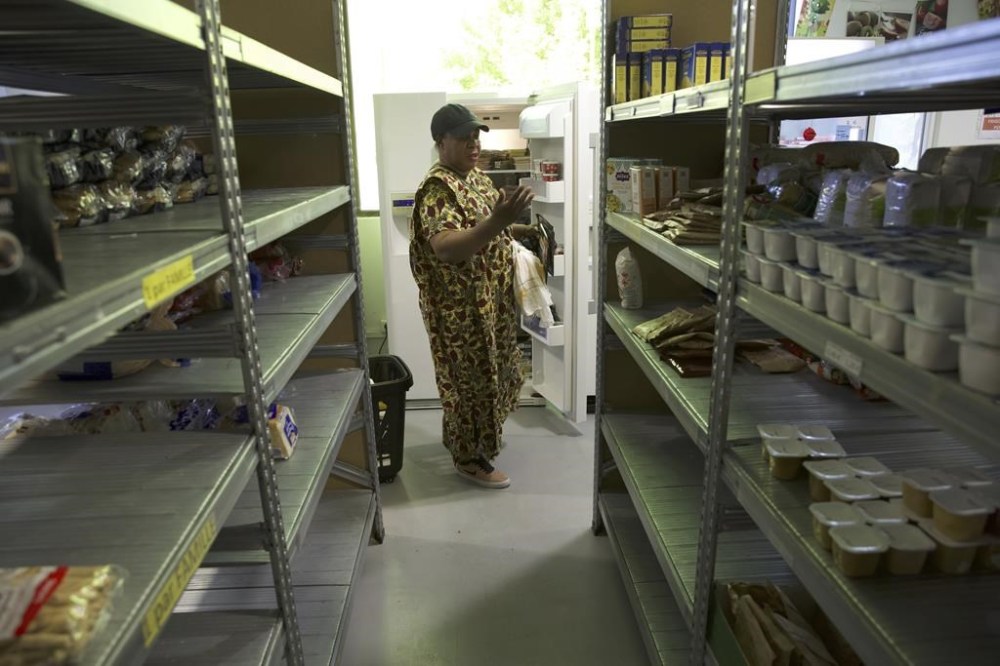
Some of the bounty collected by the food bank was brought to a grocery store in Epinay-sur-Seine, a northern suburb of Paris, that sells food at deeply discounted prices.
“We take advantage of this place because it helps us, it helps us enormously,” said Jeanne Musaga, 64, who gets 900 euros ($984) a month in retirement payments, 500 euros ($547) of which goes to pay her rent.

“For those of us who don’t earn much, for a family that’s suffering, we come here to get food for the month,” she said. “Instead of buying from an expensive shop, we pay less here.”
___
Associated Press video journalist Nicolas Garriga in Gennevilliers and Epinay-sur-Seine contributed reporting.
___
For more coverage of the Paris Olympics, visit https://apnews.com/hub/2024-paris-olympic-games.
Related Articles
China track cyclist Yuan Liying has to be helped off velodrome after causing hard keirin crash





Advertisement Advertise With Us
Advertisement Advertise With Us