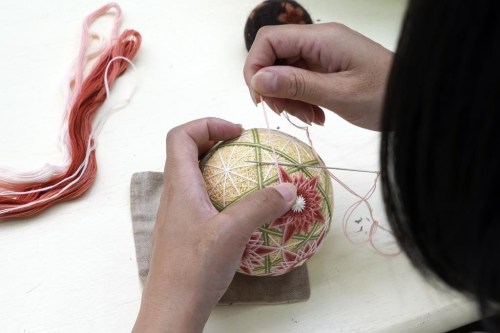
Dedicated artists are keeping Japan’s ancient craft of temari alive
Advertisement
Read this article for free:
or
Already have an account? Log in here »
To continue reading, please subscribe:

Digital Subscription
One year of digital access for only $205*
- Enjoy unlimited reading on winnipegfreepress.com
- Read the E-Edition, our digital replica newspaper
- Access News Break, our award-winning app
- Play interactive puzzles
*First annual payment billed as $205.00 + GST for one year. This annual subscription will automatically renew at $233.00 + GST every 52 weeks (10% off the regular annual price of $259.35). Offer available to new and qualified returning subscribers only. Cancel any time.
To continue reading, please subscribe:
Add Free Press access to your Brandon Sun subscription for only an additional
$1 for the first 4 weeks*
- Enjoy unlimited reading on winnipegfreepress.com
- Read the E-Edition, our digital replica newspaper
- Access News Break, our award-winning app
- Play interactive puzzles
*Your next Brandon Sun subscription payment will increase by $1.00 and you will be charged $17.95 plus GST for four weeks. After four weeks, your payment will increase to $24.95 plus GST every four weeks.
Read unlimited articles for free today:
or
Already have an account? Log in here »
Hey there, time traveller!
This article was published 16/09/2024 (759 days ago), so information in it may no longer be current.
KAWARAMACHI, Japan (AP) — Time seems to stop here.
Women sit in a small circle, quietly, painstakingly stitching patterns on balls the size of an orange, a stitch at a time.
At the center of the circle is Eiko Araki, a master of the Sanuki Kagari Temari, a Japanese traditional craft passed down for more than 1,000 years on the southwestern island of Shikoku.
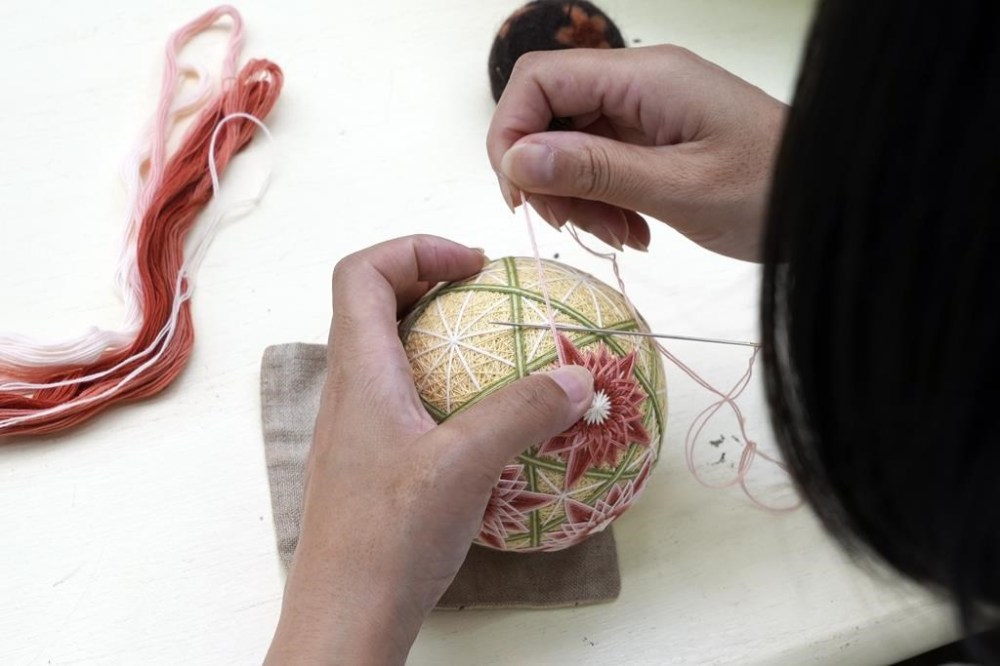
Each ball, or “temari,” is a work of art, with colorful geometric patterns carrying poetic names like “firefly flowers” and “layered stars.” A temari ball takes weeks or months to finish. Some cost hundreds of dollars (tens of thousands of yen), although others are much cheaper.
These kaleidoscopic balls aren’t for throwing or kicking around. They’re destined to be heirlooms, carrying prayers for health and goodness. They might be treasured like a painting or piece of sculpture in a Western home.
The concept behind temari is an elegant otherworldliness, an impractical beauty that is also very labor-intensive to create.
“Out of nothing, something this beautiful is born, bringing joy,” says Araki. “I want it to be remembered there are beautiful things in this world that can only be made by hand.”
Natural materials
The region where temari originated was good for growing cotton, warm with little rainfall, and the spherical creations continue to be made out of the humble material.
At Araki’s studio, which also serves as head office for temari’s preservation society, there are 140 hues of cotton thread, including delicate pinks and blues, as well as more vivid colors and all the subtle gradations in between.
The women dye them by hand, using plants, flowers and other natural ingredients, including cochineal, a bug living in cacti that produces a red dye. The deeper shade of indigo is dyed again and again to turn just about black. Yellow and blue are combined to form gorgeous greens. Soy juice is added to deepen the tints, a dash of organic protein.
Outside the studio, loops of cotton thread, in various tones of yellow today, hang outside in the shade to dry.
Creating and embroidering the balls
The arduous process starts with making the basic ball mold on which the stitching is done. Rice husks that are cooked and then dried are placed in a piece of cotton, then wound with thread, over and over, until, almost magically, a ball appears in your hands.
Then the stitching begins.
The balls are surprisingly hard, so each stitch requires a concentrated, almost painful, push. The motifs must be precise and even.
Each ball has lines to guide the stitching — one that goes around it like the equator, and others that zigzag to the top and bottom.
Appealing to a new generation
These days, temari is getting some new recognition, among Japanese and foreigners as well. Caroline Kennedy took lessons in the ball-making when she was United States ambassador to Japan a decade ago.
Yoshie Nakamura, who promotes Japanese handcrafted art in her duty-free shop at Tokyo’s Haneda airport, says she features temari there because of its intricate and delicate designs.
“Temari that might have been everyday in a faraway era is now being used for interior decoration,” she said.
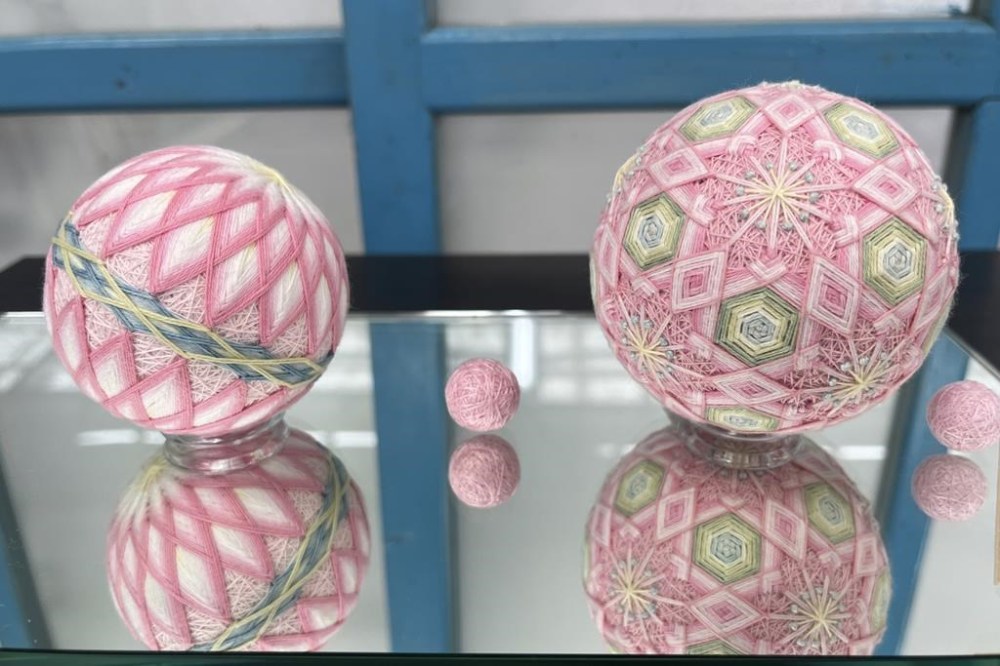
“I really feel each Sanuki Kagari Temari speaks of a special, one-and-only existence in the world.”
Araki has come up with some newer designs that feel both modern and historical. She is trying to make the balls more accessible to everyday life — for instance, as Christmas tree ornaments. A strap with a dangling miniature ball, though quite hard to make because of its size, is affordable at about 1,500 yen ($10) each.
Another of Araki’s inventions is a cluster of pastel balls that opens and shuts with tiny magnets. Fill it with sweet-smelling herbs for a kind of aromatic diffuser.
A tradition passed down through generations
Araki, a graceful woman who talks very slowly, her head cocked to one side as though always in thought, often travels to Tokyo to teach. But mostly she works and gives lessons in her studio, an abandoned kindergarten with faded blue paint and big windows with tired wooden frames.
She started out as a metalwork artist. Her husband’s parents were temari masters who worked hard to resurrect the artform when it was declining in the modern age, at risk of dying out.
They were stoic people, rarely bestowing praise and instead always scolding her, she remembers. It’s a tough-love approach that’s common in the handing down of many Japanese traditional arts, from Kabuki acting to hogaku music, that demand lifetimes of selfless devotion.
Today, only several dozen people, all women, can make the temari balls to traditional standards.
“The most challenging aspect is nurturing successors. It typically takes over 10 years to train them, so you need people who are willing to continue the craft for a very long time,” Araki said.
“When people start to feel joy along with the hardship that comes with making temari, they tend to keep going.”
___
AP journalist Ayaka McGill contributed to this report.
___
Yuri Kageyama is on X: https://x.com/yurikageyama