Pile on the slop

Advertisement
Read this article for free:
or
Already have an account? Log in here »
To continue reading, please subscribe:

Digital Subscription
One year of digital access for only $205*
- Enjoy unlimited reading on winnipegfreepress.com
- Read the E-Edition, our digital replica newspaper
- Access News Break, our award-winning app
- Play interactive puzzles
*First annual payment billed as $205.00 + GST for one year. This annual subscription will automatically renew at $233.00 + GST every 52 weeks (10% off the regular annual price of $259.35). Offer available to new and qualified returning subscribers only. Cancel any time.
To continue reading, please subscribe:
Add Free Press access to your Brandon Sun subscription for only an additional
$1 for the first 4 weeks*
- Enjoy unlimited reading on winnipegfreepress.com
- Read the E-Edition, our digital replica newspaper
- Access News Break, our award-winning app
- Play interactive puzzles
*Your next Brandon Sun subscription payment will increase by $1.00 and you will be charged $17.95 plus GST for four weeks. After four weeks, your payment will increase to $24.95 plus GST every four weeks.
Read unlimited articles for free today:
or
Already have an account? Log in here »
Hey there, time traveller!
This article was published 28/09/2024 (731 days ago), so information in it may no longer be current.
If you’ve spent any amount of time scrolling on Facebook, you’ve almost certainly encountered slop — those spammy, scammy AI images clogging up your newsfeed.
You know the ones. The weird photos of maimed children telling you it’s their birthday, or busty cabin crews with engagement-bait prompts such as “Why don’t pictures like this ever trend?”
The slop genre already has its own greatest hits, such as Shrimp Jesus — which is Jesus, but if his body were made entirely out of shrimp — or the 120-year-old woman who baked her own birthday cake.
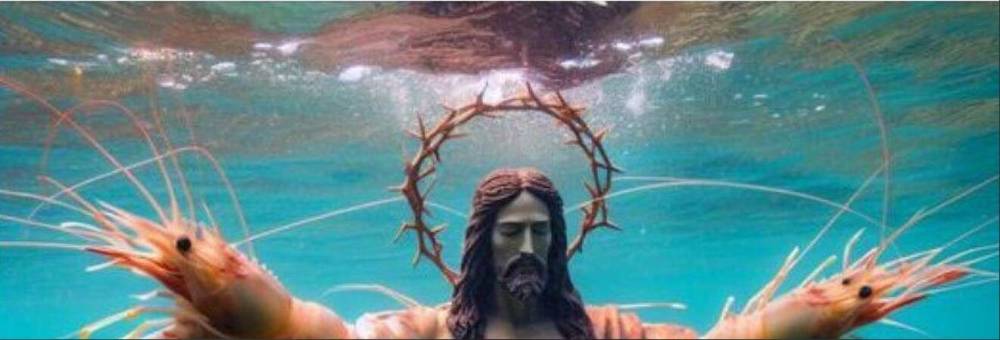
Shrimp Jesus is only one example of the weird, concerning “AI slop” churning through the internet.
Another slop staple is what online slop chroniclers — slopologists, if you will — have dubbed Creative Rural Boy: it’s always some impoverished kid from an unspecified developing nation posing beside a bicycle made out of kumquats or whatever with a caption imploring us to “show him some love.”
Slop isn’t even always this outlandish. Sometimes it comes in the form of uncanny-valley desserts where the icing is too glossy, or photos of interior design that look normal until you realize that staircase goes to nowhere.
Just as I was writing this column, I saw an ostensibly informational post about hurricane Helene and its impact on Disney World, except the accompanying image — a truly apocalyptic storm cloud that was possibly based on a mushroom cloud behind a Disneyesque castle — was AI.
Slop isn’t just confined to Facebook, either. It’s everywhere.
Obviously, as a journalist and writer who creates things and puts them out into the world, this is concerning.
I get asked, from time to time, why I don’t just use ChatGPT, a generative AI chatbot, to “do my job,” which is confusing to me. Do they mean for the writing part? Why would I do that? I am a writer. I became a writer because I like to write and, after many years of writing, I have become decently good at writing.
That’s how it works. There are no shortcuts to mastery. If you want to do something creative, you’re going to have to create.
Don’t get me wrong: writing is hard, and working at a newspaper is like signing up for a career where it feels like you always have an English paper due. But writing isn’t just about the finished product. Writing is an act, and I have to engage in the whole process of it, beginning to end — sorting out ideas and information and finding clear and compelling ways to communicate them to you.
Writing is like doing a giant puzzle with a great many pieces: logic, reason, storytelling, voice. When any part of the process — including tasks such as making an outline or brainstorming ideas — are outsourced to ChatGPT, we become lazier thinkers.
You might be thinking I’m talking about two different things, ChatGPT and AI slop, but they are related. Both are the logical progression of the digital ecosystem we’ve built.
At some point, everything became “content” — that empty, fast-food catchall used to refer to everything from art to photography to comedy to TV to music to journalism — and artists and professionals who have spent years honing their skills became a monolithic class of “content creators.”
Content creators have the insatiable maw of the internet to feed, so they are forced to create more and more content so that the algorithm won’t deprioritize them and they stop getting eyeballs.
And eyeballs are important. The attention economy means we’re all vying for eyeballs — engagement that’s measured only in views and virality and not, you know, how — or even if — people actually engaged with the content in a meaningful way. We are at the whims of algorithms.
Meanwhile, the internet has allowed us to consume more content, more quickly. We live in an everything-now, instant-gratification culture. We’re bingeing TV series and listening to podcasts on 1.5x speed and scrolling through endless TikTok videos. So creators need to work faster to produce more to keep us satiated. But we’re never satiated.
Layered on top of this is a productivity and optimization worldview that’s baked into so much of how we live and work. Do more. Do it faster. Do more. Do it faster. Can you do it for cheaper? Can we get it for less?
So it’s not exactly surprising that squeezed, burned-out creatives might find AI shortcuts appealing, nor is it surprising that we’ve seen the rise of engagement farming — posts designed to get likes, shares and comments, like slop.

And it’s getting more difficult to distinguish between the content creators and the slop slingers. We’re all just shouting into the void, only now the robots are there, too. But the humans are the ones who have to sift through what’s real and what’s AI, what’s content and what’s slop.
In an illumating piece on the slop economy for New York magazine, Max Read writes about how all of us idly scrolling or buying AI cookbooks on Amazon are creating the demand for cheaply produced, good-enough slop.
“Slop is the most appropriate word for what (generative AI) produces because, as disgusting and unappetizing as it may seem, we still eat it. It’s what’s right there in the trough,” he writes.
Indeed. I guess that’s why it’s called a “feed.”
jen.zoratti@winnipegfreepress.com
Jen Zoratti is a columnist and feature writer working in the Arts & Life department, as well as the author of the weekly newsletter NEXT. A National Newspaper Award finalist for arts and entertainment writing, Jen is a graduate of the Creative Communications program at RRC Polytech and was a music writer before joining the Free Press in 2013. Read more about Jen.
Every piece of reporting Jen produces is reviewed by an editing team before it is posted online or published in print – part of the Free Press‘s tradition, since 1872, of producing reliable independent journalism. Read more about Free Press’s history and mandate, and learn how our newsroom operates.
Our newsroom depends on a growing audience of readers to power our journalism. If you are not a paid reader, please consider becoming a subscriber.
Our newsroom depends on its audience of readers to power our journalism. Thank you for your support.
Jen Zoratti is a columnist and feature writer working in the Arts & Life department, as well as the author of the weekly newsletter NEXT. A National Newspaper Award finalist for arts and entertainment writing, Jen is a graduate of the Creative Communications program at RRC Polytech and was a music writer before joining the Free Press in 2013. Read more about Jen.
Every piece of reporting Jen produces is reviewed by an editing team before it is posted online or published in print – part of the Free Press‘s tradition, since 1872, of producing reliable independent journalism. Read more about Free Press’s history and mandate, and learn how our newsroom operates.
Our newsroom depends on a growing audience of readers to power our journalism. If you are not a paid reader, please consider becoming a subscriber.
Our newsroom depends on its audience of readers to power our journalism. Thank you for your support.
Advertisement Advertise With Us
Advertisement Advertise With Us