Palau’s vibrant Helen Reef is a magnet for poachers. These rangers keep it safe

Advertisement

Advertise with us

HELEN ISLAND, Palau (AP) — The handful of rangers who protect one of Earth's most remote and biologically diverse reefs have only each other for company for months at a time. They worry about running out of gas for boat patrols, their drinking water can get dangerously low and rising seas are nipping away at the tiny island that hosts their station.

Read this article for free:


or

Already have an account? Log in here »

To continue reading, please subscribe:

Subscribe and receive a limited-edition Free Press branded hat or tote.

Digital Subscription

One year of digital access for only $205*

  • Enjoy unlimited reading on winnipegfreepress.com
  • Read the E-Edition, our digital replica newspaper
  • Access News Break, our award-winning app
  • Play interactive puzzles

*First annual payment billed as $205.00 + GST for one year. This annual subscription will automatically renew at $233.00 + GST every 52 weeks (10% off the regular annual price of $259.35). Offer available to new and qualified returning subscribers only. Cancel any time.

To continue reading, please subscribe:

Add Free Press access to your Brandon Sun subscription for only an additional

$1 for the first 4 weeks*

  • Enjoy unlimited reading on winnipegfreepress.com
  • Read the E-Edition, our digital replica newspaper
  • Access News Break, our award-winning app
  • Play interactive puzzles
Start now

*Your next Brandon Sun subscription payment will increase by $1.00 and you will be charged $17.95 plus GST for four weeks. After four weeks, your payment will increase to $24.95 plus GST every four weeks.

Hey there, time traveller!
This article was published 18/10/2024 (718 days ago), so information in it may no longer be current.

HELEN ISLAND, Palau (AP) — The handful of rangers who protect one of Earth’s most remote and biologically diverse reefs have only each other for company for months at a time. They worry about running out of gas for boat patrols, their drinking water can get dangerously low and rising seas are nipping away at the tiny island that hosts their station.

On the plus side, the fishing is amazing — and they’re the only people allowed to do it.

Helen Reef, a 40-square-mile atoll at the southern limit of Palau, is home to precious plants and animals that include the Napoleon wrasse, bumphead parrotfish, hawksbill sea turtles and sea cucumbers. More than 500 other fish species, giant clams, sharks, manta rays and hundreds of hard and soft coral species thrive in its protected waters. On Helen Island, the scrap of the atoll that lies a few feet above sea level, the sky fills with thousands of birds including boobies, frigate birds and terns, and green sea turtles lay their eggs on the beach during nesting season in July.
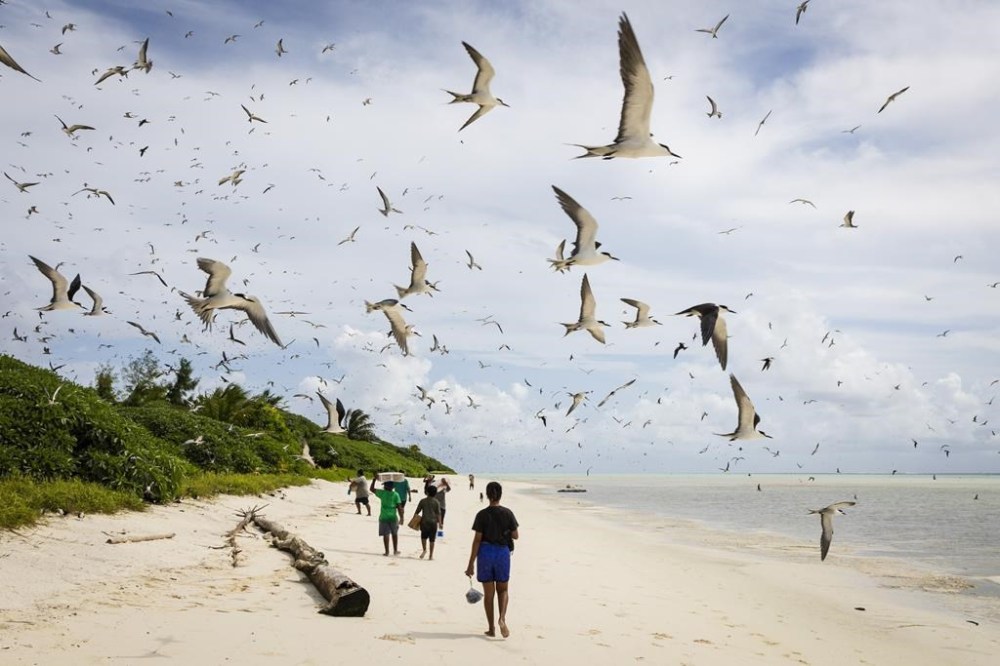
Goods that were brought to Helen Island, Palau, are carried through low tide to the ranger station on July 17, 2024. (AP Photo/Yannick Peterhans)

That rich sea life is a magnet for poachers, which is where the Hatohobei State Rangers come in. Four rangers at a time, generally in three-month rotations, scratch out a life on what’s little more than a sandbar as they carry out regular patrols to protect the reef in accordance with Palau national law.

“It’s a reef our ancestors used to go to and harvest food for the community back in the days,” said Hercules Emilio, a senior conservation officer and 17-year ranger. “So to us, now we are still conserving the resources that we have there, that’s why we do the enforcement.”

The rangers and their supplies — gasoline, food, toilet paper, lumber, batteries, dog food and more — arrive four times a year via a chartered boat that takes two days for the journey from Koror, some 360 miles (about 577 kilometers) to the north, where most of Palau’s people live.

At low tide, boats can’t land at Helen Island’s ranger station, so goods are carried ashore. Blue paint is peeling from the two-story station, which includes living quarters, a radio room and a downstairs lounge with shutters that let in the cool ocean breeze. Across a small path in a separate building is their kitchen, with a trio of chickens who have the run of the place. A pair of 1,000-gallon drums collect rainwater for drinking, and often run dangerously low during the dry season.

When they aren’t patrolling the reef, the rangers fix the station and surrounding buildings, care for their chickens, and hunt shorebirds like bridled tern for eggs and meat. The birds are easy prey on an island where thousands make their nests and the din of their cries can be heard hundreds of yards from shore.

Though the work can be isolating, the rangers know they’re fulfilling their role as traditional protectors of an area that has sustained their people for generations.

“It feels good,” said Emilio, who grew up on a small island in Hatohobei state and whose wife is also a ranger. “For me, I’m doing something for the people of my community.”

Palau, an archipelago of hundreds of islands, has only about 20,000 people, and Hatohobei state — which includes Helen Island and Helen Reef — has only a few dozen people. The reef is one of 39 sites in Palau’s Protected Areas Network, which get preservation help from a nonprofit fund that includes fees from tourists and visitors.

Boat fuel is a major challenge for the rangers, who have to make about 100 gallons last across three months of operations. They patrol the reef regularly on small boats with a single outboard engine, and fishing within the reef for food is a unique privilege only they have.

“Sometimes we don’t have enough fuel to patrol and then go fishing. So we go (at the) same time,” said ranger Tony Chayum.

There’s no cell reception on the island, so rangers rely on a spotty single sideband radio to communicate with their colleagues in Palau’s more populous islands far to the north. They can use the radio to speak with their family members on holidays and birthdays. It’s also the way they report illegal activity and summon help to the reef, as they did in 2021 when a Chinese fishing boat came to take sea cucumbers and clams.

“We didn’t allow them. They offered money and some goods, which we didn’t take,” Emilio recalled. The vessel was later taken to Koror state and fined by Palau’s Marine Law Enforcement.

These days, the threat from a warming planet is as concerning as poachers. Ray Marino, the governor of Hatohobei state, said a slow erosion seen in past years has progressed to “a lot of mass erosion.”

“Of course, we can only blame it on climate change, there is no other reason for it,” he said.

The rangers plan to install wooden barriers to try to slow the erosion.

“What we are worried about is the disappearance of the island,” Emilio said.

___

The Associated Press’ climate and environmental coverage receives financial support from multiple private foundations. AP is solely responsible for all content. Find AP’s standards for working with philanthropies, a list of supporters and funded coverage areas at AP.org.

Report Error Submit a Tip

More Stories

A Selkirk woman was sentenced to two-and-a-half years in prison last week for nearly $500,000 in tax fraud, the Canada Revenue Agency says

Michele Gabrielle pleaded guilty to one count of fraud over $5,000 in provincial court in Selkirk on Friday, the CRA says.

The tax agency had uncovered a scheme in which Gabrielle fraudulently claimed Manitoba tax credits from 2016 and 2019. She also filed and amended returns for two family members and a romantic partner, using their names to commit further fraud.

She made false claims in 22 of her own returns and 33 returns file or amended on behalf of others, the CRA says.

Real journalists matter in an AI world

Paul Deegan 4 minute read Preview

Real journalists matter in an AI world

Paul Deegan 4 minute read 2:00 AM CDT

An algorithm can decide what you see, but it doesn’t report the news. Nunatsiaq News, an award-winning newspaper in Nunavut, recently reported that a so-called “news” website was posting AI-generated articles about the north by stealing real news stories produced by real journalists.

The articles were supposedly written by Nunavut correspondent Leah Qammaniq — a fake journalist, with a fake photo and a fake bio.

Governor General Louise Arbour warned us of fake news in her installation speech in June. She said, “We must continue to protect the public space in which our national debates take place: from schools and universities to the media, political parties, unions and civil society organizations …With instant access to vast amounts of information, it is very tempting to pay little attention to the reliability of sources. The lines between knowledge and belief, between truth and falsehood, between facts and assumptions, are increasingly blurred. AI could be threatening not only the way we live and work, but also the control we exercise over our own destiny.”

The Government of Canada has recognized the problem as well. Its recent discussion paper, Enhancing trust in artificial intelligence through increased transparency, stated, “Canadians encounter news reporting, product reviews, and audio-visual content across the internet, often without any indication of whether it was written by a person, generated by an AI system, or produced through some combination of both … A particular concern within this broader landscape is that generative AI greatly enables the creation and dissemination of deceptive or misleading content.”

Read
2:00 AM CDT

Telekinetic teen hits small screen

Denise Duguay 4 minute read Preview

Telekinetic teen hits small screen

Denise Duguay 4 minute read 2:00 AM CDT

At desperate times like these, it’s good to be reminded that one person can make a difference. A telekinetic high schooler, grieving lover, ambitious law firm, frantic father and spiritual climber offer a variety of inspiring lessons in this new offering of TV recommendations.

Carrie (series premières Wednesday, Oct. 7 on Prime Video)Famously over-the-top filmmaker Brian De Palma (Phantom of the Paradise, Dressed to Kill, Scarface) directed the 1976 Carrie into its status as one of the scariest films of the time and beyond. It became better known than the debut horror novel by Stephen King from which it was adapted. It even trumped the three adaptations that followed. This new TV series looks ready to challenge that supremacy. Taking the title role made famous by Sissy Spacek, Manitoba actress Summer H. Howell (see Randall King’s interview at wfp.to/carrie) plays a homeschooler thrilled to finally be allowed to attend public high school. But when the mean girls begin circling and blood manifests in scary new ways, the new girl’s telekinetic potential blossoms in spectacular fashion. Also of horrific note as Halloween approaches: Below (Netflix miniseries premièring Thursday) stars Josh Hartnett as a fisherman trying to protect his family and town from a mysterious sea creature; Eternally Yours (sitcom premièring Thursday, Oct. 8, on CBS/Global) is a new vampire comedy; and Crystal Lake (thriller series premières Oct. 15 on Crave) stars Linda Cardellini (DTF St. Louis) as Pam Voorhees, single mom of a tormented kid named Jason, in this Friday the 13th origin story. Boo!


Small Prophets (series Canadian première Wednesday, Oct. 7, on Apple TV)Canadian fans of British TV have been champing at the bit for this quirky series since its acclaimed U.K. première in February. It’s a shaggy, quietly hilarious character study in the vein of Detectorists (2014-22, AcornTV), both of which were created by Mackenzie Crook (Pirates of the Caribbean), who also starred in Detectorists and plays a supporting role in Small Prophets. When the new story opens, Michael Sleep (Detectorists’ Pearce Quigley) is living a life of quiet desperation, visiting his father (Sir Michael Palin) and pining for the return of his disappeared beloved, Clea. Until, that is, Dad shares a loony alchemical recipe that sparks hope in Michael that he might be able to summon spirits to then summon Clea to … the garden shed? Not as creepy as it sounds? A tale of hope, frustratingly indirect action, meddlesome and ineffectual neighbours and, of course, true, true love.

Read
2:00 AM CDT

Two hospitalized in Osborne Village assault

1 minute read Updated: Yesterday at 10:12 AM CDT

Two people are in hospital and another two are in police custody after a serious assault in Osborne Village early Monday morning.

Winnipeg Police Service spokesman Const. Pat Saydak said officers were called to the assault scene on Osborne Street near River Avenue just after midnight.

Two people were rushed to hospital, one in critical condition and the other in stable condition.

Two individuals, both adults, were arrested by police. There's no word yet on charges.

Pimp sentenced to 11 years in prison

Erik Pindera 5 minute read Preview

Pimp sentenced to 11 years in prison

Erik Pindera 5 minute read 2:00 AM CDT

A man who picked up a vulnerable 17-year-old child-welfare ward on the streets of Winnipeg and coerced her into providing sexual services for several months has been sent to prison for more than a decade.

After a trial, Hassan Kargbo, who’s in his early 30s, was found guilty of sexual exploitation, making child sexual abuse and exploitation material, receiving a material benefit from sexual services provided by a person under 18, procuring a person under 18 and advertising sexual services.

Provincial court Judge Julie Frederickson sentenced him to 11 years behind bars late last month.

“Mr. Kargbo picked up a young Indigenous girl walking over the Osborne Street bridge and quickly got her involved in drug use and escorting,” Frederickson said in a written decision.

Read
2:00 AM CDT

Puzzles Palace

1 minute read Monday, Jul. 27, 2026

To solve our puzzles, please subscribe with this special offer: |