Daylight saving time ends this weekend. This is how to prepare for the potential health effects

Advertisement

Advertise with us

The good news: You will get a glorious extra hour of sleep. The bad: It'll be dark as a pocket by late afternoon for the next few months.

Read this article for free:


or

Already have an account? Log in here »

To continue reading, please subscribe:

Subscribe and receive a limited-edition Free Press branded hat or tote.

Digital Subscription

One year of digital access for only $205*

  • Enjoy unlimited reading on winnipegfreepress.com
  • Read the E-Edition, our digital replica newspaper
  • Access News Break, our award-winning app
  • Play interactive puzzles

*First annual payment billed as $205.00 + GST for one year. This annual subscription will automatically renew at $233.00 + GST every 52 weeks (10% off the regular annual price of $259.35). Offer available to new and qualified returning subscribers only. Cancel any time.

To continue reading, please subscribe:

Add Free Press access to your Brandon Sun subscription for only an additional

$1 for the first 4 weeks*

  • Enjoy unlimited reading on winnipegfreepress.com
  • Read the E-Edition, our digital replica newspaper
  • Access News Break, our award-winning app
  • Play interactive puzzles
Start now

*Your next Brandon Sun subscription payment will increase by $1.00 and you will be charged $17.95 plus GST for four weeks. After four weeks, your payment will increase to $24.95 plus GST every four weeks.

Hey there, time traveller!
This article was published 27/10/2024 (663 days ago), so information in it may no longer be current.

The good news: You will get a glorious extra hour of sleep. The bad: It’ll be dark as a pocket by late afternoon for the next few months.

Daylight saving time ends at 2 a.m. local time Sunday, which means you should set your clock back an hour before you go to bed. Standard time will last until March 9 when we will again “spring forward” with the return of daylight saving time.

That spring time change can be tougher on your body. Darker mornings and lighter evenings can knock your internal body clock out of whack, making it harder to fall asleep on time for weeks or longer. Studies have even found an uptick in heart attacks and strokes right after the March time change.
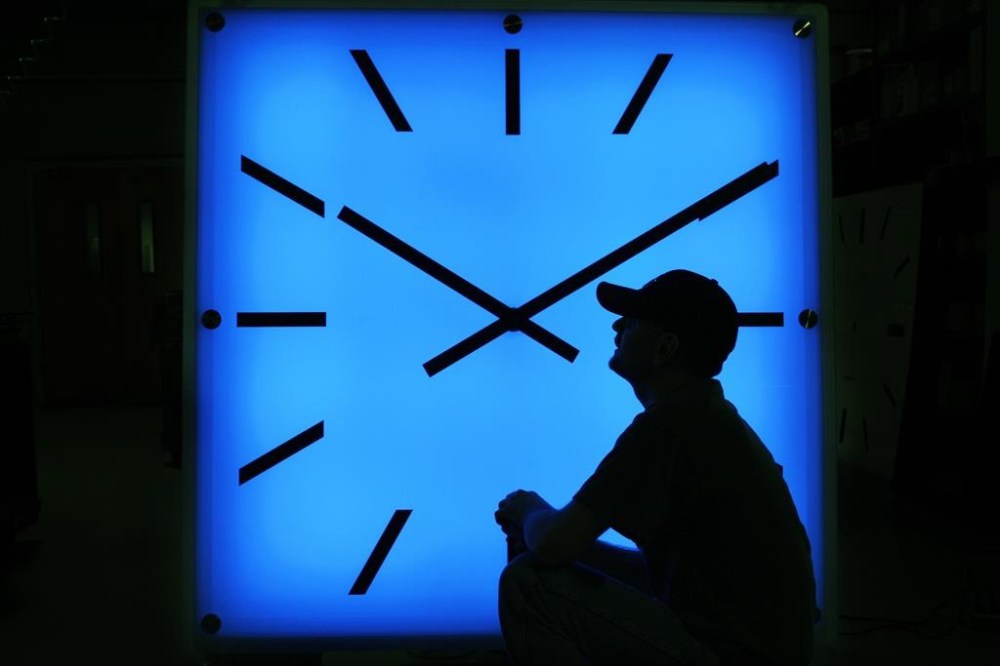
FILE - In this Oct. 30, 2008, file photo, an Electric Time Company employee adjusts the color on a clock at the plant in Medfield, Mass., days before the switch to standard time. (AP Photo/Elise Amendola, File)

“Fall back” should be easier. But it still may take a while to adjust your sleep habits, not to mention the downsides of leaving work in the dark or trying to exercise while there’s still enough light. Some people with seasonal affective disorder, a type of depression usually linked to the shorter days and less sunlight of fall and winter, may struggle, too.

Some health groups, including the American Medical Association and American Academy of Sleep Medicine, have said it’s time to do away with time switches and that sticking with standard time aligns better with the sun — and human biology.

Most countries do not observe daylight saving time. For those that do — mostly in Europe and North America — the date that clocks are changed varies.

Yukon and most of Saskatchewan keep their clocks the same year-round. Two states — Arizona and Hawaii — don’t change and also stay on standard time.

Here’s what to know about the twice yearly ritual.

How the body reacts to light

The brain has a master clock that is set by exposure to sunlight and darkness. This circadian rhythm is a roughly 24-hour cycle that determines when we become sleepy and when we’re more alert. The patterns change with age, one reason that early-to-rise youngsters evolve into hard-to-wake teens.

Morning light resets the rhythm. By evening, levels of a hormone called melatonin begin to surge, triggering drowsiness. Too much light in the evening — that extra hour from daylight saving time — delays that surge and the cycle gets out of sync.

And that circadian clock affects more than sleep, also influencing things like heart rate, blood pressure, stress hormones and metabolism.

How do time changes affect sleep?

Even an hour change on the clock can throw off sleep schedules — because even though the clocks change, work and school start times stay the same.

That’s a problem because so many people are already sleep deprived. About 1 in 3 U.S. adults sleep less than the recommended seven-plus hours nightly, and more than half of U.S. teens don’t get the recommended eight-plus hours on weeknights.

Sleep deprivation is linked to heart disease, cognitive decline, obesity and numerous other problems.

Hayden Ashley guides cows to their 3:00 PM milking at the Jarrell Bros. Dairy Farm in Kentwood, La., Wednesday, Oct. 30, 2024. (AP Photo/Gerald Herbert)

How to prepare for the time change

Some people try to prepare for a time change jolt by changing their bed times little by little in the days before the change. There are ways to ease the adjustment, including getting more sunshine to help reset your circadian rhythm for healthful sleep.

Will we ever get rid of the time change?

Lawmakers occasionally propose getting rid of the time change altogether. In the U.S., the most prominent recent attempt, a now-stalled bipartisan bill named the Sunshine Protection Act, proposes making daylight saving time permanent. Health experts say the lawmakers have it backward — standard time should be made permanent.

If passed, the U.s. law would have knock-on effects across Canada with provinces including British Columbia and Ontario waiting on neighbouring U.S. states to ditch the time change before they do so too.

Dairy farmer Aubrey Jarrell in Kentwood, Louisiana, isn’t a fan of the time change. He said it interferes with his cows’ strict milking routine and causes them stress “and stress on a dairy cow is not good.” There’s a dip in milk production until they adjust, he said.

“Keep the time the same — whatever it may be — but keep it the same,” he said.

___

The Associated Press Health and Science Department receives support from the Howard Hughes Medical Institute’s Science and Educational Media Group. The AP is solely responsible for all content.


Report Error Submit a Tip

More Stories

Manitoba premier open to lifting U.S. booze ban but hopes Canadians won’t buy it

Ian Bickis, The Canadian Press 4 minute read Preview

Manitoba premier open to lifting U.S. booze ban but hopes Canadians won’t buy it

Ian Bickis, The Canadian Press 4 minute read Updated: Yesterday at 5:13 PM CDT

WINNIPEG - Manitoba's premier says he is reluctantly open to returning U.S. booze to provincial shelves as part of a trade deal, but hopes Canadians won't buy it.

Wab Kinew said Thursday he's still waiting for key details, including what the final tariff rates will be, before making any commitments. 

He said Prime Minister Mark Carney has all but begged the provinces to agree to allow U.S. alcohol sales, as Canada and the United States work to finalize a new trade deal to ward off further punishing tariffs on Canadian goods.

While he hasn't agreed to it yet, Kinew said if the province does agree, he hopes Canadians still buy locally.

Read
Updated: Yesterday at 5:13 PM CDT

Private governance or public good

David Nutbean 5 minute read 2:00 AM CDT

The Manitoba government recently held public forums to discuss regulations for Bill 51, the Public Sector Artificial Intelligence and Cybersecurity Governance Act. I was able to participate in the meeting in Brandon and there was also a session in Winnipeg.

I was a bit fired up, ready to rail about data centres and phone terms and conditions and generally give it to big tech. The discussion, however, was focused on what the public sector responses should be regarding cybersecurity, data and privacy protections, and AI usage in government.

With all the recent attention on social media bans, the harms of AI, misinformation and the like, I was somewhat disappointed that these would not be tackled directly in this meeting. Those issues may be discussed at future forums.

At this event, as focus groups developed responses, the discussion between private companies and public governance kept getting mixed in, pointing out the reliance of government services on private companies in running their digital operations. As government operations become more dependent on digital infrastructure and towards AI agency and control, rethinking how technology is implemented may be crucial to our democracy.

Finish summer strong with these fun, relaxing options

Conrad Sweatman 6 minute read Preview

Finish summer strong with these fun, relaxing options

Conrad Sweatman 6 minute read 5:00 AM CDT

Late summer can feel neither here nor there.

As on a Sunday night, a certain back-to-school or -work melancholy sets in. The big Manitoba festivals have come and gone. You’re starting to take a reckoning of all the craft beer and food-truck calories you’ve sopped up for two months, without having done as much hiking, canoeing or yard work as you promised yourself.

The wind begins breathing threats of fall, but the golden colours, jack-o’- lanterns and corn mazes aren’t here yet to reassure you of fall’s dusky pleasures. Instead, on a perfect 22 C day, you find yourself having flashbacks of Winnipeg winter nights colder than Mars.

Are we being overly depressing? Absolutely.

Read
5:00 AM CDT

Chronic blame game festers

Tom Brodbeck 5 minute read Preview

Chronic blame game festers

Tom Brodbeck 5 minute read 6:00 AM CDT

Health Minister Uzoma Asagwara doesn’t mince words when describing how bad things are in the province’s emergency departments and urgent-care centres.

“The wait times that we are seeing in Manitoba are unacceptable,” said Asagwara in an interview with the Free Press. “I hear from families, I hear from providers, I hear from Manitobans who are concerned about the wait times that they’re seeing, that they’re experiencing, and those concerns are valid — I share those concerns.”

So what is the NDP, who promised voters nearly three years ago it had the answers to bring down wait times, doing about it?

A lot, according to Asagwara, who has been the province’s health minister since the NDP was sworn into office in October 2023.

Read
6:00 AM CDT

Provincial teacher watchdog releases names, details in three disciplinary matters

Maggie Macintosh 6 minute read Preview

Provincial teacher watchdog releases names, details in three disciplinary matters

Maggie Macintosh 6 minute read Yesterday at 6:07 PM CDT

An Interlake teacher with a history of “intimidating” outbursts has been ordered to participate in counselling and study anger-management strategies after he made a child cry.

Read
Yesterday at 6:07 PM CDT

Don’t buy U.S. booze if, when it’s back on Liquor Mart shelves: Kinew

Chris Kitching 6 minute read Preview

Don’t buy U.S. booze if, when it’s back on Liquor Mart shelves: Kinew

Chris Kitching 6 minute read Updated: Yesterday at 5:22 PM CDT

Manitoba hasn’t agreed to put American liquor back on shelves despite Prime Minister Mark Carney’s request while his government finalizes a trade deal with the U.S. to avoid new tariffs.

Read
Updated: Yesterday at 5:22 PM CDT