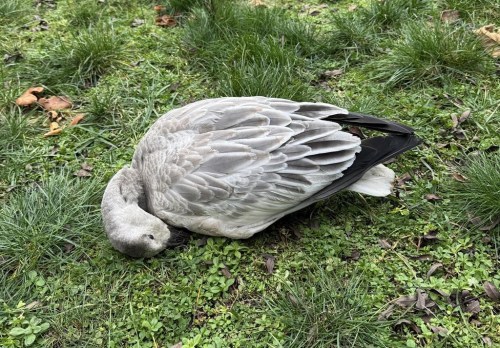
What do you do when a goose dies in your backyard, amid concerns about avian flu?
Advertisement
Read this article for free:
or
Already have an account? Log in here »
To continue reading, please subscribe:

Digital Subscription
One year of digital access for only $205*
- Enjoy unlimited reading on winnipegfreepress.com
- Read the E-Edition, our digital replica newspaper
- Access News Break, our award-winning app
- Play interactive puzzles
*First annual payment billed as $205.00 + GST for one year. This annual subscription will automatically renew at $233.00 + GST every 52 weeks (10% off the regular annual price of $259.35). Offer available to new and qualified returning subscribers only. Cancel any time.
To continue reading, please subscribe:
Add Free Press access to your Brandon Sun subscription for only an additional
$1 for the first 4 weeks*
- Enjoy unlimited reading on winnipegfreepress.com
- Read the E-Edition, our digital replica newspaper
- Access News Break, our award-winning app
- Play interactive puzzles
*Your next Brandon Sun subscription payment will increase by $1.00 and you will be charged $17.95 plus GST for four weeks. After four weeks, your payment will increase to $24.95 plus GST every four weeks.
Read unlimited articles for free today:
or
Already have an account? Log in here »
Hey there, time traveller!
This article was published 13/11/2024 (687 days ago), so information in it may no longer be current.
Carolyn Law didn’t think much of it when a snow goose landed in her Richmond, B.C., backyard, on Halloween.
But hours later it had barely moved. Then it started bobbing its head repeatedly. About eight hours after she first saw the bird, it rolled over, began convulsing and died.
“It was quite a sad thing to see, actually — really frightening,” Law said.
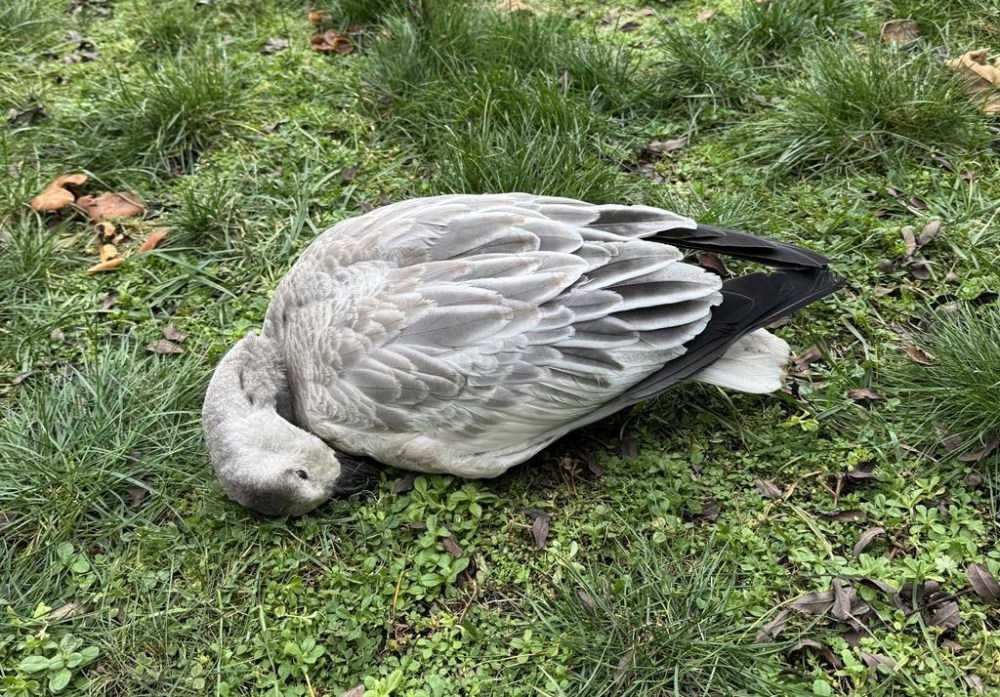
Law said she called a wildlife rescue group and was told the symptoms suggested avian flu rather than a physical injury, but without testing it couldn’t be confirmed.
Encounters like Law’s are under new scrutiny after a B.C. teenager tested positive for bird flu in the first case of human infection occurring in Canada. The patient, whose infection was confirmed by the Public Health Agency of Canada on Wednesday, is in critical condition.
Provincial Health Officer Dr. Bonnie Henry said in a news conference on Tuesday that the source of infection wasn’t clear.
Experts and health authorities say that while the risk of human infection with the H5N1 strain of the avian influenza remains low, people should avoid contact with sick or dead birds.
“People who work with animals or in environments contaminated by animals should take precautions, including using other personal protective measures to reduce the risk of getting or spreading respiratory infectious diseases,” Health Canada said in a statement.
Concerns around bird flu have heightened in recent years, with the virus resulting in millions of poultry across North America being culled.
Infections among commercial flocks have jumped to more than 20 in B.C. in recent weeks as migratory birds fly south for winter.
Brian Ward, an infectious diseases microbiologist at McGill University, said he couldn’t speculate whether the goose in Law’s backyard had influenza, but “it’s possible if there are some increasing number of ducks and geese found dead, then they’re very likely to have been infected with highly pathogenic avian influenza.”
Ward said it was concerning that authorities were unsure how the sick B.C. teenager caught H5N1, with Henry saying the teen had no known contacts with poultry farms.
But Ward said a human infection in Canada was “almost inevitable,” given the spread of the disease in recent years in North America and Europe. The U.S. Centres for Disease Control says there have been 46 human cases of avian flu in the U.S., although there has been no known human-to-human spread.
Health Canada said in a statement that current evidence domestically shows that “risk to the general public remains low.”
“To date, there has been no evidence of sustained person-to-person spread of the virus in any of the cases identified globally,” the department said. “Human infection with avian influenza A (H5N1) is rare and usually occurs after close contact with infected birds or highly contaminated environments.”
The agency’s website says humans are unable to get infected by eating thoroughly cooked poultry, eggs or meat.
Henry said the only other case in Canada was recorded in Alberta in 2014, in a person who likely contracted the virus while travelling in China.
But Henry acknowledged the risk posed by wild birds.
“One of the important things that we need to do right now, recognizing that this virus is circulating in wild foul, geese and ducks primarily, (is) be sure that if you’re in contact with sick birds or dead birds, that you don’t touch them directly (and) keep pets away from them,” she said, noting that in Ontario a dog was infected after biting a dead bird.
Henry said that humans may be infected by “inhaling the virus in aerosols, in droplets that get into the eyes, back of the throat, nose or deep into the lungs.”
“There’s been very few that might have been transmitted from person to person, so in some ways this is reassuring, in that this virus doesn’t seem to spread easily between people if they get infections, but it also causes very severe illness, particularly in young people,” she said.
Henry said it’s very likely that the B.C. teen’s infection took place due to an exposure to either a sick animal or something in the environment, but it is a “real possibility” that they may never determine the source.
Her office said Tuesday that people should report dead or sick poultry or livestock to the Canadian Food Inspection Agency animal health office and that encounters involving wild birds should be reported to the BC Wild Bird Mortality Line.
It said anyone exposed to sick or dead birds, or who had been in contact with farms where avian flu was confirmed, should watch for flu-like symptoms.
“If you get symptoms within 10 days after exposure to sick or dead animals, tell your health-care provider that you have been in contact with sick animals and are concerned about avian influenza,” it said. “This will help them give you appropriate advice on testing and treatment. Stay home and away from others while you have symptoms.”
Ward also advised people who encountered a dead bird to call authorities instead of disposing of it themselves.
“But, if it’s on your property and you want to dispose of it, then certainly wearing a mask and gloves, getting it into a plastic bag as soon as possible, and doing everything you can to avoid aerosols, makes a great deal of sense,” he said, noting that H5N1 is a respiratory virus.
Law said her biggest concern was about her dog that came within a few feet of the dying goose.
“We didn’t want to approach it,” she said.
But later that night, her husband took matters into his own hands.
Wearing gloves and a mask, he double bagged the dead bird, and put it in the garbage bin, “which I felt was kind of unceremonious, but I guess that’s what you would do,” Law said.
This report by The Canadian Press was first published Nov. 13, 2024.