Amazon and Starbucks workers are on strike. Trump might have something to do with it
Advertisement
Read this article for free:
or
Already have an account? Log in here »
To continue reading, please subscribe:

Digital Subscription
One year of digital access for only $205*
- Enjoy unlimited reading on winnipegfreepress.com
- Read the E-Edition, our digital replica newspaper
- Access News Break, our award-winning app
- Play interactive puzzles
*First annual payment billed as $205.00 + GST for one year. This annual subscription will automatically renew at $233.00 + GST every 52 weeks (10% off the regular annual price of $259.35). Offer available to new and qualified returning subscribers only. Cancel any time.
To continue reading, please subscribe:
Add Free Press access to your Brandon Sun subscription for only an additional
$1 for the first 4 weeks*
- Enjoy unlimited reading on winnipegfreepress.com
- Read the E-Edition, our digital replica newspaper
- Access News Break, our award-winning app
- Play interactive puzzles
*Your next Brandon Sun subscription payment will increase by $1.00 and you will be charged $17.95 plus GST for four weeks. After four weeks, your payment will increase to $24.95 plus GST every four weeks.
Read unlimited articles for free today:
or
Already have an account? Log in here »
Hey there, time traveller!
This article was published 20/12/2024 (635 days ago), so information in it may no longer be current.
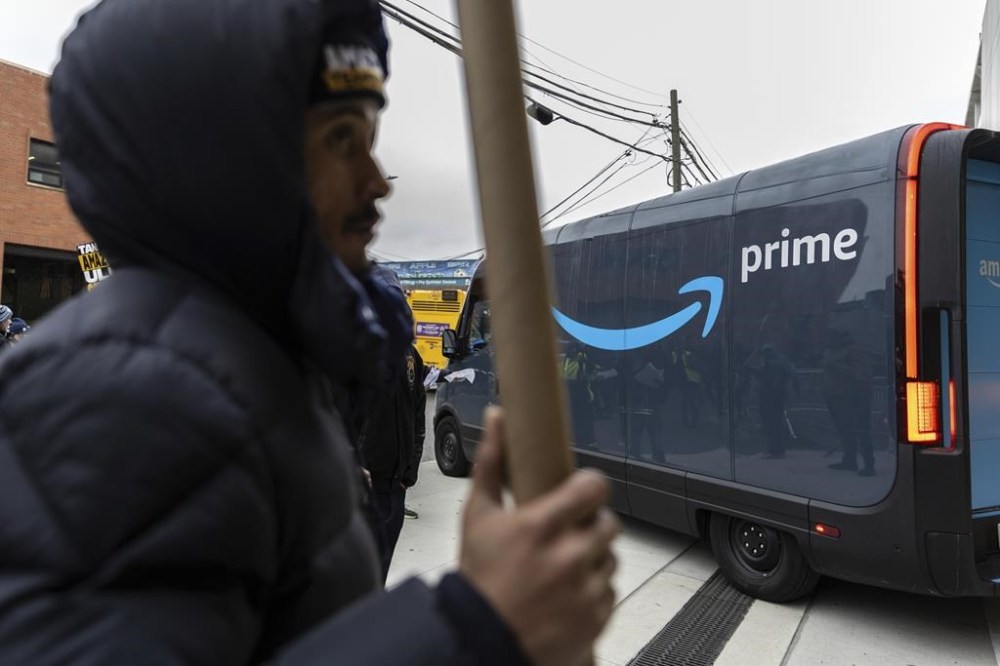
Amazon delivery drivers and Starbucks baristas are on strike in a handful of U.S. cities as they seek to exert pressure on the two major companies to recognize them as unionized employees or to meet demands for an inaugural labor contract.
The strikes that started Thursday and Friday followed other recent standoffs between corporate America and organized labor. Large and established labor unions secured meaningful employer concessions this year following strikes by Boeing factory workers, dockworkers at East and Gulf coast ports, video game performers, and hotel and casino workers on the Las Vegas Strip.
But workers at Starbucks, Amazon and some other prominent consumer brands still are fighting for their first contracts. Amazon refuses to acknowledge the organizing efforts of drivers and warehouse workers — many of whom have voted to unionize — even though the powerful Teamsters union says it represents them. Starbucks long resisted the unionization of its stores, but had agreed to negotiate a contract by the end of the year.
Why are the strikes happening now?
Strikes — particularly ones that happen during the holidays, a time of high economic activity — can help unions exercise leverage during negotiations or flex their muscles by garnering support from workers and sympathetic consumers.
Both Amazon and Starbucks saw a wave of organizing efforts following the COVID-19 pandemic. The pandemic focused attention on front-line workers and the impact of economic inequality on the lives of wage-earning Americans.
Employees organized at bookstores, where unions are rare, and were successful with campaigns at some stores run by Apple, Trader Joe’s and the outdoor equipment company REI.
But turning those wins into contracts can be a challenge. At Amazon and Starbucks, which were not unionized before the pandemic, workers have yet to secure an agreement with the e-commerce and coffee giants, which both have their headquarters in Seattle.
John Logan, director of labor and employment studies at San Francisco State University, said he thinks the Amazon and Starbucks workers are “desperate” to make progress before President-elect Donald Trump gets to appoint a Republican majority to the National Labor Relations Board, which is expected to be less friendly to unions during his administration.
“The unions want to make these disputes public and bring political pressures on the companies,” Logan said in a written statement. “If these disputes drag on until next year, and if they are fought largely through the labor board and the courts, the unions and workers will almost certainly lose. This might be their last, best chance to pressure the companies in public before Trump comes into office.”
However, Trump has also given some signs that he might be friendlier to labor during his second term compared to his first term. Last month, he picked Oregon Rep. Lori Chavez-DeRemer to lead the Department of Labor in his new administration, elevating a Republican congresswoman who has strong support from unions, including the Teamsters. Teamsters President Sean O’Brien also spoke at the Republican National Convention this past summer.
Teamster-led strikes at Amazon
The Teamsters say workers at Amazon are striking at seven delivery stations in Southern California, San Francisco, New York City, Atlanta and Skokie, Illinois, because the company ignored a Sunday deadline the union had set for contract negotiations. At midnight on Saturday, the Teamsters say workers will also strike at a prominent warehouse in New York, which voted to join the fledgling Amazon Labor Union in 2022 and have since elected to affiliate with the Teamsters.
The prominent labor group says it’s fighting for higher wages, better benefits and safer working conditions for Amazon employees, many of whom experience economic insecurity while working for a company worth $2.3 trillion. It has not said how many Amazon warehouse workers or drivers are joining the striking.
The union has mainly focused on organizing delivery drivers, which the company says are not its workers because they are directly employed by contractors Amazon recruited to handle package deliveries.
That type of setup gives the Amazon more cover from unionization attempts in an industry — transportation and trucking — that’s dominated by the Teamsters. However, the union has argued before the National Labor Relations Board that the drivers, who wear Amazon’s ubiquitous gray-blue vests and drive similarly colored vans, should be classified as company employees.
Meanwhile, the online retailer has accused the union of pushing a “false narrative” about the thousands of workers it claims to represent. Amazon has also touted its pay, saying it provides warehouse and transportation employees a base wage of $22 per hour plus benefits. It also recently boosted hourly pay for the subcontracted delivery drivers.
In September, the NLRB, which has taken a more pro-labor stance under President Joe Biden, filed a complaint that found the drivers to be joint employees of Amazon. The agency also accused Amazon of unlawfully failing to bargain with the Teamsters on a contract for drivers at a California delivery hub.
The Teamsters union says it also represents Amazon warehouse workers, including thousands of employees at the major New York City fulfillment center who voted to be represented by the Amazon Labor Union.
Amazon objected to the 2022 warehouse election results, alleging the Amazon Labor Union and the federal labor board had tainted the vote. A regional NLRB director issued a complaint last year that accused Amazon of violating the law by refusing to bargain with the union.
Amazon, in turn, is challenging the constitutionality of the NLRB in federal court along with Elon Musk’s SpaceX. In June, the Supreme Court made it harder for the agency to win court orders in labor disputes, siding with Starbucks in a case brought by the company.
Contract negotiations at Starbucks
Unlike Amazon, contract negotiation have been underway at Starbucks.
But Starbucks Workers United, the union that has organized workers at 535 company-owned U.S. stores since 2021, said the company has failed to honor a commitment made in February to reach a labor agreement this year.
The union also wants Starbucks to resolve outstanding legal issues, including hundreds of unfair labor practice charges that workers have filed with the National Labor Relations Board. The agency also has opened or settled hundreds of charges against Amazon.
In launching the strikes that started Friday in Chicago, Los Angeles and Seattle, Workers United said Starbucks proposed an economic package with no new wage increases for unionized baristas now and a 1.5% increase in future years.
Starbucks said Workers United prematurely ended a bargaining session this week. The company also says it already offers pay and benefits worth $30 per hour for baristas who work at least 20 hours per week.

Starbucks workers walked off the job on two occasions last year. Workers United has said the latest strikes could spread to hundreds of stores across the country by Christmas Eve.
Patricia Campos-Medina, who recently ran for the U.S. Senate as a Democrat in New Jersey and leads Cornell University’s Worker Institute at the School of Industrial and Labor Relations, said she expects there to be more union activity before Trump takes office.
Trump’s reactions will give the public a chance to see what his “commitments are to the working class,” Campos-Medina said.
___
Dee-Ann Durbin in Detroit contributed to this story.