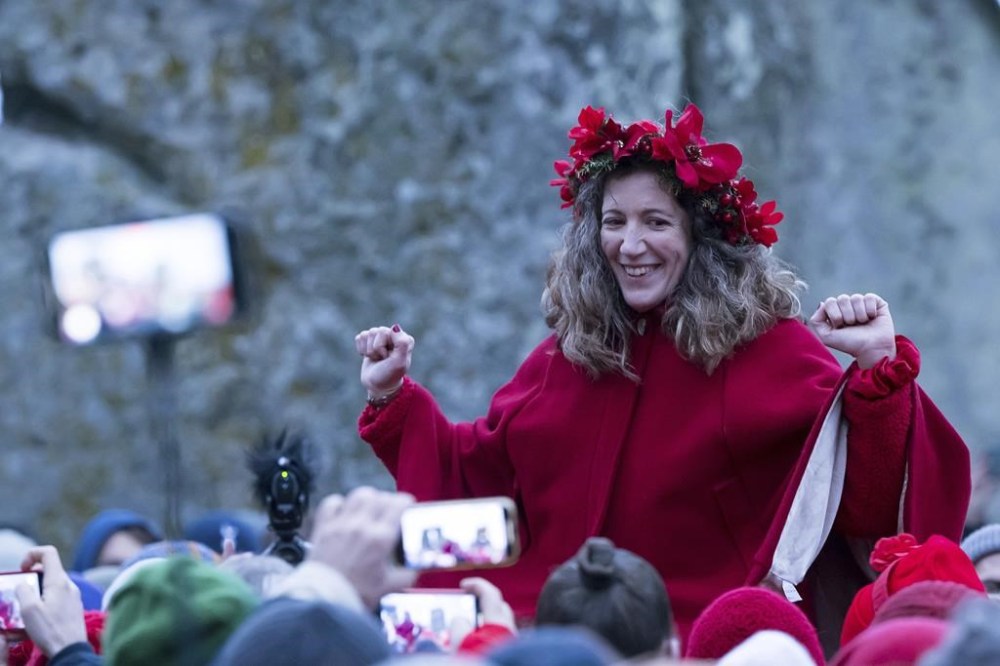
Thousands greet the winter solstice at the ancient Stonehenge monument
Advertisement
Read this article for free:
or
Already have an account? Log in here »
To continue reading, please subscribe:

Digital Subscription
One year of digital access for only $205*
- Enjoy unlimited reading on winnipegfreepress.com
- Read the E-Edition, our digital replica newspaper
- Access News Break, our award-winning app
- Play interactive puzzles
*First annual payment billed as $205.00 + GST for one year. This annual subscription will automatically renew at $233.00 + GST every 52 weeks (10% off the regular annual price of $259.35). Offer available to new and qualified returning subscribers only. Cancel any time.
To continue reading, please subscribe:
Add Free Press access to your Brandon Sun subscription for only an additional
$1 for the first 4 weeks*
- Enjoy unlimited reading on winnipegfreepress.com
- Read the E-Edition, our digital replica newspaper
- Access News Break, our award-winning app
- Play interactive puzzles
*Your next Brandon Sun subscription payment will increase by $1.00 and you will be charged $17.95 plus GST for four weeks. After four weeks, your payment will increase to $24.95 plus GST every four weeks.
Read unlimited articles for free today:
or
Already have an account? Log in here »
Hey there, time traveller!
This article was published 21/12/2024 (663 days ago), so information in it may no longer be current.
LONDON (AP) — Thousands of tourists, pagans, druids and people simply yearning for the promise of spring marked the dawn of the shortest day of the year Saturday at the ancient Stonehenge monument.
Revelers cheered and beat drums as the sun rose at 8:09 a.m. (0809 GMT) over the giant standing stones on the winter solstice — the shortest day and the longest night in the Northern Hemisphere. No one could see the sun through the low winter cloud, but that did not deter a flurry of drumming, chanting and singing as dawn broke.
There will be less than eight hours of daylight in England on Saturday — but after that, the days get longer until the summer solstice in June.
The solstices are the only occasions when visitors can go right up to the stones at Stonehenge, and thousands are willing to rise before dawn to soak up the atmosphere.
“This is all about renewal, rebirth, we’re entering into the new year, and it’s also a good time to acknowledge what’s taking place in the year that’s been,” said civil servant Chris Smith, 31. “There’s such a vibe. I mean, if you look around, you’ve got everybody here, there’s such an energy in the space.”
The stone circle, whose giant pillars each took 1,000 people to move, was erected starting about 5,000 years ago by a sun-worshiping Neolithic culture. Its full purpose is still debated: Was it a temple, a solar calculator, a cemetery, or some combination of all three?
In a paper published in the journal Archaeology International, researchers from University College London and Aberystwyth University said the site on Salisbury Plain, about 128 kilometers (80 miles) southwest of London, may have had political as well as spiritual significance.

That follows from the recent discovery that one of Stonehenge’s stones — the unique stone lying flat at the center of the monument, dubbed the “altar stone” — originated in Scotland, hundreds of miles north of the site. Some of the other stones were brought from the Preseli Hills in southwest Wales, nearly 240 kilometers (150 miles) to the west,

Lead author Mike Parker Pearson from UCL’s Institute of Archaeology said the geographical diversity suggests Stonehenge may have served as a “monument of unification for the peoples of Britain, celebrating their eternal links with their ancestors and the cosmos.”