No more fact-checking for Meta. How will this change media – and the pursuit of truth?
Advertisement
Read this article for free:
or
Already have an account? Log in here »
To continue reading, please subscribe:
Digital Subscription
One year of digital access for only $1.44 a week*
- Enjoy unlimited reading on winnipegfreepress.com
- Read the E-Edition, our digital replica newspaper
- Access News Break, our award-winning app
- Play interactive puzzles
*Billed as $5.77 plus GST every four weeks. After 52 weeks, price increases to the regular rate of $19.95 plus GST every four weeks. Offer available to new and qualified returning subscribers only. Cancel any time.
To continue reading, please subscribe:
Add Free Press access to your Brandon Sun subscription for only an additional
$1 for the first 4 weeks*
- Enjoy unlimited reading on winnipegfreepress.com
- Read the E-Edition, our digital replica newspaper
- Access News Break, our award-winning app
- Play interactive puzzles
*Your next Brandon Sun subscription payment will increase by $1.00 and you will be charged $17.95 plus GST for four weeks. After four weeks, your payment will increase to $24.95 plus GST every four weeks.
Read unlimited articles for free today:
or
Already have an account? Log in here »
Hey there, time traveller!
This article was published 09/01/2025 (646 days ago), so information in it may no longer be current.
“Everyone is entitled to his own opinion, but not his own facts,” the late New York Sen. Daniel Patrick Moynihan memorably wrote four decades ago.
That seems like a simpler time — especially when you consider Meta’s decision to end a fact-checking program on social media apps Facebook, Instagram and Threads and what the ramifications might be for an industry built to bring clarity and to seek truth itself.
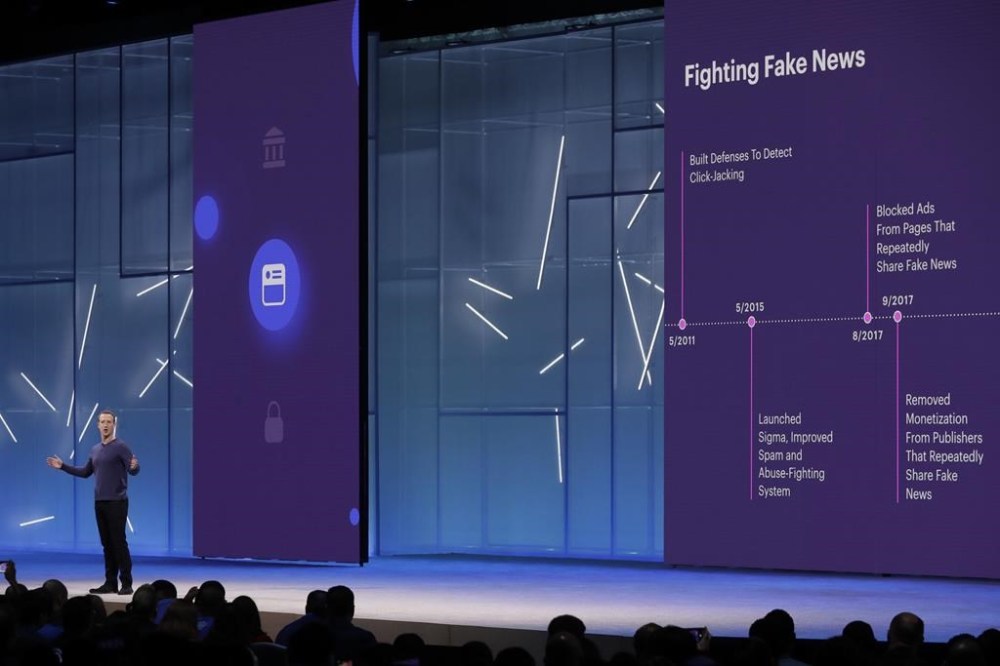
Meta founder Mark Zuckerberg’s announcement this week was widely seen in news verification circles as a genuflection to president-elect Donald Trump, whose first term in office popularized the phrase “alternative facts.”
Meta is replacing its fact-checking with a “community notes” system reminiscent of X, where it depends on users to correct misinformation on its platforms. In a way, that hearkens back to “he said-she said” journalism, or the view of some political debate moderators that it should be the role of opponents, not journalists, to point out falsehoods. It also hints at something else: the notion that the loudest voices and the best-told stories can win the day.
The moment is a crossroads for the fact-checking industry, which will see its influence sharply curtailed when Trump takes office for his second term.
“In the short term, this is bad news for people who want to go on social media to find trustworthy and accurate information,” said Angie Drobnic Holan, director of the International Fact-Checking Network. Her organization started in 2015 with about 50 members and now has 170, some of whom face staff cuts and potential closure because of Meta’s move.
“In the long term,” she said, “I think it’s very uncertain what this will all mean.”
Fact-checking in the media is a few decades old
Fact-checking is an odd industry, particularly when you consider that it’s a function of all journalism. The concept bubbled up about three decades ago in part to counter “he said-she said” stories and monitor claims in political ads. The organization FactCheck.org, whose primary aim was to help reporters, started in 2003 and the more public-facing PolitiFact four years later.
PolitiFact, started by then-Tampa Bay Times Washington bureau chief Bill Adair in 2007, won a Pulitzer Prize for its 2008 campaign coverage. It called out politicians for bending or breaking the truth in ways often difficult for reporters who were protective of the sources whose voices populated their stories.
By 2012, fact-checkers were under attack, primarily by Republicans convinced many were biased and researched voting records to try and prove many arbiters were Democrats, said Adair, now a Duke University professor. Trump, he said, “sped up a trend that had already begun.”
Some conservative suspicion of fact-checkers has been warranted because of mistakes that have been made, although there were some Republicans who uttered falsehoods and just didn’t like being called out for it, said Steve Hayes, CEO and editor of the center-right site The Dispatch.
“The people who practice fact-checking are in some ways saying, ’We are the arbiter of truth, period,” Hayes said. “And anytime you do this, it invites scrutiny on the work that you do.”
Labeling systems largely didn’t help, either. Giving a misstatement the label of “pants on fire,” as some fact-checkers have, may be a catchy way of attracting attention but also fostered resentment.
Holan resists the view that fact-checkers have been biased in their work: “That attack line comes from those who feel they should be able to exaggerate and lie without rebuttal or contradiction.”
People think truth remains elusive even with fact-checking
GOP suspicion still quickly took root. Journalism’s Poynter Institute, in a survey taken in 2019, found that 70% of Republicans thought the work of fact-checkers was one-sided. Roughly the same percentage of Democrats thought they were fair. Poynter hasn’t asked the same question since. Yet last year, Poynter found that 52% of Americans say they generally find it difficult to determine whether what they’re reading about elections is true or not.
The statistic illustrates a hunger to cut through rhetoric. To many, the shift in many opinions about the Jan. 6, 2021 Capitol insurrection is a recent reminder about what could happen if false narratives are given room to take root.
In a column Wednesday on the conservative watchdog site NewsBusters.org, Tim Graham wrote that during the first nine months of 2024, PolitiFact criticized Republican officials for delivering “mostly false” facts 88 times compared to 31 times for Democrats. To Graham, this proves that the idea the site is independent or nonpartisan is laughable.
But is that bias? Or is it checking facts?
Adair used to be reluctant to say what is now the title of his new book: “Beyond the Big Lie: The Epidemic of Political Lying, Why Republicans Do it More, and How it Could Burn Down Our Democracy.” He’s not hesitant anymore.
“Trump is unmatched as a liar in American politics,” Adair said. “I’m not the first to say that. I think he has capitalized on the fact that there has been this pushback on fact-checkers, and showed other politicians that you can get away with lying, so go ahead and do that.”
Tension about fact-checking played out during the recent presidential campaign, when Trump’s team was furious with ABC News for calling attention to false statements by the former president during his only debate with Democrat Kamala Harris.
Trump’s second victory has changed the equation at Meta. Already, X has curtailed its independent fact-checking under owner Elon Musk, a Trump ally. The moves are significant because it removes fact-checking from venues where many users might not otherwise be exposed to it.
On its own, fact-checking “doesn’t reach those exposed to misinformation,” said Kathleen Hall Jamieson of the University of Pennsylvania, who started FactCheck.org. “It tends to reach audiences that were already knowledgeable and wary.”

On social media, fact-checking also became part of the algorithms that drove information to people, or away from them. Material labeled as false would often be downgraded so it received less exposure. To Republicans who have criticized Big Tech, that amounted to censorship. Yet to Jamieson, successful fact-checking is not censorship — “it’s the process of arguing.”
Jamieson expressed some optimism that other smart social media users will step up to prevent the dangerous spread of falsehoods. But for fact-checking as it is today to continue to thrive and, even, exist as a journalistic endeavor, Adair said it will likely take influential Republican figures to publicly stand up for the importance of truth, and he praised Hayes’ outlet The Dispatch as a conservative site that has done aggressive fact-checks.
NewsBuster columnist Graham, in an interview, had a more pointed piece of advice. “My remedy in all arguments about media trust,” he said, “is that humility is required.”
___
David Bauder writes about media for the AP. Follow him at http://x.com/dbauder and https://bsky.app/profile/dbauder.bsky.social
Related Articles
Mark Zuckerberg will cohost reception with Republican billionaires for Trump inauguration
Advertisement Advertise With Us
Advertisement Advertise With Us