B.C. farmers challenge government order to cull ostrich herd over avian flu outbreak
Advertisement
Read this article for free:
or
Already have an account? Log in here »
To continue reading, please subscribe:

Digital Subscription
One year of digital access for only $205*
- Enjoy unlimited reading on winnipegfreepress.com
- Read the E-Edition, our digital replica newspaper
- Access News Break, our award-winning app
- Play interactive puzzles
*First annual payment billed as $205.00 + GST for one year. This annual subscription will automatically renew at $233.00 + GST every 52 weeks (10% off the regular annual price of $259.35). Offer available to new and qualified returning subscribers only. Cancel any time.
To continue reading, please subscribe:
Add Free Press access to your Brandon Sun subscription for only an additional
$1 for the first 4 weeks*
- Enjoy unlimited reading on winnipegfreepress.com
- Read the E-Edition, our digital replica newspaper
- Access News Break, our award-winning app
- Play interactive puzzles
*Your next Brandon Sun subscription payment will increase by $1.00 and you will be charged $17.95 plus GST for four weeks. After four weeks, your payment will increase to $24.95 plus GST every four weeks.
Read unlimited articles for free today:
or
Already have an account? Log in here »
Hey there, time traveller!
This article was published 15/01/2025 (623 days ago), so information in it may no longer be current.
British Columbia ostrich farmers ordered to cull a herd of 400 due to an avian flu outbreak are holding onto hope that the Canadian Food Inspection Agency will change its mind before their kill date in just over two weeks.
The federal agency sent Universal Ostrich Farms Inc. a notice on Dec. 31 instructing their ostriches to be destroyed and disposed of by Feb. 1, but the owners are asking for more time to prove their farm should be spared.
They’re making the case that the flightless birds – which are part of an ongoing international research project on COVID-19 antibodies – can instead be used to study the mechanics of the avian flu that infected the youngest members of their herd.
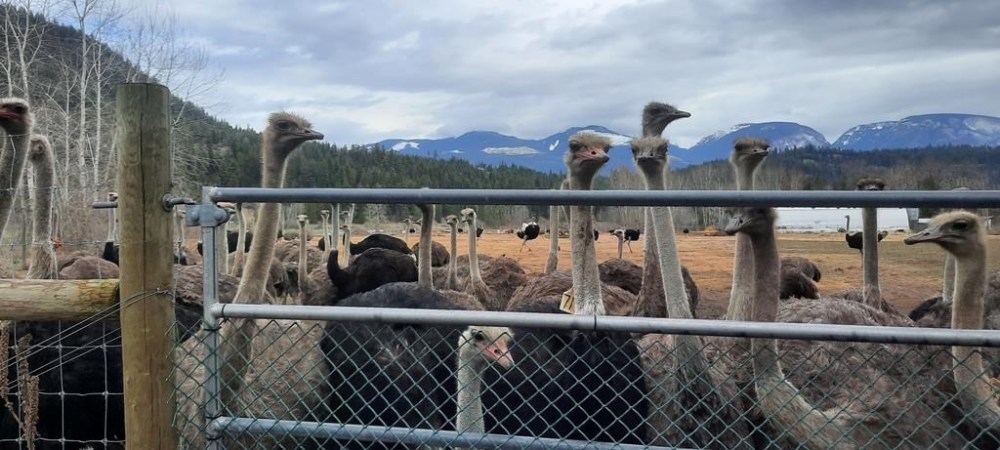
Of their 400 ostriches, about 10 per cent have died since avian flu hit their property in Edgewood, approximately 200 kilometres east of Kelowna, said Katie Pasitney, who is the daughter of farm co-owner Karen Espersen. She said the flu spread after a flock of wild ducks landed nearby.
Some of the ostriches on their farm are over 30 years old, but it’s the very young ones that mainly seem to be affected by the virus, Pasitney said.
“We would be culling 300 plus absolutely healthy animals,” Pasitney said.
Pasitney said the CFIA only tested two ostriches that died at the beginning of the outbreak in December. They have asked for more testing to be done, and are considering bringing in third party testing.
Espersen has been in the ostrich business since 1991. Three years ago they stopped selling meat, pivoted to conduct scientific research on the animals and founded a bioscience company to commercialize ostrich antibodies.
Since then the ostriches have been the subject of a research project in collaboration with Dr. Yasuhiro Tsukamoto, president of Kyoto Prefectural University in Japan, also known as Dr. Ostrich. He’s been extracting COVID-19 antibodies from ostrich eggs in B.C., building on his decades of research on the antibodies in ostrich egg yolk that can block infectious diseases.
Tsukamoto said his research can be applied to avian flu.
“Currently, I have a stockpile of ostrich-derived neutralizing antibodies against H5N1 in Japan, primarily intended for use in masks. However, due to their exceptionally high neutralizing activity, these antibodies can also be applied to livestock,” Tsukamoto said in an email.
In a statement to The Canadian Press, the CFIA said the World Organisation for Animal Health classifies ostriches as poultry, and that “Humane depopulation and disposal is required for all poultry premises infected with highly pathogenic avian influenza.”
On. Jan. 10, the CFIA denied the farm’s application for an exemption path which exists for select flocks that demonstrate “significant genetic value to the industry.”
Flocks that don’t meet the criteria of rare and valuable genetics are ordered to depopulate, the agency said.
“We do not take these decisions lightly and consider the best science in our decisions. However, once an order to destroy animals is issued, it is final.”
But Pasitney said they just need more time to show the value of these animals.
She said the ostriches are on a strict quarantine protocol, pose no flight risk, and live in a remote area that’s not in the vicinity of commercial poultry farms, with the closest city an hour and a half away. She said the only people who interact with the animals are the farm co-owners, and that they disinfect the ostriches’ feeding dishes, step into foot baths at every barn entrance and sanitize the truck used to feed animals, which is no longer driven into town.
An Alberta Health Services board member, who became aware of the B.C. farm ten years ago when it started looking into studying the ostriches’ immune systems, said the CFIA could monitor the day-to-day operations of the farm if that’s of concern.
“You’ve got an opportunity. You’ve got a flock that was infected by ducks. You’ve got a flock where you know, I think the last number I heard is that 75 or 85 per cent of them are surviving. Maybe you should take a look at this and ask yourselves why are they surviving? This is a very important health item,” Dr. Lyle Oberg said.
Oberg had written to the CFIA in support of the farm.
Dr. Scott Weese, an infectious disease veterinarian professor at the University of Guelph, said culling is used as an “end tool” to stop potential transmission.
“And it will definitely do that. The question is, do we need to do that? Are there alternatives that can be done that can achieve the same thing?”
He said this is where there are nuances that need to be considered, such as if the spread is containable and if culling will eradicate the disease.
In this case, Weese said avian flu is already widespread in Canada.
According to CFIA surveillance posted online, there are 3,459 positive wildlife cases in the country, and about 66 premises with infected domestic birds.
“We’re not eradicating H5N1 by culling these ostriches because it’s all over the place. And we’re probably not going to drop the broader risk overall very much because there’s so much out there,” Weese said.

Weese, who has not visited the farm, said broadly that such decisions come down to evaluating the risk in the grand scheme. Infection control inspectors are going to err on the side of eliminating risk while farmers will want to save animals, he said.
“That’s where you get into different perspectives driving different approaches” Weese said.
“You’ve got to find that sweet spot in the middle.”
This report by The Canadian Press was first published Jan. 15, 2025.
Canadian Press health coverage receives support through a partnership with the Canadian Medical Association. CP is solely responsible for this content.
Related Articles
Saga of B.C. ostrich farm nears necessary conclusion
Advertisement Advertise With Us
Advertisement Advertise With Us