Chinese researchers report a pig kidney transplant and a first-step liver experiment

Advertisement

Advertise with us

WASHINGTON (AP) — Chinese researchers are reporting new steps in the quest for animal-to-human organ transplants – with a successful pig kidney transplant and a hint Wednesday that pig livers might eventually be useful, too.

Read this article for free:


or

Already have an account? Log in here »

To continue reading, please subscribe:

Subscribe and receive a limited-edition Free Press branded hat or tote.

Digital Subscription

One year of digital access for only $205*

  • Enjoy unlimited reading on winnipegfreepress.com
  • Read the E-Edition, our digital replica newspaper
  • Access News Break, our award-winning app
  • Play interactive puzzles

*First annual payment billed as $205.00 + GST for one year. This annual subscription will automatically renew at $233.00 + GST every 52 weeks (10% off the regular annual price of $259.35). Offer available to new and qualified returning subscribers only. Cancel any time.

To continue reading, please subscribe:

Add Free Press access to your Brandon Sun subscription for only an additional

$1 for the first 4 weeks*

  • Enjoy unlimited reading on winnipegfreepress.com
  • Read the E-Edition, our digital replica newspaper
  • Access News Break, our award-winning app
  • Play interactive puzzles
Start now

*Your next Brandon Sun subscription payment will increase by $1.00 and you will be charged $17.95 plus GST for four weeks. After four weeks, your payment will increase to $24.95 plus GST every four weeks.

Hey there, time traveller!
This article was published 26/03/2025 (560 days ago), so information in it may no longer be current.

WASHINGTON (AP) — Chinese researchers are reporting new steps in the quest for animal-to-human organ transplants – with a successful pig kidney transplant and a hint Wednesday that pig livers might eventually be useful, too.

A Chinese patient is the third person in world known to be living with a gene-edited pig kidney. And the same research team also reported an experiment implanting a pig liver into a brain-dead person.

Scientists are genetically altering pigs so their organs are more humanlike in hopes of alleviating a transplant shortage. Two initial xenotransplants in the U.S. — two pig hearts and two pig kidneys – were short-lived. But two additional pig kidney recipients so far are thriving – an Alabama woman transplanted in November and a New Hampshire man transplanted in January. A U.S. clinical trial is about to begin.
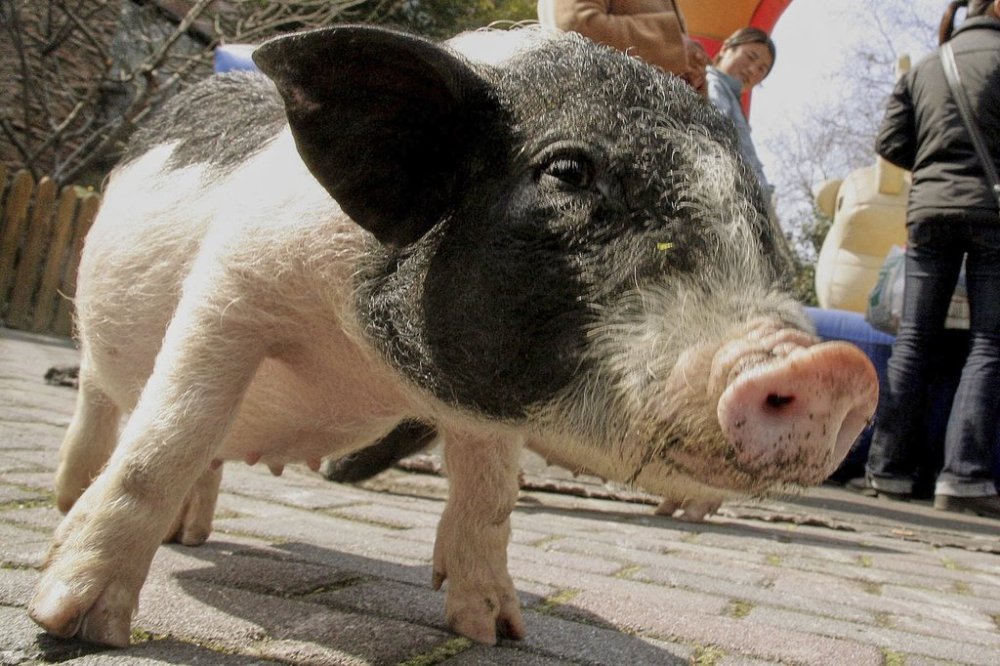
FILE - A miniature pig waits for visitors to feed it at a zoo in Shanghai, China, on Thursday Feb. 15, 2007. (AP Photo/Eugene Hoshiko, File)

Nearly three weeks after the kidney surgery the Chinese patient “is very well” and the pig kidney likewise is functioning very well, Dr. Lin Wang of Xijing Hospital of the Fourth Military Medical University in Xi’an told reporters in a briefing this week.

Wang, part of the hospital’s xenotransplant team, said the kidney recipient remains in the hospital for testing. Chinese media have reported she is a 69-year-old woman diagnosed with kidney failure eight years ago.

But Wang pointed to a potential next step in xenotransplantation — learning to transplant pig livers. His team reported Wednesday in the journal Nature that a pig liver transplanted into a brain-dead person survived for 10 days, with no early signs of rejection. He said the pig liver produced bile and albumin — important for basic organ function — although not as much as human livers do.

The liver is a complex challenge because of its varied jobs, including removing waste, breaking down nutrients and medicines, fighting infection, storing iron and regulating blood clotting.

“We do find that it could function a little bit in a human being,” Wang said. He speculated that would be enough to help support a failing human liver.

In the U.S. last year, surgeons at the University of Pennsylvania attempted that sort of “bridge” support by externally attaching a pig liver to a brain-dead human body to filter blood, much like dialysis for failing kidneys. U.S. pig developer eGenesis is studying that approach.

In China, Wang’s team didn’t remove the deceased person’s own liver, instead implanting the pig liver near it.

That “clouds the picture,” said Dr. Parsia Vagefi, a liver transplant surgeon at UT Southwestern Medical Center who wasn’t involved with the work. “It’s hopefully a first step but it’s still, a lot like any good research, more questions than answers.”

Wang said his team later replaced the human liver of another brain-dead person with a pig liver and is analyzing the outcome.

According to media reports, another Chinese hospital last year transplanted a pig liver into a living patient after a piece of his own cancerous liver was removed but it’s unclear how that experiment turned out.

___

The Associated Press Health and Science Department receives support from the Howard Hughes Medical Institute’s Science and Educational Media Group and the Robert Wood Johnson Foundation. The AP is solely responsible for all content.

Report Error Submit a Tip

More Stories

Essential workers ruling raises questions

Editorial 4 minute read Preview

Essential workers ruling raises questions

Editorial 4 minute read Updated: Yesterday at 3:56 PM CDT

Ever been to a Dynacare clinic? Most of us have been. It’s an amazing demographic and ethnic slice of the city we’ve become.

Read
Updated: Yesterday at 3:56 PM CDT

Chinese researchers report a pig kidney transplant and a first-step liver experiment

Lauran Neergaard, The Associated Press 4 minute read Preview

Chinese researchers report a pig kidney transplant and a first-step liver experiment

Lauran Neergaard, The Associated Press 4 minute read Wednesday, Mar. 26, 2025

WASHINGTON (AP) — Chinese researchers are reporting new steps in the quest for animal-to-human organ transplants – with a successful pig kidney transplant and a hint Wednesday that pig livers might eventually be useful, too.

A Chinese patient is the third person in world known to be living with a gene-edited pig kidney. And the same research team also reported an experiment implanting a pig liver into a brain-dead person.

Scientists are genetically altering pigs so their organs are more humanlike in hopes of alleviating a transplant shortage. Two initial xenotransplants in the U.S. — two pig hearts and two pig kidneys – were short-lived. But two additional pig kidney recipients so far are thriving – an Alabama woman transplanted in November and a New Hampshire man transplanted in January. A U.S. clinical trial is about to begin.

Nearly three weeks after the kidney surgery the Chinese patient "is very well” and the pig kidney likewise is functioning very well, Dr. Lin Wang of Xijing Hospital of the Fourth Military Medical University in Xi’an told reporters in a briefing this week.

Read
Wednesday, Mar. 26, 2025

Michael Douglas comes to terms with fears, fame, father

Hillel Italie 6 minute read Preview

Michael Douglas comes to terms with fears, fame, father

Hillel Italie 6 minute read 2:01 AM CDT

NEW YORK — Michael Douglas, the award-winning actor and producer, recently turned 82. He is a cancer survivor, a recovered addict, a married man, the father and son of actors.

He is also an author, who begins his memoir with a message of thanks to his family — past and present and future — for the “sense of immortality.”

“Many times my father was asked, ‘Kirk, are you jealous of your son?’” he said during a recent interview at a Manhattan hotel, referring to his late father, fellow actor and sometime combatant Kirk Douglas.

“And he said, ‘Jealous?’ This is a sense of immortality, a continuity of generations.’”

Read
2:01 AM CDT

Police seize cocaine valued at $1.5M, about $750K in cash in raid on St. Vital house

Scott Billeck 5 minute read Preview

Police seize cocaine valued at $1.5M, about $750K in cash in raid on St. Vital house

Scott Billeck 5 minute read Yesterday at 3:30 PM CDT

A St. Vital homeowner and her husband were going about their business during an afternoon last month when police officers in tactical gear suddenly appeared, walking across their front lawn.

The target was a few doors down: a maroon bi-level home on a quiet stretch of Satinwood Place, within earshot of children playing outside at a nearby school.

The homeowner, who asked not to be named to protect their privacy, said the police presence caught the couple by surprise in the Southglen neighbourhood, where they weren’t accustomed to seeing that kind of activity.

“We never heard the (police) cars pull up, but there were cars blocking the entrance to the street from both sides,” said the neighbour. “They had a shield, a battering ram — everything. Just not used to seeing that.”

Read
Yesterday at 3:30 PM CDT

Youth centre library cancellation baffles

Editorial 4 minute read Preview

Youth centre library cancellation baffles

Editorial 4 minute read 2:00 AM CDT

It’s difficult to understand why Manitoba Corrections would shut down a library program that cost taxpayers nothing, was popular with young inmates and was designed to help them learn.

Read
2:00 AM CDT

Alzheimer’s has sent my mother back in time

Pam Frampton 5 minute read Preview

Alzheimer’s has sent my mother back in time

Pam Frampton 5 minute read 2:01 AM CDT

My mother does a lot of time-travelling — time-shifting, the Alzheimer’s Society calls it.

Read
2:01 AM CDT