Bored with manicured lawns, some homeowners adopt No Mow May all year long

Advertisement

Advertise with us

NASHVILLE, Tenn. (AP) — No Mow May encourages homeowners to stash the lawn mower each spring and let flowers and grass grow for pollinators and water retention. And if your neighbor's lawn already looks like a wildflower field most of the time, it could be more intentional than passersby might assume.

Read this article for free:


or

Already have an account? Log in here »

To continue reading, please subscribe:

Subscribe and receive a limited-edition Free Press branded hat or tote.

Digital Subscription

One year of digital access for only $205*

  • Enjoy unlimited reading on winnipegfreepress.com
  • Read the E-Edition, our digital replica newspaper
  • Access News Break, our award-winning app
  • Play interactive puzzles

*First annual payment billed as $205.00 + GST for one year. This annual subscription will automatically renew at $233.00 + GST every 52 weeks (10% off the regular annual price of $259.35). Offer available to new and qualified returning subscribers only. Cancel any time.

To continue reading, please subscribe:

Add Free Press access to your Brandon Sun subscription for only an additional

$1 for the first 4 weeks*

  • Enjoy unlimited reading on winnipegfreepress.com
  • Read the E-Edition, our digital replica newspaper
  • Access News Break, our award-winning app
  • Play interactive puzzles
Start now

*Your next Brandon Sun subscription payment will increase by $1.00 and you will be charged $17.95 plus GST for four weeks. After four weeks, your payment will increase to $24.95 plus GST every four weeks.

Hey there, time traveller!
This article was published 21/05/2025 (485 days ago), so information in it may no longer be current.

NASHVILLE, Tenn. (AP) — No Mow May encourages homeowners to stash the lawn mower each spring and let flowers and grass grow for pollinators and water retention. And if your neighbor’s lawn already looks like a wildflower field most of the time, it could be more intentional than passersby might assume.

The movement has expanded to “Let It Bloom June” and the fall version: “Leave the leaves.” Conservation and horticulture groups say year-round low-mowing while selectively leaving native plants to grow can save huge amounts of drinking water and lead to lasting and impactful ecological changes.

When Amanda Beltramini Healan moved into her Nashville ranch house in 2016, the yard had been manicured for sale: a walnut tree, roses from a home improvement store and short grass. So she experimented, first with a 10-by-10-foot patch where she dug up the grass and sowed native seeds. Then she planted goldenrods in the culvert near the street, and let more of her yard grow tall without mowing.
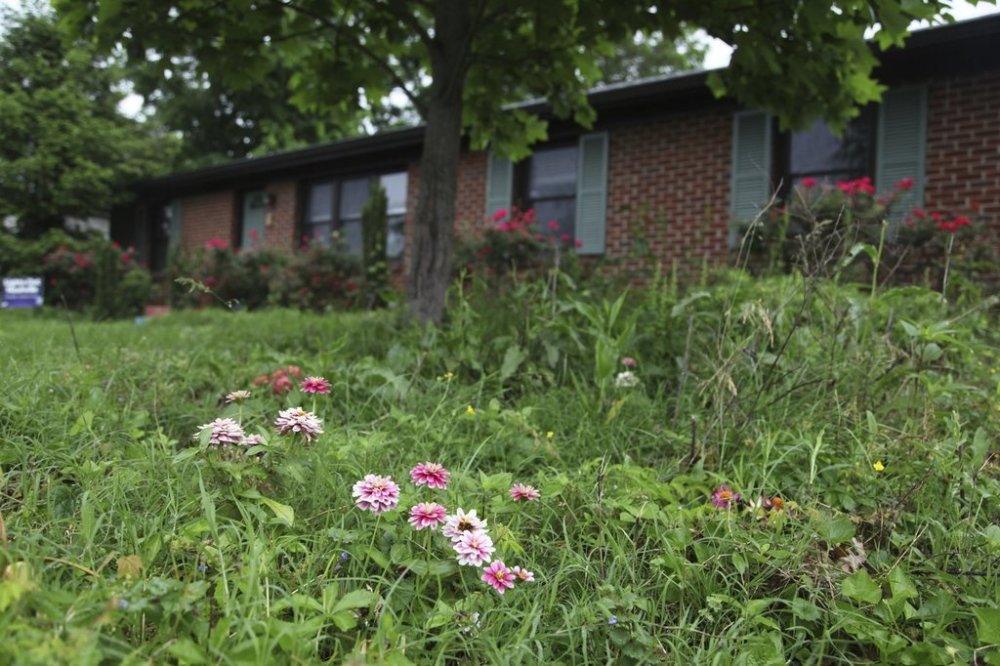
Flowers and tall grass cover the lawn of Amanda Beltranmini Healen in Nashville, Tenn., Monday, May 19, 2025, who participates in No Mow Months to improve water retention and encourage pollinators. (AP Photo/Kristin M. Hall)

Local authorities apparently didn’t appreciate her natural look: “I got a letter from the city saying that I had to mow it,” she said.

But then, a friend told her about No Mow Month signs, provided by the Cumberland River Compact, a local water conservation nonprofit. Soon she was signaling to the city that she’s no derelict, but a participant in an international movement.

These days, every month is No Mow May in parts of her property. While she keeps the growth shorter near the culvert and street, her backyard is filled with native grasses and plants up to her knees or waist. There’s a decomposing tree trunk where scores of skinks and bugs live, birds nest under her carport and she regularly finds fawns sleeping in the safety of the high grasses.

“I have a lot of insects and bugs and that’s protein, so the birds and the bird’s nests are everywhere. Cardinals and wrens and cowbirds and robins,” she said. “I wake up to them, especially during spring migration right now. It’s just a cacophony in the morning and in the evening, especially when the mulberries come in.”

The movement is popularized by groups such as Plantlife, a conservation organization based in England.

American lawns, based on English and French traditions, are increasingly seen as a wasteful monoculture that encourages an overuse of pesticides, fertilizer and water. Outdoor spraying and irrigation account for over 30% of a U.S. household’s total water consumption, and can be twice that in drier climates, according to the EPA.

Some criticize No Mow campaigns as a fad that could invite invasive plants to spread unchecked without helping pollinators much, if only done for a month.

A guide outlining No Mow pros, cons and limitations, written by consumer horticulture extension specialist Aaron Steil at Iowa State University, says reducing mowing to every two weeks and replacing turf with plants that pollinate all year long can offer more benefits without risking a citation or complaints.

The No Mow effort does encourage people to think more about biodiversity in their yards, and many local nature organizations advise provide guidance on picking noninvasive plants that fit each region’s climate and precipitation levels.

Reducing mowing encourages longer-rooted native grasses and flowers to grow, which breaks up compacted soil and improves drainage, “meaning that when it rains, more water is going to be captured and stored in lawns versus being generated as a runoff and entering into our stormwater system,” said Jason Sprouls, urban waters program manager for the Cumberland River Compact.

Beltramini Healan isn’t just letting just anything grow — she learned which plants are invasive, non-native or not beneficial to the ecosystem and carefully prunes and weeds so the keepers have room to thrive.

Nashville homeowner Brandon Griffith said he was just tired of mowing when he decided years ago wait and see what comes up. Then he consciously added flowering plants to attract bees and bugs. Now he sees so many insects and pollinators all over his garden that the neighbors’ kids come over to look for butterflies.

It’s about giving them the time “to come out of their larva or their egg stage and be able to grow,” said Griffith. He said he’s never heard a complaint — in fact, some of his neighbors also stopped mowing for a month each spring. His four-year-old son catches lizards, digs for worms and hunts for bugs in the yard.

“I just enjoy coming out and walking around,” said Griffith. “And looking at it, it’s kind of peaceful. It’s kinda relaxing.”

__

This story has been updated to correct the spelling of Amanda Beltramini Healan’s name and to correct that Aaron Steil works at Iowa State University, not the University of Iowa.

Report Error Submit a Tip

More Stories

‘She was looking to destroy me’: convicted harasser faces new charges

Dean Pritchard 6 minute read Preview

‘She was looking to destroy me’: convicted harasser faces new charges

Dean Pritchard 6 minute read Yesterday at 6:54 PM CDT

When Agnieszka Ciochon-Newton moved into the 55-plus apartment building on Stradbrook Avenue last year, she came across as “timid, soft-spoken and sensitive,” said building manager Tanya Owen.

Little did Owen know the meek-looking 58-year-old woman would soon turn her life and the lives of many of her tenants upside down and threaten her career and family.

“She was looking to destroy me for a simple tenant disagreement,” Owen said Thursday.

Court records show Ciochon-Newton was arrested earlier this month and charged with seven counts of criminal harassment, two counts of uttering threats and one count each of fraud, breaking and entering, attempting to obstruct justice, intimidation of a justice official, mischief and defamatory libel.

Read
Yesterday at 6:54 PM CDT

Bored with manicured lawns, some homeowners adopt No Mow May all year long

Kristin M. Hall, The Associated Press 5 minute read Preview

Bored with manicured lawns, some homeowners adopt No Mow May all year long

Kristin M. Hall, The Associated Press 5 minute read Thursday, May. 22, 2025

NASHVILLE, Tenn. (AP) — No Mow May encourages homeowners to stash the lawn mower each spring and let flowers and grass grow for pollinators and water retention. And if your neighbor's lawn already looks like a wildflower field most of the time, it could be more intentional than passersby might assume.

The movement has expanded to “Let It Bloom June” and the fall version: “Leave the leaves.” Conservation and horticulture groups say year-round low-mowing while selectively leaving native plants to grow can save huge amounts of drinking water and lead to lasting and impactful ecological changes.

When Amanda Beltramini Healan moved into her Nashville ranch house in 2016, the yard had been manicured for sale: a walnut tree, roses from a home improvement store and short grass. So she experimented, first with a 10-by-10-foot patch where she dug up the grass and sowed native seeds. Then she planted goldenrods in the culvert near the street, and let more of her yard grow tall without mowing.

Local authorities apparently didn't appreciate her natural look: “I got a letter from the city saying that I had to mow it,” she said.

Read
Thursday, May. 22, 2025

‘Parental rights’ issue resurfaces

Maggie Macintosh 5 minute read Preview

‘Parental rights’ issue resurfaces

Maggie Macintosh 5 minute read Yesterday at 2:00 AM CDT

Trustee campaign material that condemns rainbow flags is being met with outrage of all kinds, written complaints and, in one case, a cease-and-desist order.

“Parental rights,” including questions about classroom diversity, equity and inclusion policies, are resurfacing heading into school board elections across Manitoba.

“People are trying to advance their politics and their issues while simultaneously calling teachers ideologues and brainwashers,” said Shannon Moore, an associate professor at the University of Manitoba who studies sexual health education. “And I find that rich.”

Moore said parents have a right to choose independent school or homeschool, but they do not have a right to dictate curriculum that is currently developed using research and mainstream morals.

Read
Yesterday at 2:00 AM CDT

We used to love a good thunderstorm

Jessica Scott-Reid 5 minute read Preview

We used to love a good thunderstorm

Jessica Scott-Reid 5 minute read 2:00 AM CDT

Growing up on the prairies, even as a city girl, summertime thunderstorms were always cause for excitement. That first rumble signalled it was time to go search for the sleeping bags.

We’d cuddle under them on the front step, under the awning, as we watched the rain pour. And we’d stay out there until we were soaked.

If the lightning wasn’t bad enough for our parents to call us in, we neighbourhood kids would then throw on our bathing suits and go play in the warm puddles. It was some of the best stuff of summer.

As a mom now, with a little girl of my own, I was excited to watch her growing up loving Winnipeg thunderstorms, too.

Read
2:00 AM CDT

Letters, Sept. 18

7 minute read 2:00 AM CDT

Efficiency matters

Re: A development infused with personal memory, Think Tank, Sept. 15

Columnist Brent Bellamy mentions “a focus on high energy efficiency and near-zero carbon emissions over the life of the building.”

I hope this means geothermal heating, which is not specifically mentioned. This environmentally friendly feature is highly touted and is supposedly being employed in the new Southwood Circle development. This project at The Forks would also seem to be a prime candidate for the same.

‘One of a kind’: CEO, philanthropist Doug Harvey dies at 72

Morgan Modjeski 5 minute read Preview

‘One of a kind’: CEO, philanthropist Doug Harvey dies at 72

Morgan Modjeski 5 minute read Updated: Yesterday at 12:57 PM CDT

Doug Harvey, a Winnipeg business titan and philanthropist, has died after battling cancer for more than a decade.

Harvey gave millions of dollars to Winnipeg organizations while he was CEO of DLH Group, a nationwide network of businesses that support heavy duty truck and trailer users.

Loren Remillard, CEO and president of the Winnipeg Chamber of Commerce, said the business community is mourning the loss of the influential businessman who helped shape Winnipeg.

“We are a transportation and logistics hub in Winnipeg and it was partly the result of geography, and a big part because of leaders and visionaries like Doug Harvey,” he said.

Read
Updated: Yesterday at 12:57 PM CDT