Innovative horse simulator helps riders with disabilities get in the saddle

Advertisement

Advertise with us

VICTORIA - "Do you want to go faster?"

Read this article for free:


or

Already have an account? Log in here »

To continue reading, please subscribe:

Subscribe and receive a limited-edition Free Press branded hat or tote.

Digital Subscription

One year of digital access for only $205*

  • Enjoy unlimited reading on winnipegfreepress.com
  • Read the E-Edition, our digital replica newspaper
  • Access News Break, our award-winning app
  • Play interactive puzzles

*First annual payment billed as $205.00 + GST for one year. This annual subscription will automatically renew at $233.00 + GST every 52 weeks (10% off the regular annual price of $259.35). Offer available to new and qualified returning subscribers only. Cancel any time.

To continue reading, please subscribe:

Add Free Press access to your Brandon Sun subscription for only an additional

$1 for the first 4 weeks*

  • Enjoy unlimited reading on winnipegfreepress.com
  • Read the E-Edition, our digital replica newspaper
  • Access News Break, our award-winning app
  • Play interactive puzzles
Start now

*Your next Brandon Sun subscription payment will increase by $1.00 and you will be charged $17.95 plus GST for four weeks. After four weeks, your payment will increase to $24.95 plus GST every four weeks.

Hey there, time traveller!
This article was published 23/05/2025 (455 days ago), so information in it may no longer be current.

VICTORIA – “Do you want to go faster?”

Jayne Imeson already knew the answer she was going to get from her six-year-old son, Casey, sitting astride his new steed in a park in Central Saanich, B.C.

He nodded with a smile. “Always faster — this kid loves his speed,” Imeson said.
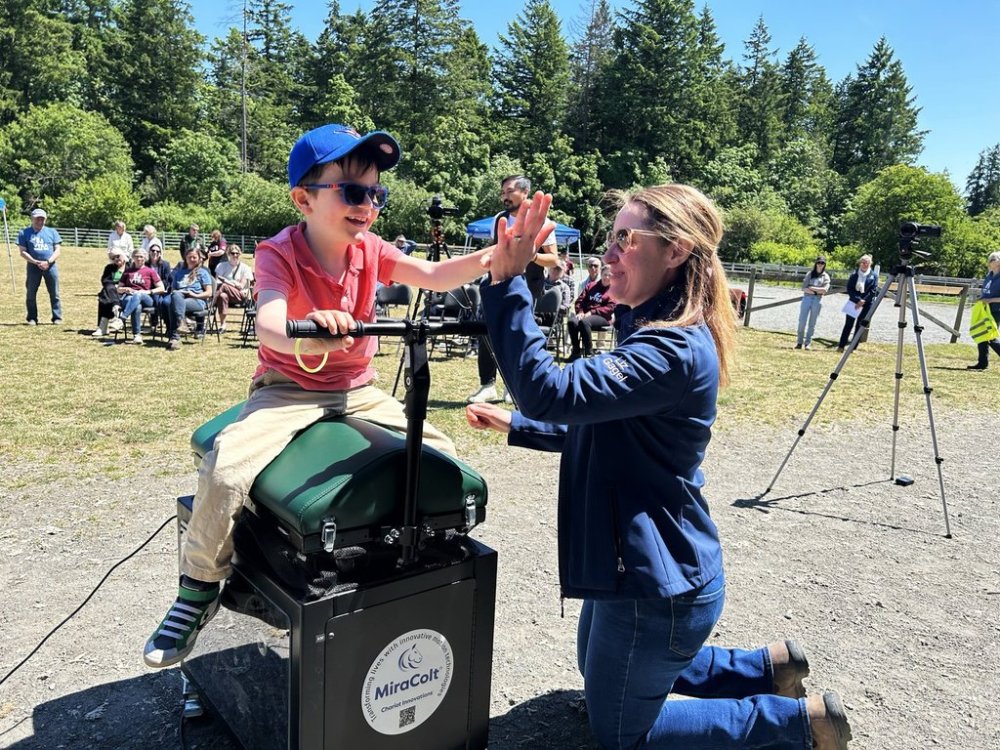
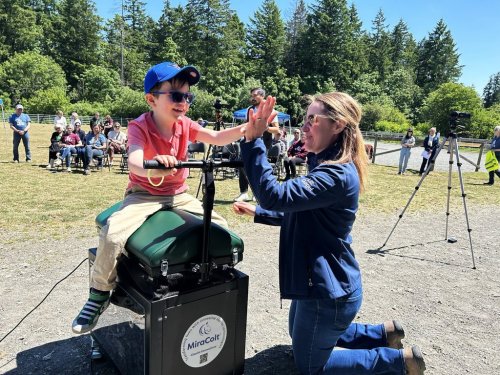
Six-year-old Casey, of Saanich B.C., becomes the first official user of the new MiraColt Horse-Riding Motion Simulator as Victoria Therapeutic Riding Association board chair Liz Gagel assists him at a demonstration hosted by the VTRA in Central Saanich, B.C. on Thursday, May 22, 2025. The simulator is the first of its kind by pairing a commercially available simulator with software developed at the University of Victoria in Victoria, B.C. to create a more authentic and motivating experience for riders. THE CANADIAN PRESS/Wolfgang Depner

Casey’s usual ride is a Fjord horse named Valla, but on Thursday, he became the first official user of the MiraColt horse-riding motion simulator developed for the Victoria Therapeutic Riding Association.

The first-of-its-kind device combines a commercially available riding simulator with  software designed by CanAssist, an organization that is part of the University of Victoria, dedicated to helping people with disabilities.

The system allows riders to control the speed of their simulated ride through a variety of virtual trails. The university says it’s aimed particularly at those unable to ride a real horse.

Casey has cerebellar ataxia affecting his muscle control but he can ride Valla at the Victoria Therapeutic Riding Association, which has 13 horses of different sizes and kinds.

But Casey’s toothy grin as he rode the MiraColt suggested it was a good substitute.

Users who straddle and sway on the device the size of a large suitcase can pick the scene displayed on a screen — a local park, an urban street or the Arizona desert.

“It replicates the movement of a horse at the gait of a walk,” said Liza Gagel, executive director of the Victoria Therapeutic Riding Association.

“It can go from a very slow walk to a very, very fast walk, and the walk is actually the most beneficial gait for therapeutic purposes, for both physical and mental movement.”

Gagel said the simulator had the promise to help her organization meet growing demand.

“We are limited by the number of hours in a day and horses we have and staff we have,” she said.

“So we are trying to figure out how we are going to meet the needs of our community and then CanAssist showed up at the right time.”

About 230 participants take part in the riding association’s program, with another 50 people waiting, Gagel said.

“We don’t know where we are going to add those people, so we are working with our committees right now to see how many of those people could do the simulator rather than the riding lessons, and then we can have people trade in and trade out,” she said.

Gagel said the simulator would allow riders to warm up their muscles and improve core strength before hopping on a genuine horse.

She added that it would allow others with behavioural challenges to release some of their energy before riding a real horse.

Unlike a real horse, the simulator can also easily move to other locations. “We can actually pick it up and take it to clinics or a physiotherapist office or people’s homes, if that is a need,” Gagel said.

Imeson, Casey’s mother, has seen the benefits of therapeutic riding.

Casey has been riding with the association for two years and the improvements have “truly been incredible,” Imeson said.

“When he is in session here … he’s always improving his abilities and his balance and his motor skills and his reflexes,” she says. “It’s leaps and bounds,” she adds.

Imeson said she believes that the simulator would help her son make additional gains.

“It does an incredible job of replicating the horse movement,” she said.

The simulator is the third project between the riding association and CanAssist during a 15-year collaboration with two local donors, Lynda and Murray Farmer, covering the full cost of the project, which is undisclosed.

This report by The Canadian Press was first published May 23, 2025.

Report Error Submit a Tip

More Stories

Innovative horse simulator helps riders with disabilities get in the saddle

Wolfgang Depner, The Canadian Press 4 minute read Preview

Innovative horse simulator helps riders with disabilities get in the saddle

Wolfgang Depner, The Canadian Press 4 minute read Friday, Oct. 10, 2025

VICTORIA - "Do you want to go faster?"

Jayne Imeson already knew the answer she was going to get from her six-year-old son, Casey, sitting astride his new steed in a park in Central Saanich, B.C.

He nodded with a smile. "Always faster -- this kid loves his speed," Imeson said.

Casey's usual ride is a Fjord horse named Valla, but on Thursday, he became the first official user of the MiraColt horse-riding motion simulator developed for the Victoria Therapeutic Riding Association.

Read
Friday, Oct. 10, 2025

Low-income residents of 114-year-old downtown block staggered by proposed rent hikes

Malak Abas 9 minute read Preview

Low-income residents of 114-year-old downtown block staggered by proposed rent hikes

Malak Abas 9 minute read Updated: Yesterday at 11:27 AM CDT

Marcel Blanchette’s life has not travelled down a smooth road.

In 2014, he was violently assaulted in his home, an unprovoked attack that left him with severe injuries, including permanent brain damage. He underwent months of hospitalization and rehabilitation. During that time, he learned his possessions had been sold off when the Office of The Public Guardian and Trustee took over his affairs.

Twelve years later, he finds himself in another fight. This time, it comes in the form of a proposal from the new owners of the Conway Court apartment block that would nearly double his monthly rent. While he’s been able to live in the Kennedy Street unit with the support of disability income assistance for nearly five years, the sudden spike, he said, could leave him homeless.

“To go through that, and now I’m going through this, it’s another obstacle,” Blanchette told the Free Press. “I fought the Public Guardian and Trustee, and I’ll fight this too, with whatever I have.”

Read
Updated: Yesterday at 11:27 AM CDT

Global spy games heat back up

Kyle Volpi Hiebert 5 minute read Preview

Global spy games heat back up

Kyle Volpi Hiebert 5 minute read 2:00 AM CDT

In 2013, whistleblower Edward Snowden exposed a massive dragnet of U.S. surveillance programs built to intercept the data and communications of targets worldwide. By comparison, human intelligence work suddenly seemed clumsy and antiquated. Perhaps even unnecessary.

Yet espionage is now making a comeback. Governments are rediscovering the value of covertly undermining rivals and dealing with risks abroad before they pose security threats at home.

Israeli and American forces swiftly decapitated Iran’s leadership in March thanks to Mossad agents penetrating the regime in Tehran and tracking officials’ daily movements beforehand. Russian and Ukrainian operatives have staged at least 150 assassination attempts on each other’s soil since 2022.

North Korean spies are using fake IT credentials and AI-generated profiles to get hired at Fortune 500 companies. The goal: steal trade secrets and divert lucrative tech salaries toward Pyongyang’s nuclear weapons program.

Read
2:00 AM CDT

Demolition ordered after fire in vacant city home

Free Press staff 2 minute read Preview

Demolition ordered after fire in vacant city home

Free Press staff 2 minute read Yesterday at 11:56 AM CDT

A Winnipeg firefighter was assessed by paramedics and an emergency demolition was ordered after a vacant house caught fire Thursday morning for the second time in less than three months.

The two-storey home, at Argyle Street and Disraeli Freeway, in South Point Douglas, was boarded up following a blaze that occurred June 1.

Firefighters returned to the house after flames were reported shortly after 6 a.m. Thursday. The house was engulfed when crews arrived.

“Due to heavy fire conditions, crews were unable to enter the structure,” a Winnipeg Fire Paramedic Service spokesperson wrote in an email to the Free Press.

Read
Yesterday at 11:56 AM CDT

Puzzles Palace

1 minute read Monday, Jul. 27, 2026

To solve our puzzles, please subscribe with this special offer: |

Educated people vote

John R. Wiens 5 minute read 2:00 AM CDT

I add my voice to Erna Buffie’s Think Tank piece “Democracy is a civic election issue” (Aug. 13) by asserting that democracy is a public education issue. Put another way, this fall’s municipal and school board elections are a test of public education — educating democratic citizens who appreciate our democratic inheritance enough to take responsibility for renewing it.

Voter turnouts for elections in Canada are abysmal. Where there should be 100 per cent participation, it often approaches 50 per cent federally and provincially, 25 per cent in local elections. The explanations given seem insufficient and unsatisfying, as are the reasons given by those who decide not to bother.

Some say they feel disempowered and alienated from the political process, feeling they have no say in governmental decisions which rule their lives.

Others appear resigned to the fact that, if they were to speak, they would simply be passed over or ignored, choosing not to vote because their votes, like their voices, make no difference and count for nothing. Still others say they’re too busy or just don’t care.