Which compact pickup is better? Edmunds compares the Ford Maverick and Hyundai Santa Cruz

Advertisement

Advertise with us

If you wanted a midsize truck 10 years ago, your choices included an aging Toyota Tacoma or an even older Nissan Frontier design. Today, renewed versions of the Chevrolet Colorado, Ford Ranger and Honda Ridgeline have revitalized the segment enough to have spawned a new compact pickup class, led by the Ford Maverick and Hyundai Santa Cruz.

Read this article for free:


By clicking the button above, an account will be created and you will begin to receive some of our recommended newsletters. You may opt out of any newsletter by visiting your Email and Communication Preferences page or by clicking "unsubscribe" at the bottom of any email.

or

Already have an account? Log in here »

To continue reading, please subscribe:

Digital Subscription

One year of digital access for only $1.44 a week*

  • Enjoy unlimited reading on winnipegfreepress.com
  • Read the E-Edition, our digital replica newspaper
  • Access News Break, our award-winning app
  • Play interactive puzzles

*Billed as $5.77 plus GST every four weeks. After 52 weeks, price increases to the regular rate of $19.95 plus GST every four weeks. Offer available to new and qualified returning subscribers only. Cancel any time.

To continue reading, please subscribe:

Add Free Press access to your Brandon Sun subscription for only an additional

$1 for the first 4 weeks*

  • Enjoy unlimited reading on winnipegfreepress.com
  • Read the E-Edition, our digital replica newspaper
  • Access News Break, our award-winning app
  • Play interactive puzzles
Start now

*Your next Brandon Sun subscription payment will increase by $1.00 and you will be charged $17.95 plus GST for four weeks. After four weeks, your payment will increase to $24.95 plus GST every four weeks.

Hey there, time traveller!
This article was published 04/06/2025 (506 days ago), so information in it may no longer be current.

If you wanted a midsize truck 10 years ago, your choices included an aging Toyota Tacoma or an even older Nissan Frontier design. Today, renewed versions of the Chevrolet Colorado, Ford Ranger and Honda Ridgeline have revitalized the segment enough to have spawned a new compact pickup class, led by the Ford Maverick and Hyundai Santa Cruz.

They approach light-duty truck utility from different angles. Although it offers a wildly fuel-efficient hybrid engine, the Maverick, with robust towing and hauling limits, plus its bouncy ride and barren interior, is a more conventional pickup. The Santa Cruz is classier and more comfortable, more SUV than truck. It can tow more than the Ford, but it lacks the heavy hauling strength. The best one for buyers really comes down to intended use.

Power and fuel economy
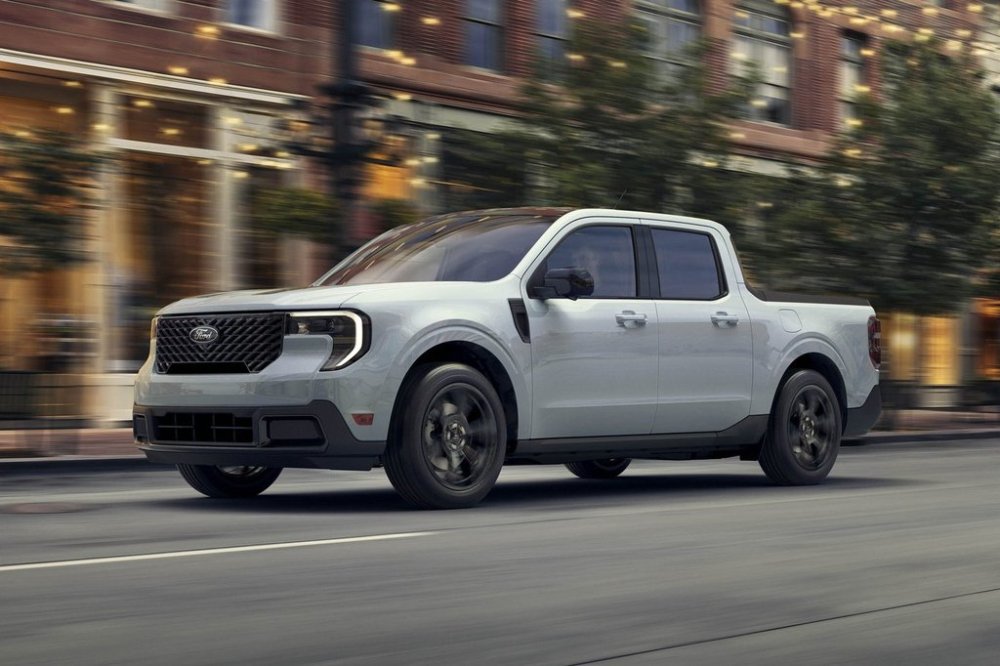
This photo provided by Ford shows the 2025 Ford Maverick, a compact pickup available with a fuel-efficient hybrid engine. (Courtesy of Ford Motor Co. via AP)

Both the Maverick and Santa Cruz start with four-cylinder engines rated at 191 horsepower. Neither truck is quick, but both are capable. Importantly, the Maverick is a hybrid that delivers an impressive 38 mpg combined, and we even squeezed out a few extra mpg in our real-world testing. The Santa Cruz isn’t a hybrid but gets up to 25 mpg combined (22 city/30 highway). Adding all-wheel drive shaves the estimates for both trucks by 1 mpg.

Both models offer optional turbo engines for better performance. The Maverick can dash from 0 to 60 mph in 6.6 seconds with its 250-horsepower four-cylinder, while the Santa Cruz is nearly as swift (6.8 seconds) with its 281-horsepower engine. The turbo trucks are also more evenly matched at the pump. The turbo Maverick gets an EPA-estimated 23-25 mpg combined, which we confirmed in our real-world testing, while the Santa Cruz actually outperformed its 21-22 mpg combined EPA rating with 29 mpg in our tests.

Winner: Maverick

Towing and payload

Properly equipped, the Maverick can tow up to 4,000 pounds, plenty for a small pop-up or travel trailer, or a couple of dirt bikes with a trailer and fuel, but doing so requires the pricier turbo engine. (The hybrid is limited to 2,000 pounds.) The Santa Cruz is rated at a more robust 5,000 pounds with its turbo engine or 3,500 pounds with its base engine. One thousand pounds isn’t much when comparing big trucks, but it’s a sizable advantage for a compact pickup.

The Maverick’s 1,500-pound payload capacity — fuel, passengers and bed weight combined — edges out the Santa Cruz’s rating of 1,411 pounds, and the Ford’s slightly longer bed improves utility. The Maverick also offers a trailering package — hitch, wiring harness and trailer brake controller — from the factory. For the Santa Cruz, you’d need to source aftermarket components. Since both trucks are capable in different ways, this choice comes down to specific use cases.

Winner: tie

Off-road capability

Neither truck offers serious off-road hardware, although the Maverick comes close. Both can handle a rutted trail or fire road thanks to optional all-wheel drive, a measure of body armor, and roughly 8.5 inches of ground clearance. The Santa Cruz XRT trim includes all-terrain tires, front tow hooks and a surround-view monitor to enhance visibility, but the Maverick Tremor trim is the best choice for dirt work.

The Tremor comes with even higher ground clearance, a specially tuned suspension and locking rear differential, underbody skid plates, and modes that optimize speed and traction for different terrain. But the pricey Tremor ($42,690) isn’t the only way to go off-road. The optional FX4 package for the Maverick XLT trim offers several of the same features for less money.

Winner: Maverick

Comfort, tech and value

If you expect a truck-like ride, the Maverick doesn’t disappoint. It jostles along like a basic work truck, its street-oriented Lobo trim the only exception. The Santa Cruz feels like a Mercedes by comparison, with a softer, controlled ride more typical of a crossover. The theme continues in the cabin, which feels fresher and more upmarket than the Maverick’s plastic expanse.

Both trucks come with large touchscreens — 13.2-inch in the Maverick, 12.3-inch in the Santa Cruz — underpinned by clean user interfaces and responsive software. But the Hyundai’s extra standard and optional driver aids, including adaptive cruise control, give it an edge. You can also get more optional creature comforts with the Santa Cruz, such as ventilated seats and leather upholstery. Both trucks cost nearly the same, with the Maverick starting at $29,840 (including destination) and the Santa Cruz at $30,200. The latter’s classier features give it an edge here.

Winner: Santa Cruz

Edmunds says

Get the Maverick if you need typical truck muscle or excellent fuel economy. Get the Santa Cruz if you want classier crossover comfort or need to tow heavier loads.

____________

This story was provided to The Associated Press by the automotive website Edmunds.

Dan Frio is a contributor at Edmunds.

Report Error Submit a Tip

More Stories

Reynolds exerts ‘maximum effort’ to boost Winnipeg after quick meet with mayor

Gabrielle Piché 3 minute read Preview

Reynolds exerts ‘maximum effort’ to boost Winnipeg after quick meet with mayor

Gabrielle Piché 3 minute read Updated: Yesterday at 8:13 PM CDT

Ryan Reynolds wasn’t wearing his Deadpool suit, but that didn’t stop Mayor Scott Gillingham from wanting to talk about films with the Vancouver-born Hollywood movie star.

Reynolds, who appeared at IG Wealth Management's 100th anniversary celebration Wednesday at the RBC Convention Centre, took to social media afterward, sharing a photo of himself with Gillingham and trumpeting the province’s tax incentives.

“An incredible place to shoot,” the Instagram post read.

On Thursday, Gillingham said the actor, best known for portraying an irreverent, erratic anti-hero on the big screen, is a “really nice gentleman.”

Read
Updated: Yesterday at 8:13 PM CDT

Letters, Oct. 23

7 minute read 2:00 AM CDT

People over cars — always

Re: Researchers: lights at crossing ‘long overdue’ (Oct. 22)

Maggie Macintosh’s article was right on the mark. The biggest problem with pedestrian crossings is the remarkable inconsistency, but there is also the fact that drivers at every traffic light are trained to keep running through amber lights until they turn to red.

I use the pedestrian crossing at Roblin Boulevard and Hunterspoint Road and drive through it every day. Almost every day I see drivers, from a full block away, who will just keep going through the flashing ambers (at the crossing), especially if there is traffic ahead of them doing the same thing.

Builder beefs up security after string of blazes

Morgan Modjeski 3 minute read 2:01 AM CDT

A Winnipeg builder said he’s had to beef up security around his developments after one of his projects sustained significant damage Wednesday in suspected arson cases.

“This is so bad for me,” said Rupinder Brar. “This is so sad.”

Firefighters were sent to the construction site at 297 Regal Ave., shortly before 4 a.m. Heavy smoke and flames were coming from the two homes on the site and threatened to jump to nearby buildings.

Winnipeg Police Service Const. Claude Chancy said police are investigating the blaze, as well as two fires in St. Boniface that were five days apart.

Henderson crosswalk has glaring safety gap, say researchers months after pedestrian killed

Maggie Macintosh 5 minute read Preview

Henderson crosswalk has glaring safety gap, say researchers months after pedestrian killed

Maggie Macintosh 5 minute read Yesterday at 2:00 AM CDT

Six months after a fatal collision at a crosswalk on Henderson Highway, two traffic safety researchers question why the intersection remains an outlier that is missing key flashing lights.

The City of Winnipeg is being urged to install “backflashers” to better protect road users moving in all directions at the intersection where a 32-year-old father died in the spring.

“It’s these little, mundane, non-sexy engineering problems that can cause everything right up to fatality,” said Curt Pankratz, an associate professor at the University of Winnipeg who studies traffic engineering and policymaking.

On April 19, shortly before sunrise, Gabe Beardy was struck when he was crossing the six-lane thoroughfare at Neil Avenue.

Read
Yesterday at 2:00 AM CDT

Bibi, the ‘anti-Bibi’ and the ‘wanna-Bibis’

Gwynne Dyer 5 minute read Preview

Bibi, the ‘anti-Bibi’ and the ‘wanna-Bibis’

Gwynne Dyer 5 minute read 2:00 AM CDT

According to the 1970s anarchist slogan, “No matter who you vote for, the government always gets in.”

That’s certainly true for the election in Israel on Tuesday, even if the winner is not Prime Minister Benjamin (Bibi) Netanyahu himself. All the other party leaders, says Israeli journalist Anshel Pfeffer, are just “wanna-Bibis.”

Or rather, all the rest except one. Former general Gadi Eisenkot, the main opposition candidate, is the “anti-Bibi,” Pfeffer says. He’s a working-class hero who joined the army as a private and worked his way up to chief of staff of the Israel Defence Forces (IDF). He retired and went into politics only four years ago, he’s modest and honest, what’s not to love?

Eisenkot certainly stands out among the party leaders in terms of style, but not so much in terms of actual policies. He was realistic enough to know that “total victory’ over Hamas was not likely, but his “Dahiya” strategy of causing “immense damage and destruction” (in Lebanon in the 2006 war) foreshadowed the cataclysm that the IDF has inflicted on Gaza since 2023.

Read
2:00 AM CDT

Hydro is getting ahead of itself

Tim Sale 5 minute read 2:00 AM CDT

Manitoba Hydro is pressing ahead with its proposed $3-billion gas-turbine project in Brandon as though approval was a foregone conclusion. Six weeks of Public Utilities Board hearings exposed serious doubts about the need for three turbines, their escalating cost and whether more affordable alternatives have been adequately examined. Yet before the PUB has delivered its recommendations and the government has authorized the investment, Hydro applied for an environmental license on Oct. 8.

Starting the environmental review early may save time but proceeding before the premier and his cabinet have made a decision risks reducing regulatory scrutiny and political approval to mere formalities. Has the government already given Hydro the green light?

Few dispute that Manitoba will need more capacity as demand grows. Daymark Energy Advisors, the PUB’s independent consultant, concluded that Hydro had established a need for additional capacity by 2030. However, Daymark questioned the size of the projected shortfall, Hydro’s load forecasts and its turbine cost assumptions. Hydro itself acknowledged that its planning costs were based on 2024 information, and that surging North American demand for gas turbines has since put significant upward pressure on prices. Then there’s the impact of Trump’s trade war. These are not minor details, but updated costs have not been obtained.

The bigger problem is how Hydro has framed the alternatives. Interim CEO Hal Turner recently argued that wind and battery storage alone cannot reliably carry Manitoba through prolonged extreme cold. Fair enough. However, critics are not proposing wind and batteries alone.