Missing loved ones leave those left behind with ‘ambiguous loss’ – a form of frozen grief
Advertisement
Read this article for free:
or
Already have an account? Log in here »
To continue reading, please subscribe:

Digital Subscription
One year of digital access for only $205*
- Enjoy unlimited reading on winnipegfreepress.com
- Read the E-Edition, our digital replica newspaper
- Access News Break, our award-winning app
- Play interactive puzzles
*First annual payment billed as $205.00 + GST for one year. This annual subscription will automatically renew at $233.00 + GST every 52 weeks (10% off the regular annual price of $259.35). Offer available to new and qualified returning subscribers only. Cancel any time.
To continue reading, please subscribe:
Add Free Press access to your Brandon Sun subscription for only an additional
$1 for the first 4 weeks*
- Enjoy unlimited reading on winnipegfreepress.com
- Read the E-Edition, our digital replica newspaper
- Access News Break, our award-winning app
- Play interactive puzzles
*Your next Brandon Sun subscription payment will increase by $1.00 and you will be charged $17.95 plus GST for four weeks. After four weeks, your payment will increase to $24.95 plus GST every four weeks.
Read unlimited articles for free today:
or
Already have an account? Log in here »
Hey there, time traveller!
This article was published 20/07/2025 (428 days ago), so information in it may no longer be current.
Rachel Ganz’s husband might be alive. But he might not be. More than three months after he was last seen near the Eleven Point River in Missouri amid severe flooding and evacuation orders, Jon Ganz is just … missing.
That leaves Rachel, 45, in a limbo of sorrow and frustration, awakening “every morning to a reality I don’t want to exist in.” She dwells there in a liminal state, she wrote by email July 11, with a stream of questions running through her head: “Is he trapped by debris in the river? Is he in a tangled mass of debris on the riverbank? Did he wander off into the forested area instead?” And one that remains stubbornly unanswered: “Are they ever going to find him?”
“Obviously I want my husband returned alive,” she wrote to The Associated Press, “though I am envious of those who have death certificates.”
It’s called ‘ambiguous loss’
Like the families of the missing after the July 4 Texas floods experienced for much of this month, Ganz is suffering from what grief experts call ambiguous loss: the agony of living in the absence of a loved one whose fate is uncertain. Humans across borders, cultures and time unfortunately know it well. Ambiguous loss can be intimate, like Ganz’ experience, or global, as in the cases of the missing from the Sept. 11 attacks, tsunamis in the Indian Ocean and Japan, the Turkey-Syria earthquake, the Israel-Hamas war and the Russian invasion of Ukraine.
The distinguishing feature, according to Pauline Boss, the researcher who coined the term in the 1970s, is the absence of ritual — a wake, a funeral, throwing dirt on a grave — to help the families left behind accept the loss. The only way forward, experts say, is learning to live with the uncertainty — a concept not well-tolerated in Western cultures.
“We’re in a state of mind, a state of the nation, right now where you either win or you lose, it’s either black or its white,” said Boss, a professor emeritus at the University of Minnesota who has researched ambiguous loss globally over a half century. “You have to let go of the binary to get past it, and some never do. They are frozen. They are stuck.”
Sarah Wayland, a social work professor from Central Queensland University in Sydney, says ambiguous loss is different from mourning because it’s about “repetitive trauma exposure,” from the 24-hour news cycle and social media. Then there is a devastating quiet that descends on the people left behind when interest has moved on to something else.
“They might be living in this space of dreading but also hoping at the same time,” Wayland said. “And they are experiencing this loss both publicly and privately.”
The uncertainty is like ‘a knife constantly making new cuts’
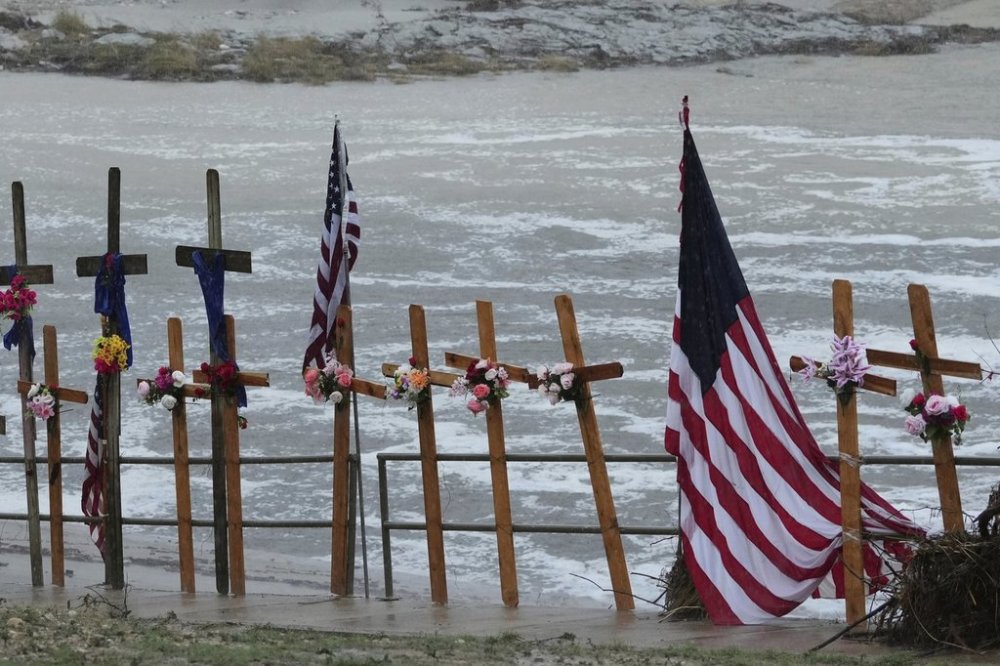
Heavy rains drove a wall of water through Texas Hill Country in the middle of the night July 4 , killing at least 132 people and leaving nearly 200 missing as of last week, though that number has dwindled as this week begins. Over just two hours, the Guadalupe River at Comfort, Texas, rose from hip-height to three stories tall, sending water weighing as much as the Empire State building downstream roughly every minute it remained at its crest.
Those without bodies to bury have been frozen in a specific state of numbness and horror — and uncertainty. “It’s beyond human imagination to believe that a loved one is dead,” Boss says.
This feeling can come in any global circumstance. Lidiia Rudenko, 39, represents a group of families in Ukraine whose relatives are missing in action. Her husband, Sergey, 41, has been missing since June 24, 2024, when his marine brigade battled the Russian army near Krynky. He’s one of tens of thousands of Ukrainians missing since the Russian invasion in 2022. And she is one of thousands in Ukraine left behind.
“Some people fall into grief and can no longer do anything, neither act nor think, while others start to act as quickly as possible and take the situation into their own hands, as I did,” Rudenko said. “There are days when you can’t get out of bed,” she said. “Sometimes we call it “getting sick. And we allow ourselves to get sick a little, cry it out, live through it, and fight again.”
For nearly a decade, Leah Goldin was part of a very small number of people in Israel with the dubious distinction of being the family of of a hostage.
Her son, Hadar Goldin, 23, a second lieutenant in the Israeli army, was killed, then his body taken on August 1, 2014. A blood-soaked shirt, prayer fringes and other evidence found in the tunnel where Goldin’s body had been held led the Israeli army to determine he’d been killed, she said. His body has never been returned.
Her family’s journey didn’t dovetail with the regular oscillations of grief. They held what Leah Goldin now calls a “pseudo-funeral’ including Goldin’s shirt and fringes, at the urging of Israel’s military rabbis. But the lingering uncertainty was like a “knife constantly making new cuts.”.
In the dizzying days after Hamas’ attack on southern Israel on Oct. 7, 2023, the Goldin family threw themselves into attempting to help hundreds of families of the 251 people Hamas had dragged into Gaza. But for a time, the Goldins found themselves shunned as advocacy for the Oct. 7 hostages surged.
“We were a symbol of failure,” Leah Goldin said. “People said, ‘We aren’t like you. Our kids will come back soon.’” She understood their fear, but Goldin, who had spent a decade pushing for Hamas to release her son’s body, was devastated by the implication. In time, the hostage families brought her more into the fold, learning from her experience.
Hamas still holds 50 Israeli hostages, fewer than half of whom are believed to be alive. In Gaza, Israel’s offensive has killed nearly 59,000 Palestinians, more than half of them women and children, according to Gaza’s Health Ministry, which doesn’t say how many militants have been killed but says over half of the dead have been women and children. Thousands of the dead are believed to be buried under rubble throughout the enclave.
How to support families of the missing — and what’s not helpful
Ganz, whose husband went missing in Missouri in April, said the sheriff’s department and others searched far and wide at first. She posted fliers around the town where his car was found, and on social media. Then someone accused her of “grieving without proof,” a remark that still makes her fume.

“One of my biggest frustrations has been people stating, ‘If you need anything, please let me know,’” Ganz said. That puts the burden on her, and follow-through has been hard to come by, she said. “We already have enough ambiguity.”
She’s thinking about setting up a nonprofit organization in Jon’s honor, dedicated to breaking the stigma against men getting therapy, to show “that it’s not weak.” That tracks with Goldin’s thinking that taking action can help resolve loss — and with Rudenko’s experience in Ukraine.
Boss recommends separate community meetings for families of the confirmed dead and those of the missing. For the latter, a specific acknowledgement is helpful: “You have to first say to the people, ‘What you are experiencing is an ambiguous loss. It’s one of the most difficult kinds of losses there is because there’s no resolution. It’s not your fault,’” Boss said.
In Ukraine, Rudenko said it helps to recognize that families of the missing and everyone else live in “two different worlds.”
“Sometimes we don’t need words, because people who have not been affected by ambiguous loss will never find the right words,” she said. “Sometimes we just need to be hugged and left in silence.”

Advertisement Advertise With Us
Advertisement Advertise With Us