Annuals are the forgotten native plants. Here are 7 worth adding to the garden
Advertisement
Read this article for free:
or
Already have an account? Log in here »
To continue reading, please subscribe:

Digital Subscription
One year of digital access for only $205*
- Enjoy unlimited reading on winnipegfreepress.com
- Read the E-Edition, our digital replica newspaper
- Access News Break, our award-winning app
- Play interactive puzzles
*First annual payment billed as $205.00 + GST for one year. This annual subscription will automatically renew at $233.00 + GST every 52 weeks (10% off the regular annual price of $259.35). Offer available to new and qualified returning subscribers only. Cancel any time.
To continue reading, please subscribe:
Add Free Press access to your Brandon Sun subscription for only an additional
$1 for the first 4 weeks*
- Enjoy unlimited reading on winnipegfreepress.com
- Read the E-Edition, our digital replica newspaper
- Access News Break, our award-winning app
- Play interactive puzzles
*Your next Brandon Sun subscription payment will increase by $1.00 and you will be charged $17.95 plus GST for four weeks. After four weeks, your payment will increase to $24.95 plus GST every four weeks.
Read unlimited articles for free today:
or
Already have an account? Log in here »
Hey there, time traveller!
This article was published 22/07/2025 (445 days ago), so information in it may no longer be current.
As home gardeners become more educated about the benefits of native plants (supporting native insects, birds and wildlife, and the environment as a whole), the focus has mainly been on trees, shrubs and perennials.
Native annuals have somehow gotten lost in the shuffle, likely because most of them aren’t readily available at the garden center. And most of the annuals (and tender perennials treated as annuals) that ARE sold in local nurseries are introduced species from faraway places. As such, they don’t provide much benefit to the local ecosystem.
Native insects have evolved along with native plants, so they recognize them as food. Filling a garden with exotic plants essentially creates a food desert, which can have dire consequences that range from fewer insect pollinators and birds to diminishing food crops and, eventually, livestock.
We know that using native plants of all types can help prevent a plethora of environmental problems. They’re also easier to care for because they’re naturally adapted to local conditions and are generally drought-tolerant.
Unfortunately, most home gardeners don’t know about or have access to native annuals. I hope that changes.
The Ladybird Johnson Wildflower Center, based in Austin, Texas, has a wonderful online plant database that allows users to search native plants by state, lifecycle, bloom time and other criteria. (It’s at www.wildflower.org.)
Consider asking your local nursery to stock them.
Here are some favorite native annuals.
7 Native annuals worth adding to the garden
Partridge pea (Chamaecrista fasciculata), which is native from Massachusetts south to northern Florida and west to Minnesota, eastern Nebraska, Oklahoma and eastern Texas, is sadly underused. The lovely 1-to-3-foot-tall plant, which produces clusters of 1-inch-wide yellow flowers on tall, slender stems, thrives in both sun and part shade. A member of the legume family, it also releases nitrogen into the soil, which provides a natural and free fertilizer for itself and the other plants in the bed.
American basket flower (Plectocephalus americanus) has a native range that spans west from Missouri to Kansas, then south to Louisiana, Texas and into Mexico. The plant, which boasts 4-inch, honey-scented, lavender-to-pinkish-purple flowers with creamy centers, thrives in full sun to part shade.
Forked Bluecurls (Trichostema dichotomum) are delicate flowers that remind me a bit of Dutch irises. Growing to just over 2 feet tall, the late-summer bloomer is native to Michigan, Missouri and Texas east to the Atlantic coast, from Maine to Florida.
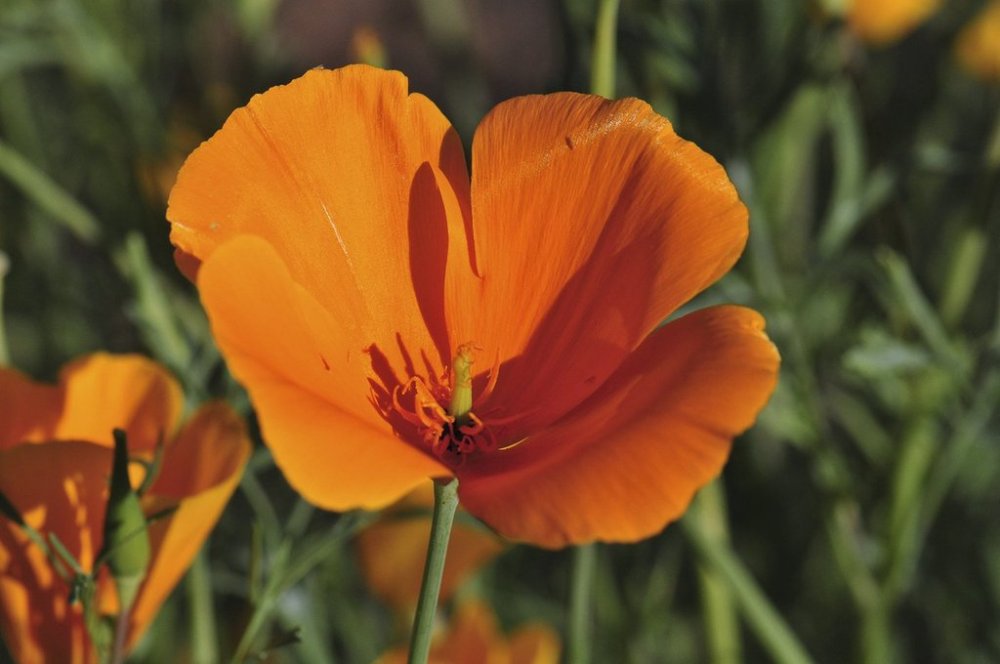
A better-known U.S. native is the California Poppy (Eschscholzia californica), which, as its name implies, is native to California and Baja California. It grows up to 2 feet tall, sending up thin stems that each hold a single yellow-orange flower.
Many sunflowers are North American natives, and some of those are perennials. But the Helianthus annus species, known as common or annual sunflower, is a native annual. Originating in Manitoba, Canada, and Minnesota, south to Texas and west from Oregon to Baja California, Mexico, the multi-branched, bushy plant becomes covered in yellow flowers with maroon centers in summer.
Indian blanket flower (Gaillardia pulchella) is another U.S. native annual that I’ve seen at the nursery. They’re not native to my home state of New York, however, but rather native from western South Dakota to Kansas and Louisiana and west to Colorado and Arizona. The 2-foot-tall plants put forth daisy-like, red-petaled flowers with yellow tips.
Impatiens capensis (Orange jewelweed) should not be confused with the widely available Impatiens walleriana, which comes to us from eastern Africa, or Impatiens hawkeri (New Guinea Impatiens), which is native to the Solomon Islands and New Guinea. Instead, this North American beauty has a native range that covers Saskatchewan to Newfoundland, Canada, then extends south to Georgia, west to Oklahoma and northward to Missouri. Great for shady spots, its speckled orange flowers are a favorite of hummingbirds, bees and butterflies.
___
Jessica Damiano writes weekly gardening columns for the AP and publishes the award-winning Weekly Dirt Newsletter. You can sign up here for weekly gardening tips and advice.
___
For more AP gardening stories, go to https://apnews.com/hub/gardening.