About 7 people a year die trying to save others from drowning in Canada, study finds

Advertisement

Advertise with us

TORONTO - A new study says an average of seven people in Canada die each year trying to save another person from drowning.  

Read this article for free:


or

Already have an account? Log in here »

To continue reading, please subscribe:

Subscribe and receive a limited-edition Free Press branded hat or tote.

Digital Subscription

One year of digital access for only $205*

  • Enjoy unlimited reading on winnipegfreepress.com
  • Read the E-Edition, our digital replica newspaper
  • Access News Break, our award-winning app
  • Play interactive puzzles

*First annual payment billed as $205.00 + GST for one year. This annual subscription will automatically renew at $233.00 + GST every 52 weeks (10% off the regular annual price of $259.35). Offer available to new and qualified returning subscribers only. Cancel any time.

To continue reading, please subscribe:

Add Free Press access to your Brandon Sun subscription for only an additional

$1 for the first 4 weeks*

  • Enjoy unlimited reading on winnipegfreepress.com
  • Read the E-Edition, our digital replica newspaper
  • Access News Break, our award-winning app
  • Play interactive puzzles
Start now

*Your next Brandon Sun subscription payment will increase by $1.00 and you will be charged $17.95 plus GST for four weeks. After four weeks, your payment will increase to $24.95 plus GST every four weeks.

Hey there, time traveller!
This article was published 31/07/2025 (429 days ago), so information in it may no longer be current.

TORONTO – A new study says an average of seven people in Canada die each year trying to save another person from drowning.  

The researchers found that 74 people drowned between January 2010 and December 2019 after attempting a rescue in the water.  

“Intervening when there is a drowning incident is critical to the outcome of the person who started drowning. However, it’s really important to do that safely,” said Tessa Clemens, a co-author of the study and a researcher with the Drowning Prevention Research Centre Canada and the Lifesaving Society of Ontario. 
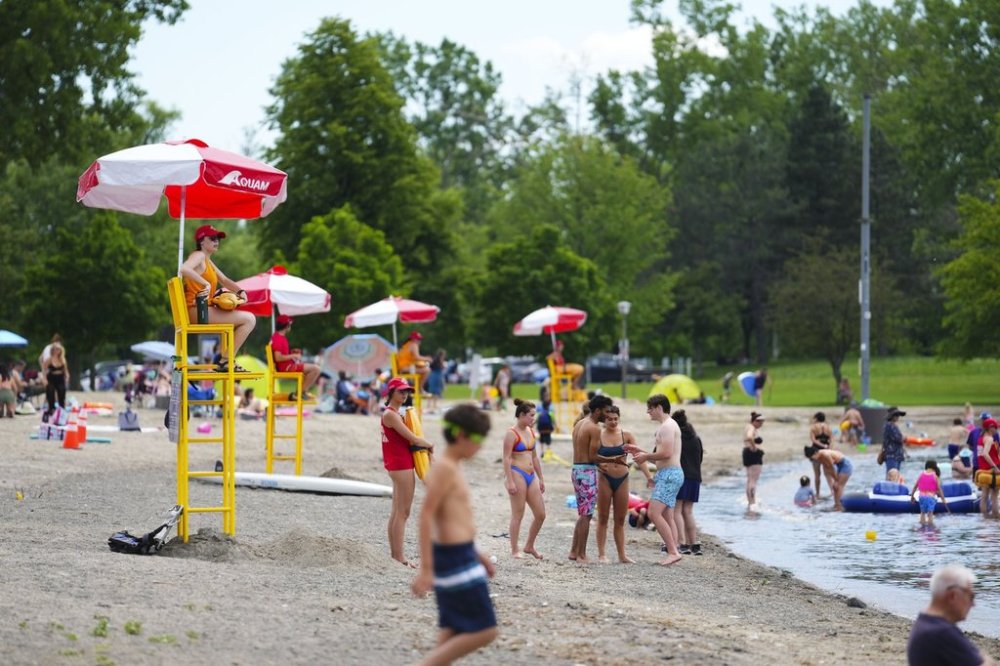
Lifeguards work at Britannia Beach of the Ottawa River in Ottawa on Friday, June 24, 2022. THE CANADIAN PRESS/Sean Kilpatrick

The Lifesaving Society released the study, which was first published in the BMJ in June, on Thursday because there has been a recent surge in drownings in Ontario and Quebec, said Stephanie Bakalar, the society’s senior communications officer. 

“In particular, we have heard of many instances of bystanders attempting rescues this summer and then becoming victims themselves,” Bakalar said in an email, noting they wanted to raise awareness about drowning prevention before the August long weekend. 

Clemens and her colleagues examined 4,535 fatal drownings over the 10-year period and found that in more than half of those cases, someone tried to rescue them.   

Most of those hundreds of rescuers did not have any lifesaving training, but frequently risked their own lives by trying to grab the drowning person in the water.  

Clemens said rescues involving getting in the water with the drowning person and trying to carry or tow them to shore should only be done by those who have taken some rescue training.

Lifesaving training teaches people how to approach a drowning person and help them without getting pulled underwater themselves, she said. 

In addition to the risk of getting pulled under, people tend to overestimate their own swimming ability in lakes, rivers and oceans, Clemens said. 

“Being able to swim in a pool can be very different than swimming in a natural water setting during a high-risk situation where somebody is in distress,” she said. 

“Most drowning in Canada does happen in natural water.”

People who haven’t had lifesaving training should try a “non-contact rescue,” including calling for help and throwing a life-jacket, ring buoy, floating toy or another buoyant object for the person to grab on to. They can also call out to the person and encourage them to swim toward them.

If someone is on shore or by a pool and sees someone drowning, they can lay flat on their stomach and reach a pole or another object out toward the person, but only if they are confident they won’t be pulled into the water.  

Clemens said the majority of the 74 rescuers who drowned knew the person they were trying to save, but some were unrelated bystanders. 

Many attempted rescues involve parents trying to save their children, Clemens said, so the instinct to do whatever it takes to save them is intense.  

She urges parents and caregivers to avoid ever being in that situation by never taking their eyes off their kids and staying within arm’s reach when they’re in the water, as well as putting up fences around backyard pools to prevent children from entering the pool area unsupervised. 

Clemens also said people should swim where there are lifeguards whenever possible and everyone — both adults and children — should wear a life-jacket while boating.  

She said everyone should know how to swim and that adult courses, as well as basic lifesaving training, are available through the Lifesaving Society.     

This report by The Canadian Press was first published July 31, 2025. 

Canadian Press health coverage receives support through a partnership with the Canadian Medical Association. CP is solely responsible for this content.

Report Error Submit a Tip

More Stories

Letters, Oct. 3

7 minute read 2:01 AM CDT

A morning in the life …

My very first lesson does not start when I walk into that lecture hall, oh no — it starts long before. It begins when I walk to my car, check the estimated arrival time to the University of Manitoba and hope that Winnipeg traffic agrees with it.

A drive that appears completely manageable changes almost immediately when I’m greeted by a tsunami of orange pylons and a line of cars that appears to go on forever. Traffic moves by the inch, lanes magically disappear and the detour I took yesterday now has a detour of its own. These factors make me do a calculation that I have become all too familiar with. How late can I arrive and still find parking, run to my class across campus and get to class with enough time left to make it worth it?

I have grown used to people saying, “Why not just leave earlier?” I do. But when I’m already leaving for my 8:30 a.m. class at 7 a.m., there’s only so much I can do. This drive that some would think is relaxing is one that feels like an assignment that I didn’t know I had to complete and is due at 8:30 a.m.

A 22-year-old man is dead and an 18-year-old is in hospital in critical condition after a two-vehicle crash on Highway 8 on Thursday evening.

A Gimli RCMP officer was driving north on the highway, near Riverton, when he witnessed the collision at about 6:45 p.m.

A vehicle headed north had passed the Mountie at a high speed before colliding with an SUV that was turning west onto Provincial Road 329 from Highway 8.

The driver of the first vehicle, an 18-year-old man from Arborg, was rushed to hospital by a helicopter ambulance with injuries RCMP describe as serious and life-threatening.

May be whiff of truth to ex’s odour ardour

Maureen Scurfield 5 minute read 2:01 AM CDT

DEAR MISS LONELYHEARTS: I ran into an old boyfriend I used to curl on a team with, and we went for drinks. We’ve been almost eight years apart, and I couldn’t remember why we broke up, as we always had such a great time together.

It wasn’t until the second date — this time on a weekend — that it came back to me, with a jolt. Pee-yew! I remembered he doesn’t use deodorant on weekends. Why? He enjoys his own body odour. I recalled that a bit too late, and it was just as awful as ever! I went home early.

Tonight, he called and I refused him another date. I said, “Think back. You remember why we broke up?” Then he said, “Oh yeah, you hated my no-deodorant weekend policy. Well, guess what? Some women don’t mind!” I said I really doubted that, and that ended the conversation. Miss L., wouldn’t any women find stinky underarms offensive?

— Sensitive Nose, Fort Richmond

Creative powerhouse Perry Rosemond never lost Winnipeg roots

Ben Waldman 7 minute read Preview

Creative powerhouse Perry Rosemond never lost Winnipeg roots

Ben Waldman 7 minute read 6:00 AM CDT

He created King of Kensington, directed the troops in the Royal Canadian Air Farce, and his creative eye was behind the lens for television shows starring Johnny Cash, Tom Jones, Mr. Dress-Up and the Friendly Giant.

He also wrote and developed the Canadian version of Sesame Street during his time as the head of school and preschool programming for CBC in Toronto, and directed a televised special in 2002 for Winnipeg sketch comedy troupe Royal Liechtenstein Theatre Company.

But before his name featured in the credits of some of the most iconic and influential pieces of the Cancon canon, Perry Rosemond was an only child living in a crammed, multi-generational home in Winnipeg’s North End, racing each day to beat the morning bell next door at William Whyte School.

In memoirs that have yet to be published, the late television producer recalled his childhood. “(T)here were 14 of us in the house at 193 Andrews St., and it wasn’t that big of a house,” he writes.

Read
6:00 AM CDT

You’re a solid, loyal sister, so worry not

Maureen Scurfield 5 minute read Yesterday at 2:00 AM CDT

DEAR MISS LONELYHEARTS: I ran into my sister’s husband at the bar recently. He was drinking with a bunch of people from his work. I noticed he was sitting close to a young woman, with his arm around her.

I just nodded without a smile as I slowly passed them. I kept on going, but he knew I saw them together. A few minutes later he came over — obviously drunk — and said, “You’re a good girl! You won’t say anything to your sister, will you?” Ha! I looked at him and said, “Of course I’m going to say something!”

My loyalty will always be to my sister. I phoned my sis in my car and blabbed. She tried to laugh it off, but she’s gone silent since — not answering my calls or messages. So apparently now I’m the troublemaker? That’d be just her style! What should I do?

— Worried About Us, North Kildonan

Dynacare workers provide essential services that must be maintained during strike, labour board rules

Nicole Buffie 5 minute read Preview

Dynacare workers provide essential services that must be maintained during strike, labour board rules

Nicole Buffie 5 minute read Thursday, Oct. 1, 2026

The Manitoba Labour Board has ruled Dynacare workers are essential employees and their services must be maintained during a labour dispute.

Read
Thursday, Oct. 1, 2026