Americans get more than half their calories from ultra-processed foods, CDC report says

Advertisement

Advertise with us

Most Americans get more than half their calories from ultra-processed foods, those super-tasty, energy-dense foods typically full of sugar, salt and unhealthy fats, according to a new federal report.

Read this article for free:


or

Already have an account? Log in here »

To continue reading, please subscribe:

Subscribe and receive a limited-edition Free Press branded hat or tote.

Digital Subscription

One year of digital access for only $205*

  • Enjoy unlimited reading on winnipegfreepress.com
  • Read the E-Edition, our digital replica newspaper
  • Access News Break, our award-winning app
  • Play interactive puzzles

*First annual payment billed as $205.00 + GST for one year. This annual subscription will automatically renew at $233.00 + GST every 52 weeks (10% off the regular annual price of $259.35). Offer available to new and qualified returning subscribers only. Cancel any time.

To continue reading, please subscribe:

Add Free Press access to your Brandon Sun subscription for only an additional

$1 for the first 4 weeks*

  • Enjoy unlimited reading on winnipegfreepress.com
  • Read the E-Edition, our digital replica newspaper
  • Access News Break, our award-winning app
  • Play interactive puzzles
Start now

*Your next Brandon Sun subscription payment will increase by $1.00 and you will be charged $17.95 plus GST for four weeks. After four weeks, your payment will increase to $24.95 plus GST every four weeks.

Hey there, time traveller!
This article was published 06/08/2025 (420 days ago), so information in it may no longer be current.

Most Americans get more than half their calories from ultra-processed foods, those super-tasty, energy-dense foods typically full of sugar, salt and unhealthy fats, according to a new federal report.

Nutrition research has shown for years that ultra-processed foods make up a big chunk of the U.S. diet, especially for kids and teens.

For the first time, however, the U.S. Centers for Disease Control and Prevention has confirmed those high levels of consumption, using dietary data collected from August 2021 to August 2023.
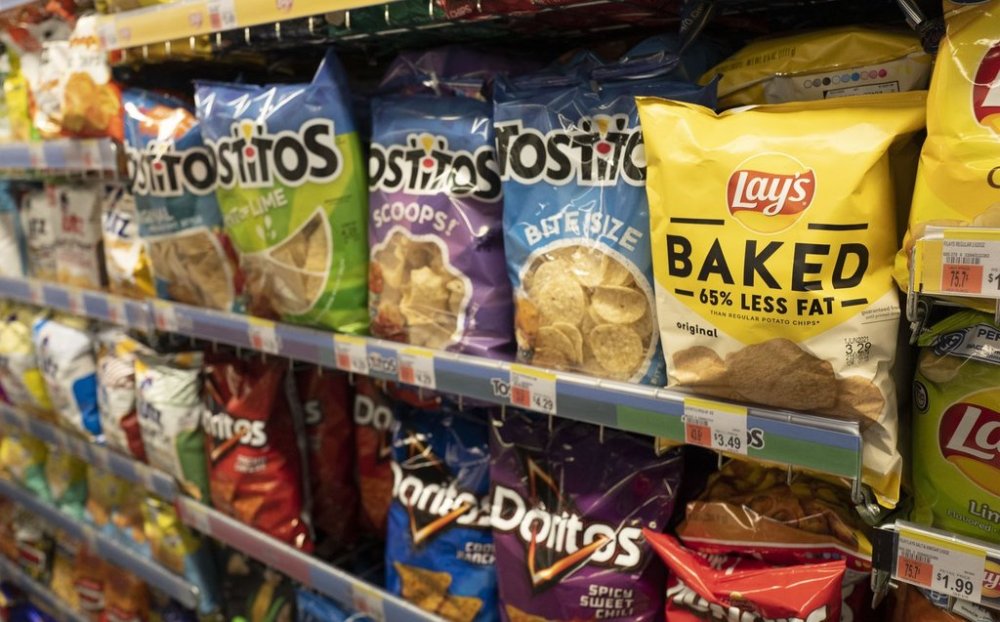
FILE - Potato chips are displayed at a store in New York, March 25, 2021. (AP Photo/Mark Lennihan, file)

The report comes amid growing scrutiny of such foods by Health Secretary Robert F. Kennedy Jr., who blames them for causing chronic disease.

“We are poisoning ourselves and it’s coming principally from these ultra-processed foods,” Kennedy told Fox News earlier this year.

Overall, about 55% of total calories consumed by Americans age 1 and older came from ultra-processed foods during that period, according to the report. For adults, ultra-processed foods made up about 53% of total calories consumed, but for kids through age 18, it was nearly 62%.

The top sources included burgers and sandwiches, sweet baked goods, savory snacks, pizza and sweetened drinks.

Young children consumed fewer calories from ultra-processed foods than older kids, the report found. Adults 60 and older consumed fewer calories from those sources than younger adults. Low-income adults consumed more ultra-processed foods than those with higher incomes.

The results were not surprising, said co-author Anne Williams, a CDC nutrition expert.

What was surprising was that consumption of ultra-processed foods appeared to dip slightly over the past decade. Among adults, total calories from those sources fell from about 56% in 2013-2014 and from nearly 66% for kids in 2017-2018.

Williams said she couldn’t speculate about the reason for the decline or whether consumption of less processed foods increased.

But Andrea Deierlein, a nutrition expert at New York University who was not involved in the research, suggested that there may be greater awareness of the potential harms of ultra-processed foods.

“People are trying, at least in some populations, to decrease their intakes of these foods,” she said.

Concern over ultra-processed foods’ health effects has been growing for years, but finding solutions has been difficult. Many studies have linked them to obesity, diabetes and heart disease, but they haven’t been able to prove that the foods directly cause those chronic health problems.

One small but influential study found that even when diets were matched for calories, sugar, fat, fiber and micronutrients, people consumed more calories and gained more weight when they ate ultra-processed foods than when they ate minimally processed foods.

Research published this week in the journal Nature found that participants in a clinical trial lost twice as much weight when they ate minimally processed foods — such as pasta, chicken, fruits and vegetables — than ultra-processed foods, even those matched for nutrition components and considered healthy, such as ready-to-heat frozen meals, protein bars and shakes.

Part of the problem is simply defining ultra-processed foods.

The new CDC report used the most common definition based on the four-tier Nova system developed by Brazilian researchers that classifies foods according to the amount of processing they undergo. Such foods tend to be “hyperpalatable, energy-dense, low in dietary fiber and contain little or no whole foods, while having high amounts of salt, sweeteners and unhealthy fats,” the CDC report said.

U.S. health officials recently said there are concerns over whether current definitions “accurately capture” the range of foods that may affect health. The U.S. Food and Drug Administration and the Agriculture Department recently issued a request for information to develop a new, uniform definition of ultra-processed foods for products in the U.S. food supply.

In the meantime, Americans should try to reduce ultra-processed foods in their daily diets, Deierlein said. For instance, instead of instant oatmeal that may contain added sugar, sodium, artificial colors and preservatives, use plain oats sweetened with honey or maple syrup. Read food packages and nutrition information, she suggested.

“I do think that there are less-processed options available for many foods,” she said.

___

The Associated Press Health and Science Department receives support from the Howard Hughes Medical Institute’s Department of Science Education and the Robert Wood Johnson Foundation. The AP is solely responsible for all content.


Report Error Submit a Tip

More Stories

Completely separating inmates unrealistic, inquest judge says in report on three Stony Mountain slayings

Erik Pindera 5 minute read Preview

Completely separating inmates unrealistic, inquest judge says in report on three Stony Mountain slayings

Erik Pindera 5 minute read 1:43 PM CDT

Nothing short of keeping inmates separated at all times could have prevented three unrelated prisoner-on-prisoner killings several years ago in Stony Mountain Institution’s maximum-security unit, an inquest judge has found.

Provincial court Judge Lindy Choy made the finding after overseeing an inquest earlier this year into the slayings of Adrian Fillion, 42, Michael Monney, 27, and Nolan Thomas, 26, all of which occurred at the hands of fellow maximum-security inmates in the federal prison just north of Winnipeg. The killings occurred when cells were unlocked, allowing inmates to briefly move around to other areas in the cell block.

“The overall impression I was left with from the (Stony Mountain Institution) witnesses was that management of inmates in a custodial facility is a very complex undertaking. There are clearly multiple levels of oversight involved in any decisions that are made and it is all done in a very structured manner,” Choy wrote in her report on the inquest, which was made public Tuesday.

“While maintaining complete physical distance between inmates at all times would have prevented the homicides from occurring, we know that from a social and psychological perspective, this is not generally realistic nor acceptable.”

Read
1:43 PM CDT

Kinew adds cabinet portfolio to focus on first responders

Carol Sanders and Nicole Buffie 5 minute read Preview

Kinew adds cabinet portfolio to focus on first responders

Carol Sanders and Nicole Buffie 5 minute read Updated: Yesterday at 6:40 PM CDT

Premier Wab Kinew shuffled his cabinet Monday and created a new ministerial position that will oversee first responders in the province.

Kinew appointed David Pankratz, the MLA for Waverley, as minister responsible for first responder initiatives.

Tuxedo MLA Carla Compton was appointed minister responsible for accessibility, taking over the role from Families Minister Nahanni Fontaine.

The new ministers were sworn in at a ceremony at the legislature Monday afternoon.

Read
Updated: Yesterday at 6:40 PM CDT

Orange Shirt Day project fits students to a tee

Maggie Macintosh 5 minute read Preview

Orange Shirt Day project fits students to a tee

Maggie Macintosh 5 minute read Yesterday at 6:57 PM CDT

On the eve of Orange Shirt Day, hundreds of black T-shirts will be handed out to teenagers at Elmwood High School — and there wasn’t a mixup in the clothing procurement process.

The student-run business behind the initiative wanted to make a statement about “truth and reconciliation” being a year-round activity, said Daniel Concepcion, a Grade 12 student.

Daniel said given that black is a staple in the wardrobe of teenagers, he hopes these shirts won’t sit on hangers for 364 days of the year.

“Every child matters, every part of the day, every day,” the 17-year-old said.

Read
Yesterday at 6:57 PM CDT

Furby Street residents fed up with inaction on drug houses

Carol Sanders 6 minute read Preview

Furby Street residents fed up with inaction on drug houses

Carol Sanders 6 minute read Updated: Yesterday at 8:39 AM CDT

Anxious Furby Street residents contacted the city and their elected officials Friday to — once again — report people coming and going from a boarded-up house they call a dangerous “drug centre” and “den of thieves” that’s just steps away from a house under construction.

Linda Zak, who was holding a yard sale with a group of neighbours Friday morning, described the trouble the home attracts, while a woman slumped on the front steps and a man standing in the yard yelled to someone inside it.

“It is a drug centre,” said Zak, 77. “We know that. A couple of days ago, a person lit the front on fire. Now, as you look at it, you can see where the facade was burning and they were trying to harm people inside.”

“We’re very concerned about it being next to the home this man is building,” she said, pointing to the two-storey that’s nearly completed. The boarded-up house is in the 500 block of Furby.

Read
Updated: Yesterday at 8:39 AM CDT

What’s open, what’s closed, what’s up in Winnipeg on National Day for Truth and Reconciliation Sept. 30, 2026

Free Press staff 4 minute read Preview

What’s open, what’s closed, what’s up in Winnipeg on National Day for Truth and Reconciliation Sept. 30, 2026

Free Press staff 4 minute read Sunday, Sep. 27, 2026

The National Day of Truth and Reconciliation, or Orange Shirt Day, as it's known in Manitoba, happens Sept. 30 with many commemorative community events scheduled.

Read
Sunday, Sep. 27, 2026

Is another goalie on Jets’ wish list?

Ken Wiebe 7 minute read Preview

Is another goalie on Jets’ wish list?

Ken Wiebe 7 minute read Sunday, Sep. 27, 2026

Kevin Cheveldayoff and company are down to the short strokes.

With the opening-day roster due on Monday afternoon, the Winnipeg Jets took steps on the weekend to get down to the final number.

As it stood on Sunday, the Jets were down to 24 healthy players in training camp after centre Danny Zhilkin and defenceman Henry Thrun were placed on waivers.

With a maximum of 23 spots available, the only things left to determine are whether the Jets are interested in claiming a more experienced goalie to serve as the backup to Stuart Skinner and if centre Brayden Yager will break camp with the big club.

Read
Sunday, Sep. 27, 2026