What is chikungunya, the virus now spreading in southern China?

Advertisement

Advertise with us

LONDON (AP) — Chinese authorities have taken measures this week to try to curb the spread of chikungunya, a virus that often causes fever and joint pain. As of Wednesday, the government reported there had been more than 7,000 cases, mostly in the southern manufacturing hub of Foshan.

Read this article for free:


or

Already have an account? Log in here »

To continue reading, please subscribe:

Subscribe and receive a limited-edition Free Press branded hat or tote.

Digital Subscription

One year of digital access for only $205*

  • Enjoy unlimited reading on winnipegfreepress.com
  • Read the E-Edition, our digital replica newspaper
  • Access News Break, our award-winning app
  • Play interactive puzzles

*First annual payment billed as $205.00 + GST for one year. This annual subscription will automatically renew at $233.00 + GST every 52 weeks (10% off the regular annual price of $259.35). Offer available to new and qualified returning subscribers only. Cancel any time.

To continue reading, please subscribe:

Add Free Press access to your Brandon Sun subscription for only an additional

$1 for the first 4 weeks*

  • Enjoy unlimited reading on winnipegfreepress.com
  • Read the E-Edition, our digital replica newspaper
  • Access News Break, our award-winning app
  • Play interactive puzzles
Start now

*Your next Brandon Sun subscription payment will increase by $1.00 and you will be charged $17.95 plus GST for four weeks. After four weeks, your payment will increase to $24.95 plus GST every four weeks.

Hey there, time traveller!
This article was published 06/08/2025 (418 days ago), so information in it may no longer be current.

LONDON (AP) — Chinese authorities have taken measures this week to try to curb the spread of chikungunya, a virus that often causes fever and joint pain. As of Wednesday, the government reported there had been more than 7,000 cases, mostly in the southern manufacturing hub of Foshan.

Here’s what to know about chikungunya:

What is chikungunya?
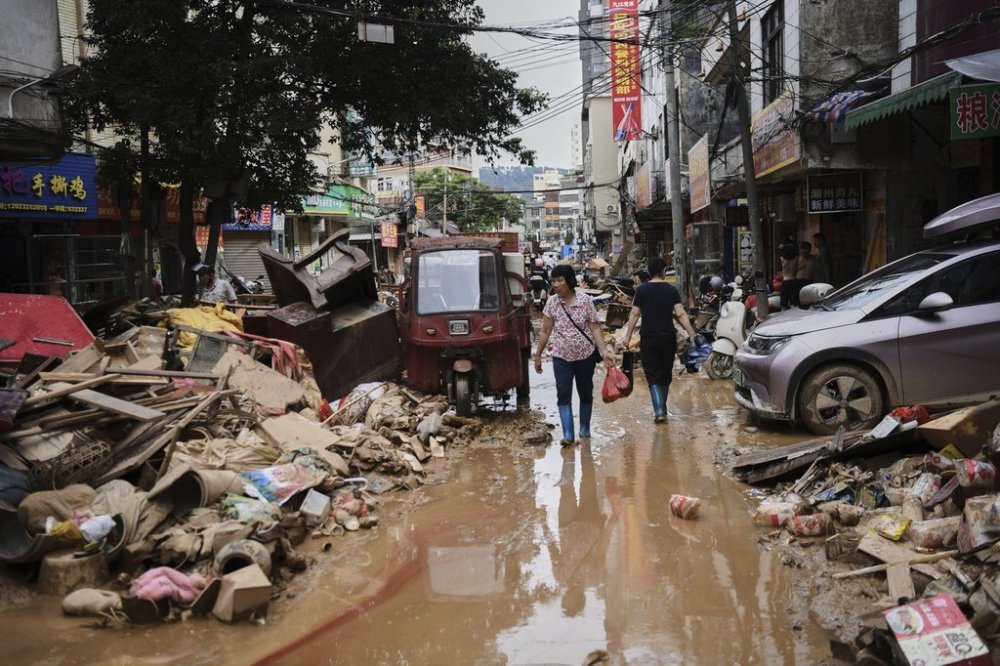
FILE -In this photo released by Xinhua News Agency, residents wade through debris along a flood-hit street after waters from a river overwhelmed towns following days of heavy rain, in Huaiji County, south China's Guangdong Province on June 19, 2025. (Deng Hua/Xinhua via AP, File)

Chikungunya is a disease caused by a virus of the same name.

The chikungunya virus was first identified in people sickened during an outbreak in Tanzania in 1952. Its name is derived from a word in the Makonde language, which means “that which bends up,” due to the severe pain it can cause.

Chikungunya is transmitted by infected mosquitoes and mostly causes mild symptoms. The majority of people who get chikungunya recover without needing medical attention after one to two weeks.

What are the symptoms of chikungunya?

Chikungunya typically produces symptoms including fever, muscle pain, nausea, fatigue and a rash.

But in rare cases, it can cause debilitating joint pain that persists for months or even years. Patients who get severely ill often require hospitalization because of the risk of organ damage.

The World Health Organization says severe cases and deaths are rare and mostly occur in babies or elderly people with underlying health conditions.

Is there a treatment or vaccine?

There is no specific treatment for chikungunya, but health workers can treat the symptoms by giving medicines to lower fevers or ease muscle pain.

Two vaccines have been approved in several regions, including Britain, Brazil, Canada and Europe. Those are mostly targeted at travelers and are not widely available in the countries most affected by chikungunya.

Where does chikungunya normally occur?

Chikungunya causes regular outbreaks in Africa, Asia and the Americas, with occasional small epidemics in Europe.

As of July, there have been about 240,000 cases of chikungunya, including 90 deaths in 16 countries, according to the European Centres for Disease Prevention and Control. The countries that reported the highest number of infections were Brazil, Bolivia, Argentina and Peru.

What’s happening in China?

With thousands of confirmed cases, this appears to be the biggest chikungunya outbreak ever documented in China, according to César López-Camacho of the University of Oxford.

“What makes this event notable is that chikungunya has never been established in mainland China before,” he said in a statement. “This suggests that most of the population had no preexisting immunity, making it easier for the virus to spread quickly.”

In response to the outbreak in Foshan, near Hong Kong, Chinese authorities have begun taking measures like distributing mosquito nets, having workers spray residential areas, streets and construction sites with insecticide.

People who do not empty bottles, flower pots or other outdoor receptacles, where water might accumulate and allow mosquitoes to breed, can be subject to fines of up to 10,000 yuan ($1,400) and have their electricity cut off.

Unusually heavy rains and high temperatures this year have worsened the crisis in China.

Are we seeing more chikungunya outbreaks?

Yes.

The number of outbreaks has increased since 2000, just as there have been more outbreaks of other mosquito-transmitted diseases like dengue and Zika, according to Robert Jones, an assistant professor at the London School of Hygiene and Tropical Medicine.

Jones said in a statement that in 2013, chikungunya was first seen in the island of St. Martin and that over the next three years, cases were confirmed in almost 50 countries in the Caribbean and the Americas, with more than 1 million suspected cases.

Jones said the risks of chikungunya epidemics have risen due to climate change and urban expansion, warning that the current outbreak could spread to other parts of southern China with humid climates and dense cities.

__

The Associated Press Health and Science Department receives support from the Howard Hughes Medical Institute’s Department of Science Education and the Robert Wood Johnson Foundation. The AP is solely responsible for all content.

Report Error Submit a Tip

More Stories

‘In Normandy, we remember’

Aaron Epp 4 minute read Preview

‘In Normandy, we remember’

Aaron Epp 4 minute read Yesterday at 6:23 PM CDT

Travelling nearly 7,000 km from his home in France to Winnipeg gave Gabriel Zaranski a new perspective on warfare.

“It’s very different to speak about war in school (than) to speak with real people who (have fought) in a war,” he said. “We can feel the emotion when they speak … The testimony has more impact when it’s real soldiers.”

Zaranski is one of 14 Grade 12 students from Bayeux, a town in France’s Normandy region, in Winnipeg this week for a learning tour.

The students, who attend Lycée Arcisse de Caumont high school, met on Saturday with veterans from the Queen’s Own Cameron Highlanders of Canada, a local military regiment, to discuss their studies and the regiment’s role in the Second World War.

Read
Yesterday at 6:23 PM CDT

Positive anticipation is growing about major housing developments underway in Winnipeg’s downtown

Gabrielle Piché 10 minute read Preview

Positive anticipation is growing about major housing developments underway in Winnipeg’s downtown

Gabrielle Piché 10 minute read Friday, Sep. 25, 2026

If traffic is light and the wind is down, Somia Sadiq is able to hear the roar of Winnipeg Jets fans twice: first through her window, then on TV.

From her apartment view high above downtown, she can look out at Graham Avenue’s painted pedestrian landscape, see construction cranes and hear the heavy equipment at work as massive housing projects take shape at The Forks, at what used to be Portage Place shopping centre and at the former Hudson’s Bay building.

Sadiq has lived at 300 Main for 2 1/2 years, a few steps from the city’s famous, windy and reopened-to-pedestrians Portage Avenue intersection. At 42 storeys, it’s the tallest building in Winnipeg.

She is among 18,000 downtown residents who will soon be joined by thousands of others attracted to the city’s core by the new wave of major construction projects.

Read
Friday, Sep. 25, 2026

Local Muslims, Indigenous people hold interfaith event

Malak Abas 3 minute read Preview

Local Muslims, Indigenous people hold interfaith event

Malak Abas 3 minute read 6:42 PM CDT

Bannock with wild rice and samosas with halal beef stew were served in equal measure as Indigenous and Muslim Winnipeggers sought common ground at an interfaith event discussing truth and reconciliation Sunday.

The Islamic Social Services Association’s second annual Muslim-Indigenous Solidarity event recognized Orange Shirt Day through conversations with elders, shared prayers and crafting.

Organizer Shahina Siddiqui said many of the people attending the gathering, held at Canadian Mennonite University, share the traumatic impacts of colonialism.

Siddiqui said she herself had attended a Catholic day school in her home country of Pakistan, where she and other students were forced to speak English, and were hurt if they didn’t. Many Muslim-majority countries, she said, have been harmed by colonialism.

Read
6:42 PM CDT

Today’s horoscope

Georgia Nicols 4 minute read Preview

Today’s horoscope

Georgia Nicols 4 minute read Yesterday at 2:01 AM CDT

MOON ALERT: Avoid shopping (except food and gas) and important decisions from 3 a.m. until 6 a.m. The full moon in Aries peaks at 11:49 p.m.

ARIES (March 21-April 19)

This is a restless day for you because the full moon is in your sign. (This happens once a year and it can create tension between you and those close to you.) Patience is your best ally. Give yourself the freedom to change plans.

TAURUS (April 20-May 20)

Read
Yesterday at 2:01 AM CDT

Special teams woes hurt Bombers in loss to Argos

Ken Wiebe 7 minute read Preview

Special teams woes hurt Bombers in loss to Argos

Ken Wiebe 7 minute read Yesterday at 8:06 PM CDT

THEY’VE been the most consistent of the three phases in the Winnipeg Blue Bombers arsenal this season.

A port in the proverbial storm, throughout this topsy-turvy campaign of ups-and-downs, the special-teams units have been supplying strength to a group that is still searching for consistency with only four games left in the regular season.

That’s what made this momentary lapse so costly in a 30-28 loss to the Toronto Argonauts on Friday at Princess Auto Stadium.

“We didn’t keep up our end of the bargain. And that hurts our football team, hurts our chances of winning games,” said Blue Bombers special teams ace Tanner Cadwallader. “And if we want to win close games. we’ve got to be a whole lot better than that. And we will. We’re going to come in (on Saturday for the film session) and go through it with a fine-tooth comb and just work a little bit harder.”

Read
Yesterday at 8:06 PM CDT

Jets’ brass warming up to El Nino?

Mike McIntyre 7 minute read Preview

Jets’ brass warming up to El Nino?

Mike McIntyre 7 minute read Friday, Sep. 25, 2026

Decisions, decisions.

The Winnipeg Jets held their final dress rehearsal Friday night before the curtain rises next week on the new NHL season.

Unlike their first three exhibitions, this one in Denver featured competitive lineups that looked an awful lot like what we’ll see when the games start counting, with plenty of star power and veteran presence on both sides.

So what are we to make of the Jets’ 5-2 loss to the mighty Colorado Avalanche, who captured the Presidents’ Trophy last year and are once again a legitimate Stanley Cup contender?

Read
Friday, Sep. 25, 2026