

Israeli election once again up for grabs
Advertisement
Read this article for free:
or
Already have an account? Log in here »
To continue reading, please subscribe:

Digital Subscription
One year of digital access for only $205*
- Enjoy unlimited reading on winnipegfreepress.com
- Read the E-Edition, our digital replica newspaper
- Access News Break, our award-winning app
- Play interactive puzzles
*First annual payment billed as $205.00 + GST for one year. This annual subscription will automatically renew at $233.00 + GST every 52 weeks (10% off the regular annual price of $259.35). Offer available to new and qualified returning subscribers only. Cancel any time.
To continue reading, please subscribe:
Add Free Press access to your Brandon Sun subscription for only an additional
$1 for the first 4 weeks*
- Enjoy unlimited reading on winnipegfreepress.com
- Read the E-Edition, our digital replica newspaper
- Access News Break, our award-winning app
- Play interactive puzzles
*Your next Brandon Sun subscription payment will increase by $1.00 and you will be charged $17.95 plus GST for four weeks. After four weeks, your payment will increase to $24.95 plus GST every four weeks.
Read unlimited articles for free today:
or
Already have an account? Log in here »
The next general election in Israel will be held on Oct. 27. Needless to say, like most elections in the country’s modern and fraught history since 1948, it is a critical contest between right and left, secular and orthodox, and left, moderate, right and extreme.
Also, given Israel’s complex proportional representative political system, which allocates a seat in its 120-seat Knesset (parliament) for winning only 3.25 per cent of the national vote, this election is nearly impossible to predict.
Even before 1948, Israelis’ ardent faith in democracy, their differing points of view and penchant for arguing led to the establishment of a multitude of political parties representing a smorgasbord of almost every conceivable position on the political spectrum.
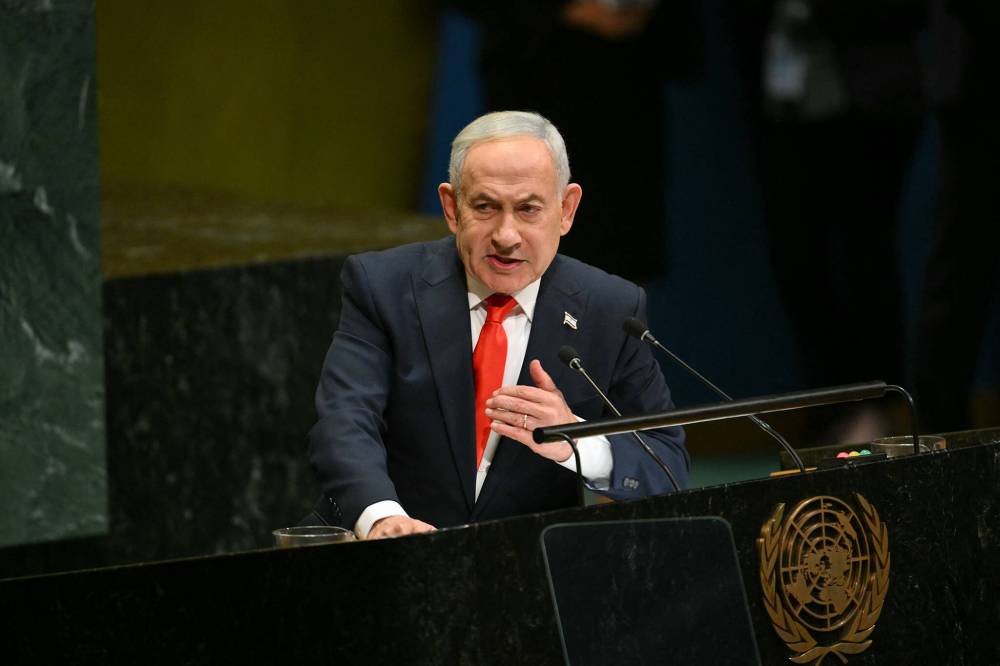
Tribune News Service
Israeli Prime Minister Benjamin Netanyahu addresses the 81st United Nations General Assembly in New York last month. He faces strong challenges in the Oct. 27 general election.
Because no political party has ever won the 61 seats required to form a majority government, the major parties have frequently had to rely on fringe parties to hold power.
This has led, for example, to the present government of Benjamin Netanyahu, of the right-wing Likud party, allocating cabinet seats and influence to Bezalel Smotrich, the finance minister, who heads the Religious Zionist Party, a far-right party, and Itamar Ben-Gvir, who is minister of national security and head of the far-right, ultra-nationalist Otzma Yehudit (Jewish Power). In the 2022 election, Smotrich and Ben-Gvir, along with Noam, a far-right, orthodox religious party, ran in a joint alliance — they separated after the election — and together received 10.8 percent of the votes, winning 14 valuable seats.
In the aftermath of the Oct. 7, 2023, Hamas terrorist attack, Smotrich and Ben-Gvir (the two control seven and six seats respectively), have wielded much power over the direction of the Netanyahu government and repeatedly threatened to bring down the administration if the prime minister did not abide by their demands. The two — especially Ben-Gvir — have often made volatile situations much worse.
The two main contenders for power in the upcoming election are Netanyahu and Gadi Eisenkot, the former chief of staff of the Israeli Defence Forces (IDF), who heads the newly formed centre-right party, Yashar (which means straight or upright). Recent polls, which change daily, have coalitions controlled by both Netanyahu and Eisenkot tied at 53 seats — which means small parties will again be the deciding factor in the formation of the next government.
The Oct. 27 election indeed may be the most important in Israel’s history. But others have also been significant. Here are three that stand out:
In May 1948, following the end of the British Mandate and the declaration of Israel as an independent state, its most notable founder and political leader was David Ben-Gurion. In the country’s first election on Jan. 25, 1949, Ben-Gurion and his Mapai (Labour Zionist) party won the most seats. Ben-Gurion became Israel’s first prime minister and established the state’s parliamentary and election system.
Nearly three decades later, on May 17, 1977, Labour’s hold on successive Israeli governments was finally broken with the rise of Menachem Begin and Likud, created four years earlier. Begin, the former leader of Irgun, a Zionist militant group organized in the early 1940s to challenge and terrorize British rule, was prime minister for six-and-half years, during which he rather remarkably negotiated a peace treaty with Egyptian president Anwar Sadat (who was assassinated for this act by an extremist Egyptian army officer). After 1977, the right-left divide in Israeli politics has been the norm.
In the election of June 23, 1992, Yitzhak Rabin, the former head of the IDF, who had served as prime minister from 1974 to 1977, successfully assembled a coalition to wrest control of the government from Likud.

This was a turbulent period of Israeli history. The first Palestinian Intifada led to violence between Israelis and Palestinians and the creation of Hamas, with its radical (and ongoing) goal of Israel’s destruction. Nonetheless, Rabin pursued peace with Yasser Arafat of the Palestine Liberation Organization and signed the Oslo Accords in 1993. On Nov. 4, 1995, Rabin was assassinated by Yigal Amir, an Israeli extremist who did not accept his peace overtures. The final Oslo peace treaty was never signed.
For the last 30 years, the most dominating Israeli politician — with a few interludes — has been Netanyahu who, over several terms since 1996, has served as prime minister for close to 19 years, longest of any Israeli leader.
Much is at stake for Netanyahu on Oct. 27. He is still facing corruption charges dating back nearly a decade. He has also steadfastly refused to appoint an independent inquiry to fully investigate the Oct. 7 attack, similar to what Golda Meir did following the Yom Kippur War of 1973, which exposed Israel’s poor military planning.
Netanyahu is charismatic, smart and politically astute, as well as determined, defiant and manipulative. It is possible he will win a razor-thin victory. Whatever happens at the end of the month, his resolve to hold on to power should not be underestimated.
Now & Then is a column in which historian Allan Levine puts the events of today in a historical context. His most recent book is The Dollar-A-Year Men: How the Best Business Brains in Canada Helped to Win the Second World War.