Someone could win $1.8B Powerball jackpot Saturday. Odds are their identity will remain a mystery
Advertisement
Read this article for free:
or
Already have an account? Log in here »
To continue reading, please subscribe:
Digital Subscription
One year of digital access for only $1.44 a week*
- Enjoy unlimited reading on winnipegfreepress.com
- Read the E-Edition, our digital replica newspaper
- Access News Break, our award-winning app
- Play interactive puzzles
*Billed as $5.77 plus GST every four weeks. After 52 weeks, price increases to the regular rate of $19.95 plus GST every four weeks. Offer available to new and qualified returning subscribers only. Cancel any time.
To continue reading, please subscribe:
Add Free Press access to your Brandon Sun subscription for only an additional
$1 for the first 4 weeks*
- Enjoy unlimited reading on winnipegfreepress.com
- Read the E-Edition, our digital replica newspaper
- Access News Break, our award-winning app
- Play interactive puzzles
*Your next Brandon Sun subscription payment will increase by $1.00 and you will be charged $17.95 plus GST for four weeks. After four weeks, your payment will increase to $24.95 plus GST every four weeks.
Read unlimited articles for free today:
or
Already have an account? Log in here »
Hey there, time traveller!
This article was published 05/09/2025 (409 days ago), so information in it may no longer be current.
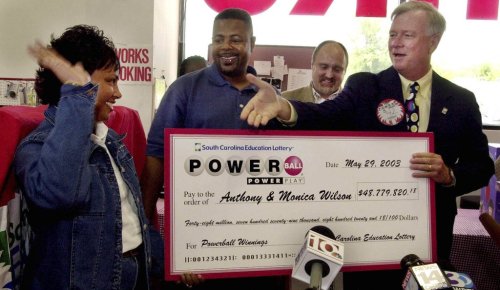
After Iowa gas station employee Timothy Schultz won a $29 million lottery jackpot in 1999, he decided to hold a press conference. Lottery officials told him it would help him avoid being “hounded by media” since state law required his name to be disclosed anyway.
But the then-21-year-old soon felt the consequences of his overnight fame.
He felt like a “deer in headlights,” and his life immediately changed: Strangers regularly asked him for autographs or to “rub him for good luck.” Shultz, now in his 40s, said he would consider remaining anonymous today if he were given the choice.

“I wasn’t just Tim anymore, I was Tim the lottery winner,” Shultz said.
Saturday’s drawing is for $1.8 billion
Saturday’s $1.8 billion Powerball jackpot is the second-largest in history, but even if there is a winner, don’t expect to find out who they are or how they plan to use their winnings — unlike when Schultz won, most winners can now remain anonymous.
Lawmakers in many states have changed the rules in recent decades to protect winners from being targeted by criminals and unscrupulous people asking for money. And even in the approximately two dozen states where names are disclosed, winners are advised to avoid public scrutiny.
Kurt Panouses is a lottery lawyer who has represented winners for decades, including some worth hundreds of millions.
Panouses advises his clients to use intermediaries where possible and claim their prizes on busy news days, such as Election Day, to avoid coverage.
Panouses regularly fields inquiries from investors, scammers and people in need, all trying to reach his clients.
“It’s hard for people who don’t have the experience or life perspective to say no,” Panouses said.
Lotteries have a long history of public disclosure
It wasn’t always this way. For centuries, public disclosure of those with winning tickets was an essential part of ensuring people could trust lotteries.
Lotteries in America date to the 1700s, when governments, like now, used them to raise money. Jonathan D. Cohen, the author of “For a Dollar and a Dream: State Lotteries in Modern America,” said they were born out of a “distinctly American desire for government services without paying taxes for them.”
Early on, they were more like raffles. Winners would be announced at fairs with ticket holders in the audience.
In the 1980s, in some states, Cohen said, people would buy tickets to jackpot games with in-person drawings. About 20 people would stand on stage and one would win. Their emotional personal stories helped fuel the popularity of lotteries.
“Here’s this housewife, here’s this orphan,” Cohen said. “The person who wins the lottery is sitting right there and, of course, immediately starts weeping.”
The big multi-state lotteries like Powerball and Mega Millions, which roll over prize money when no one wins and generate ever-larger jackpots, disrupted that approach, he said. It reduced the human element but allowed for bigger prizes.
Nine states allow all lottery winners to remain completely anonymous for all lotteries. Ten states allow lottery winners to remain anonymous for wins above a certain amount, ranging from $10,000 in Minnesota to $10 million in Virginia.
In some states where there is no anonymity for individual winners, people can still claim prizes anonymously through private trusts.
Attorney Mark K. Harder claimed the $842.4 million jackpot on behalf of a Michigan couple in 2024.
In addition to the security concerns, Harder said the couple wanted to be perceived “the way they had always been perceived.”
Harder said the family also hired a public relations team to vet their social media profiles to make sure they didn’t unintentionally give anything away.
At least one winner has regretted hitting the jackpot
In one well-known case, Andrew “Jack” Whittaker Jr. of West Virginia became an instant celebrity in 2002 when he won a lump sum of $113.4 million after taxes. It was the largest U.S. lottery jackpot won by a single ticket to date.
But he quickly fell victim to scandals, lawsuits and personal setbacks, later saying he wished he had torn up the ticket. He died in 2020.
Cohen said such well-publicized instances are outliers. The vast majority of winners are healthier and wealthier than non-winners, he said.
States, meanwhile, have an interest in disclosing the names to thwart fraud and to boost trust, he said.
“You don’t want the lottery director’s nephew to win every jackpot and just claim it anonymously and nobody knows who it is,” Cohen said.
He noted that states have mechanisms to prevent such subterfuge, like requiring that names of winners be disclosed to their lottery commissions.
The winner of the largest jackpot so far bought his ticket in California, which requires disclosure. Edwin Castro released a written statement when he won $2.04 billion in 2023 but declined to speak to reporters.
Last year, a Laotian immigrant and cancer survivor who won a $1.3 billion Powerball jackpot bucked recent trends at a press conference where he hoisted a huge check above his head. Shultz said those stories, along with his own, have value.
“I think it could be really positive, if they want to inspire other people,” he said.