Coca leaves remain a source of work, faith and identity in Bolivia
Advertisement
Read this article for free:
or
Already have an account? Log in here »
To continue reading, please subscribe:

Digital Subscription
One year of digital access for only $205*
- Enjoy unlimited reading on winnipegfreepress.com
- Read the E-Edition, our digital replica newspaper
- Access News Break, our award-winning app
- Play interactive puzzles
*First annual payment billed as $205.00 + GST for one year. This annual subscription will automatically renew at $233.00 + GST every 52 weeks (10% off the regular annual price of $259.35). Offer available to new and qualified returning subscribers only. Cancel any time.
To continue reading, please subscribe:
Add Free Press access to your Brandon Sun subscription for only an additional
$1 for the first 4 weeks*
- Enjoy unlimited reading on winnipegfreepress.com
- Read the E-Edition, our digital replica newspaper
- Access News Break, our award-winning app
- Play interactive puzzles
*Your next Brandon Sun subscription payment will increase by $1.00 and you will be charged $17.95 plus GST for four weeks. After four weeks, your payment will increase to $24.95 plus GST every four weeks.
Read unlimited articles for free today:
or
Already have an account? Log in here »
Hey there, time traveller!
This article was published 07/09/2025 (395 days ago), so information in it may no longer be current.
YUNGAS, Bolivia (AP) — Tomas Zavala performs a ritual ahead of each workday in his coca field.
Deep in the lush green mountains of Bolivia’s Yungas region, the 69-year-old farmer closes his eyes, faces the soil, and asks Mother Earth for permission to harvest coca leaves.
“The coca leaf is the core of our survival,” Zavala said. “If we work the land without permission, it gets ruined.”
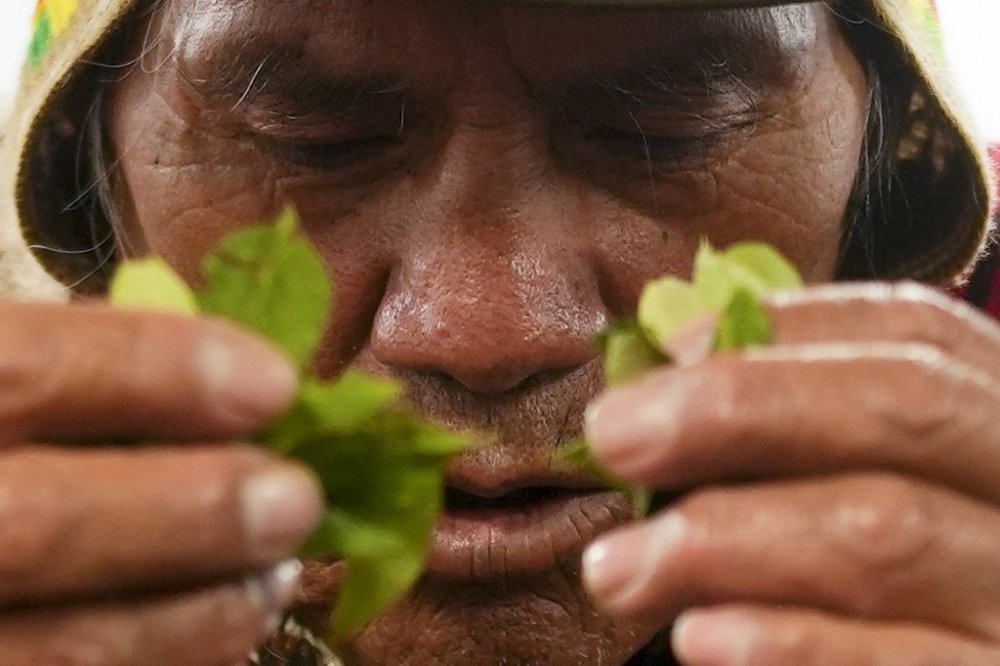
Outside Bolivia, the green leaf is best known as the main ingredient in cocaine. But within the South American country it is widely considered sacred, present in both rituals and everyday life.
“The coca leaf allows us to send our children to school and put food on the table,” said Zavala, who relies on harvesting coca leaves for income. “It’s useful for everything.”
The practice that fuels Bolivia’s workforce
Bolivia recognizes the coca leaf as part of its cultural heritage, allowing cultivation within designated areas. According to the country’s Coca Producers Association, its production employs more than 45,000 people nationwide.
Most Bolivians use coca leaves for “boleo,” a practice recognized as an intangible cultural heritage since 2016. The word has no English translation. It means placing a compact wad of leaves inside the cheek.
Many refer to it as chewing, but the leaves are rarely treated like gum. Instead, people let them slowly release their active compounds. The alkaloids act as stimulants, though producers and government officials insist their effects remain mild — far from those of processed cocaine.
“It slows down our fatigue and takes away our hunger,” said Rudi Paxi, secretary of the producers association. “You’ll always watch the people from Yungas doing boleo as they head to work.”
Neri Argane, 60, works at a coca plantation in Yungas for 11 hours a day, six days per week. “We do this no matter the sun, the rain or the cold,” Argane said.
She eats bananas, rice and corn tortillas to keep up her strength. But only boleo enables her to endure long hours crouching in the fields, she says.
Families pass down coca fields like heirlooms
Bolivia’s government has made several attempts to highlight how the coca leaf is intertwined with its people’s cultural traditions.
Even as coca’s global reputation remains linked to drug trafficking, President Luis Arce sought to highlight its cultural roots. Earlier this year, he performed a public boleo to mark National Coca Chewing Day.
“Our government values the coca because it is a cultural symbol,” he said. “It represents our identity and sovereignty. It has medicinal and ritual values, and is a source of social cohesion.”
In the Yungas region, where Zavala lives about 60 miles (100 kilometers) from the capital city of La Paz, the heritage of dozens of families is tied to these hardy leaves.
“I watched my parents working the land since I was 8,” he said. “Luckily, they entrusted it to me. So I could survive.”
Mónica López also inherited her parents’ coca fields in a neighboring town. “I have been a farmer for as long as I can remember,” she said.
Raising healthy coca leaves is demanding. All work is done by hand, without machinery or animals to help. Farmers prepare the soil by October, sow the land by December and harvest the crops around February.
Most fields are handled by family members. On any given day in Yungas, it’s common to spot children next to their mothers and grandparents while they clean the leaves.
“I’ve been in the coca fields since I was 2 and I can tell you this work is hard,” said 22-year-old Alejandra Escobar. “But the coca leaf brings us plenty of benefits. When we have no money, it’s what we consume.”
Bolivians from rural areas regularly drink coca leaf tea to heal headaches and stomach inflammation. Elsewhere in the country, people use it for pancakes, ice cream and beer.
“The coca is everywhere,” Paxi said. “It unites us as families. It’s our company.”
Coca leaf nourishes both body and spirit
The coca leaf also plays a key role in Bolivians’ spirituality. “It’s used to start most of our rituals,” said anthropologist Milton Eyzaguirre. “Before you start a new job, for example, you set up a ‘mesa’ (or table) and coca leaves around.”
In the worldview of the Aymara, the region’s Indigenous people, ‘mesas’ are offerings for Pachamama (Mother Earth). Built from wooden logs, they are arranged by spiritual leaders who pray for wealth, protection and good health.
“The coca leaf helps us see,” said Neyza Hurtado, who was hired by a family to perform a ritual ahead of the recent Pachamama month. “By deciphering a coca leaf, you can know how a person is.”
Personal rituals with coca leaves are common. According to Eyzaguirre, bricklayers regularly make a boleo before each workday. And like Zavala, they ask for Mother Earth’s permission to kick off the day.
“People even use it to travel,” Eyzaguirre said. “When you go somewhere by foot, you make coca offerings and consume it, to gather strength.”
Rituals for Pachamama live on in the Yungas
López’s coca leaf rituals start on the first minute of Aug. 1. “We thank Mother Earth, because if she gets tired, nothing sprouts,” she said.
At the mesa inside her home, her spiritual leader places sweets, rice and cinnamon. Before lighting it on fire to complete the offering, López adds 12 coca leaves. “We ask for wishes with the coca,” she said. “We ask for good luck for 12 months, from August to August.”
Just like the Yungas field, her faith in Pachamama was inherited from her parents. Now she performs her rituals alongside her five children, hoping they will keep the tradition alive.

Zavala’s rituals occur both inside his house and in his field. He, too, encourages his grandchildren to participate. “We need Pachamama in the terrain, to have a good production,” he said.
Aside from asking Mother Earth’s permission to work, Zavala performs an Andean tradition known as “chaya.” The word refers to the custom of spraying alcohol onto the ground as an offering, either for requests or as an act of gratitude that symbolizes giving back to Pachamama.
“It’s what our elders passed down to us”, he said. “So we must preserve it.”
___
Associated Press religion coverage receives support through the AP’s collaboration with The Conversation US, with funding from Lilly Endowment Inc. The AP is solely responsible for this content.
The Free Press acknowledges the financial support it receives from members of the city’s faith community, which makes our coverage of religion possible.