Study estimates 2023 Canadian wildfire smoke caused 82,000 premature deaths globally
Advertisement
Read this article for free:
or
Already have an account? Log in here »
To continue reading, please subscribe:

Digital Subscription
One year of digital access for only $205*
- Enjoy unlimited reading on winnipegfreepress.com
- Read the E-Edition, our digital replica newspaper
- Access News Break, our award-winning app
- Play interactive puzzles
*First annual payment billed as $205.00 + GST for one year. This annual subscription will automatically renew at $233.00 + GST every 52 weeks (10% off the regular annual price of $259.35). Offer available to new and qualified returning subscribers only. Cancel any time.
To continue reading, please subscribe:
Add Free Press access to your Brandon Sun subscription for only an additional
$1 for the first 4 weeks*
- Enjoy unlimited reading on winnipegfreepress.com
- Read the E-Edition, our digital replica newspaper
- Access News Break, our award-winning app
- Play interactive puzzles
*Your next Brandon Sun subscription payment will increase by $1.00 and you will be charged $17.95 plus GST for four weeks. After four weeks, your payment will increase to $24.95 plus GST every four weeks.
Read unlimited articles for free today:
or
Already have an account? Log in here »
Hey there, time traveller!
This article was published 10/09/2025 (393 days ago), so information in it may no longer be current.
VANCOUVER – Smoke from record-breaking Canadian wildfires in 2023 caused an estimated 5,400 acute deaths and about 82,100 premature deaths worldwide, a new study shows.
The study published in the peer-reviewed journal Nature acknowledges some variation in mortality estimates depending on the methods used, but says its overall conclusion is the smoke led to an “enormous and far-reaching” health burden.
Canadian co-author Michael Brauer says the findings serve as a “wake-up call” for areas that haven’t typically seen repeated or prolonged exposure to wildfire smoke.
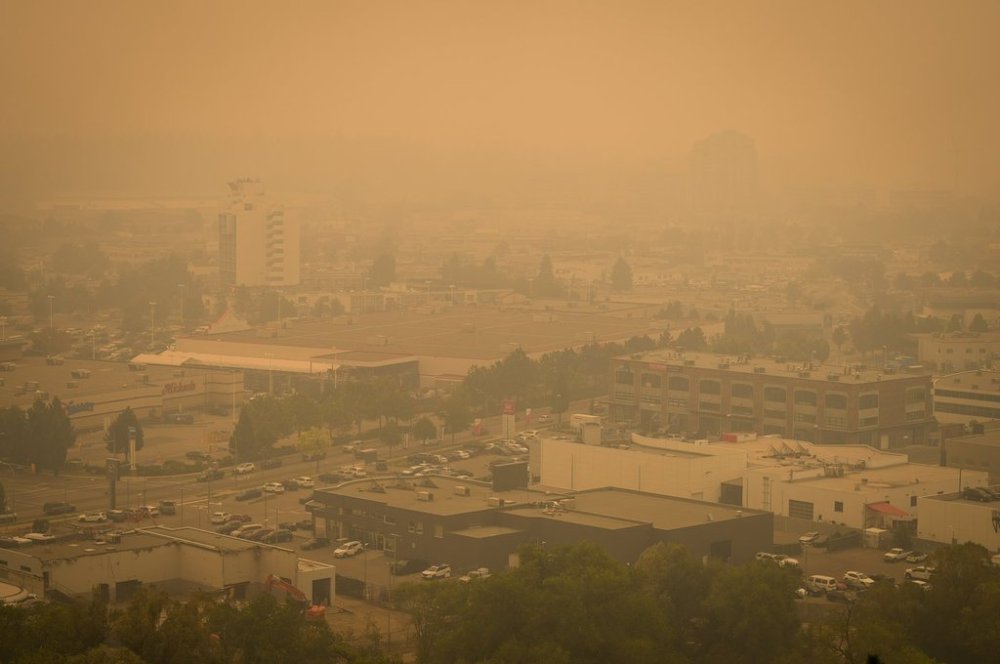
The health impacts will only increase with worsening climate change, he says, and understanding them is crucial for managing the risk and protecting people.
“While there is room for improved forest management and fire suppression … we’re still going to get a lot of smoke,” says Brauer, a professor in the School of Population and Public Health at the University of British Columbia.
“So we need to learn how to live with it and I do believe we can live with it.”
The international research team used several computer models and data sources to produce estimates of the number of deaths attributable to the particulate pollution, known as PM2.5, from Canada’s worst-ever wildfire season.
Of the estimated 82,100 premature deaths due to continuous exposure to the smoke over several months, the paper says 64,300 occurred in North America and Europe, including 33,000 deaths in the United States and 8,300 in Canada.
It says the overall figure represents 0.9 per cent of total deaths related to PM2.5 globally in 2023.
Brauer says the premature deaths represent the chronic impacts of wildfire smoke, which interacts with pre-existing risk factors and conditions, such as heart or lung disease, to potentially contribute to shortening a person’s life.
“This is sort of the slow accumulation of pollution exposure,” says Brauer, whose co-authors were based in China and the United States.
The period between June 26 and July 7, 2023, was especially smoky, causing an estimated 5,400 acute deaths in the United States and Canada, the paper says.
The study shows the chronic impacts were far greater than the acute effects, Brauer says, referring to increased ambulance dispatches, emergency room visits and hospitalizations that occur during or shortly after a smoke event.
That’s a significant finding, he says, because severe wildfire seasons are becoming more frequent with climate change.
“We’re seeing, with a warmer climate, that we’re getting kind of record or close-to-record fire seasons repeatedly every summer,” he says.
“That’s going to contribute to increased numbers of people dying prematurely.”
While smoke from wildfires in Canada’s vast forests has caused health impacts across continents, Brauer says the greenhouse gas emissions driving climate change and its impacts, including severe wildfires, are a global problem.
Canada’s 2023 fire season shattered records, with more than 6,000 fires scorching 150,000 square kilometres, according to Natural Resources Canada, while this year is the second-worst season on record, burning more than 83,000 square kilometres.
The study says the wildfires in Canada accounted for 13 per cent of global fire-related exposure to fine particulate matter in 2023, but the Canadian blazes had an outsized impact as smoke spread across North America and western Europe.
The smoke that ended up in parts of Europe wasn’t highly concentrated, but it affected areas with high population density, Brauer says.
The researchers identified “Canada smoke days” during which daily mean concentrations of PM2.5 exceeded the World Health Organization guideline and the Canadian fires accounted for at least half the average concentration over 24 hours.
Using those criteria, the study found 354 million people in North America and Europe were exposed to at least one “Canada smoke day” in 2023.
In Canada, the paper says 98 per cent of the population experienced such a day, with an average of 27.1 smoke days per person.
In the United States, the figure was 267 million people. In Europe, it was 47.7 million people, a number larger than Canada’s population, the paper notes.
In Canada, it says hotspots for smoke included the James Bay region of Quebec and large areas of Alberta, Saskatchewan and the Northwest Territories.
South of the border, the paper says smoke extended over large areas of the Rocky Mountains, Midwest, Ohio Valley and northeastern United States.
In Europe, it says the smoke was especially felt in Spain, Italy and France.
Brauer says the mounting health impacts require officials to consider public health measures and messaging to protect people during smoke events.
“So what do we do about this forecast? Do we think about, there’s summer camps or a concert or a sporting event, do we make changes? Do we provide everyone with pre-existing heart and lung disease an air filter?” Brauer says.
“There’s a lot of room to sort of improve the response,” he adds.
The paper published Wednesday points to previous research examining health impacts of wildfire-related pollution in other “hotspot” regions worldwide.
It says a recent study estimated that 384,600, 144,300 and 79,300 people died annually in sub-Saharan Africa, Southeast Asia, and Latin American and the Caribbean, respectively, due to chronic wildfire smoke between 2000 and 2019.
The paper concludes that “further well-designed epidemiological studies on this topic are urgently needed” to hone researchers’ understanding of the health impacts of wildfire smoke in contrast to other kinds of air pollution.
This report by The Canadian Press was first published Sept. 10, 2025.