Local engineer was a real game changer
With his inventive mind, George Klassen helped millions

Advertisement
Read this article for free:
or
Already have an account? Log in here »
To continue reading, please subscribe:
Digital Subscription
One year of digital access for only $1.44 a week*
- Enjoy unlimited reading on winnipegfreepress.com
- Read the E-Edition, our digital replica newspaper
- Access News Break, our award-winning app
- Play interactive puzzles
*Billed as $5.77 plus GST every four weeks. After 52 weeks, price increases to the regular rate of $19.95 plus GST every four weeks. Offer available to new and qualified returning subscribers only. Cancel any time.
To continue reading, please subscribe:
Add Free Press access to your Brandon Sun subscription for only an additional
$1 for the first 4 weeks*
- Enjoy unlimited reading on winnipegfreepress.com
- Read the E-Edition, our digital replica newspaper
- Access News Break, our award-winning app
- Play interactive puzzles
*Your next Brandon Sun subscription payment will increase by $1.00 and you will be charged $17.95 plus GST for four weeks. After four weeks, your payment will increase to $24.95 plus GST every four weeks.
Read unlimited articles for free today:
or
Already have an account? Log in here »
Hey there, time traveller!
This article was published 13/09/2025 (404 days ago), so information in it may no longer be current.
Forty-seven years ago, George Klassen had an idea that improved the lives of millions of people in Bangladesh. It was for a hand-powered rower pump, a classic piece of simple, inexpensive and appropriate technology that poor farmers could use to irrigate their crops.
Today, an estimated 500,000 rower pumps are still in operation, benefitting more than 2.5 million people in that southeast Asian country — a legacy to Klassen’s vision, curiosity and ingenuity.
Klassen, who died on April 15 in Steinbach, spent his early years in Blumenort (near Gretna) before moving with his parents and 10 siblings to a farm near Steinbach. After graduating from the University of Manitoba with a B.Sc., he taught science and math in Nigeria with Mennonite Central Committee (MCC) for three years.
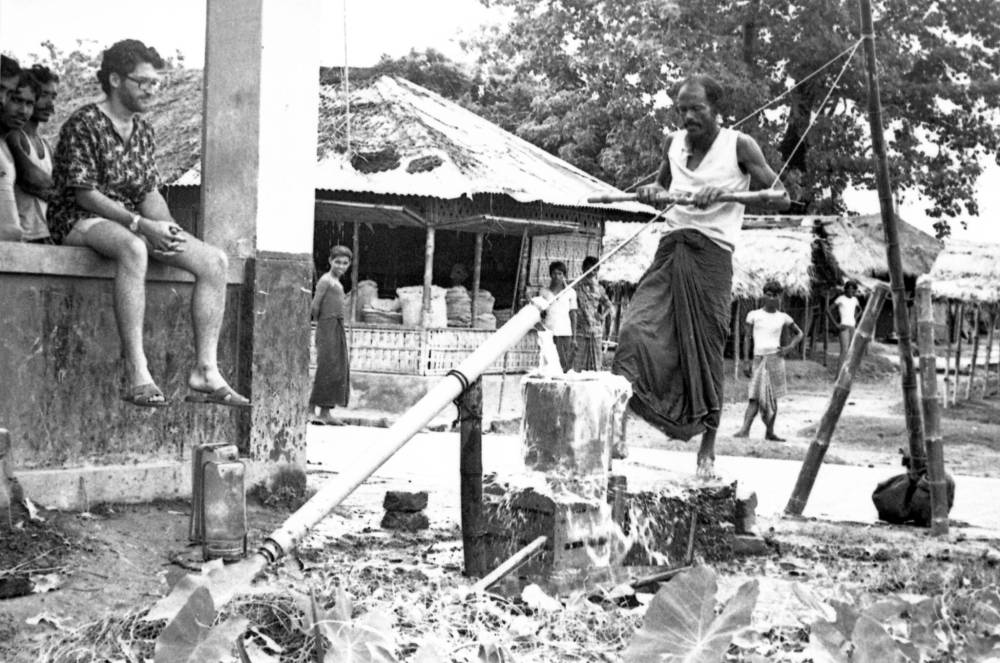
George Klassen’s rower pump invention, developed in Bangladesh, was designed to create jobs in the community. It was a highlight of his career.
There, he became convinced the best way he could serve people in the global south was by assisting them with practical skills and knowledge. With that in mind, when Klassen returned to Canada he decided to go back to the University of Manitoba to study engineering.
In 1975, he married Charlotte (Sheri). They lived in Alberta until 1977, when they went to Bangladesh with MCC, where Klassen was challenged to help farmers find an easy way to irrigate their crops.
Klassen began by asking farmers what they needed. They told him they wanted something inexpensive, easy to install, simple to use and easy to maintain. To that list, Klassen added conditions of his own: it had to be manufactured locally, easy for children and women to use and it had to use local materials — no foreign parts.
After months of talking to farmers, researching and thinking, he came up with a new and revolutionary idea: the rower pump.
“It was a brand-new design,” he said in an interview in 2018 on the occasion of the 40th anniversary of its creation. “There was nothing else like it in the world.”
Unlike traditional pumps, where people push down on a handle to draw up water from the ground, rower pump operators use a rowing motion to pull water through a pipe.
In 1978, Klassen took his design to a local school that trained students for jobs in manufacturing. The school produced two prototypes, which were taken to local villages for trials in a marketplace and a schoolyard. Local people were hired to operate them for eight hours a day for 30 days. After one month, they were taken apart to see how they held up. “There was no discernible wear. The results were very positive,” he said.
After making additional improvements, 140 pumps were made and quickly sold. Right from the start, Klassen wanted his idea to create jobs for local people — not be given away.

George Klassen (second from left) operates a rower pump in Bangladesh.
Within two years, more than 40,000 pumps had been sold and the invention is still in use.
“It changed the lives of millions of people,” Klassen said of the pump, noting he shared credit for it with others. “I borrowed ideas from here and there to come up with my own design.”
After returning to Canada, Klassen worked in Winnipeg for Manitoba Agriculture. Over the next four years, the couple’s two daughters, Rachel and Kristen, were born. The family returned to Bangladesh in 1984 for two more years to help market the rower pump.
Then Klassen returned to his job with Manitoba Agriculture. In 1991, the family moved to an acreage just outside of Carman, where he served as secretary-treasurer for a local Canadian Foodgrains Bank growing project for more than 10 years and helped sponsor and support refugees. He also started a small business making art from upcycled glass.
In 2018, Klassen and Sheri moved to Steinbach, where they joined the Steinbach Mennonite Church and he became involved in the Mennonite Heritage Village and sang in church groups.
Klassen became interested in other things, too, including climate change, especially as it related to home construction of homes, reconciliation with Indigenous people and relations between Palestinians and Israelis.
Another project was researching the life of his father, who died when he was a year-and-a-half-old, writing a book about him. The book gave his family and other descendants an accounting of his father and provided insights into Mennonite life in a small rural village in the early 20th century.
Klassen also spent time searching for and finding the grave of a sibling who had been stillborn. The location of the grave in the Blumenort cemetery had long been a mystery to the family; he managed to find it and commissioned a headstone.

George Klassen volunteered at the Mennonite Heritage Museum in Steinbach after he retired.

“It is not an overstatement to say that George left deep, indelible footprints and a rich legacy for his children and grandchildren,” said his brother-in-law, Dave Loewen.
Adds his, wife, Sheri: “As I read cards and notes and think about George’s life, it seems the main theme is that he enjoyed helping others, whether in working on providing water for crops with the rower pump and through agricultural work in Canada, or fixing things, or planting trees in the neighbourhood, or helping with things like shingling the roof on a friend’s home.
“He appreciated his roots and his upbringing and had a strong work ethic. He loved to figure out how things worked, how to create and adapt,” she said adding, “He had a strong faith, living out his faith in his works and expressing it through singing.”
In 1981, Klassen’s rower pump was recognized with the Guinness Award for Scientific Achievement in the Service of the Community. In 2002, the Canada Museum of Science and Technology in Ottawa featured a rower pump that could be operated by visitors in its Canadian inventor’s gallery.
fpcity@freepress.mb.ca
Our newsroom depends on a growing audience of readers to power our journalism. If you are not a paid reader, please consider becoming a subscriber.
Our newsroom depends on its audience of readers to power our journalism. Thank you for your support.
A LIFE’S STORY
A tribute to those who left a mark on our province
Our newsroom depends on a growing audience of readers to power our journalism. If you are not a paid reader, please consider becoming a subscriber.
Our newsroom depends on its audience of readers to power our journalism. Thank you for your support.
Advertisement Advertise With Us
Advertisement Advertise With Us