B.C. First Nation investigates sturgeon deaths, with plan to track drifting carcasses
Advertisement
Read this article for free:
or
Already have an account? Log in here »
To continue reading, please subscribe:

Digital Subscription
One year of digital access for only $205*
- Enjoy unlimited reading on winnipegfreepress.com
- Read the E-Edition, our digital replica newspaper
- Access News Break, our award-winning app
- Play interactive puzzles
*First annual payment billed as $205.00 + GST for one year. This annual subscription will automatically renew at $233.00 + GST every 52 weeks (10% off the regular annual price of $259.35). Offer available to new and qualified returning subscribers only. Cancel any time.
To continue reading, please subscribe:
Add Free Press access to your Brandon Sun subscription for only an additional
$1 for the first 4 weeks*
- Enjoy unlimited reading on winnipegfreepress.com
- Read the E-Edition, our digital replica newspaper
- Access News Break, our award-winning app
- Play interactive puzzles
*Your next Brandon Sun subscription payment will increase by $1.00 and you will be charged $17.95 plus GST for four weeks. After four weeks, your payment will increase to $24.95 plus GST every four weeks.
Read unlimited articles for free today:
or
Already have an account? Log in here »
Hey there, time traveller!
This article was published 21/09/2025 (382 days ago), so information in it may no longer be current.
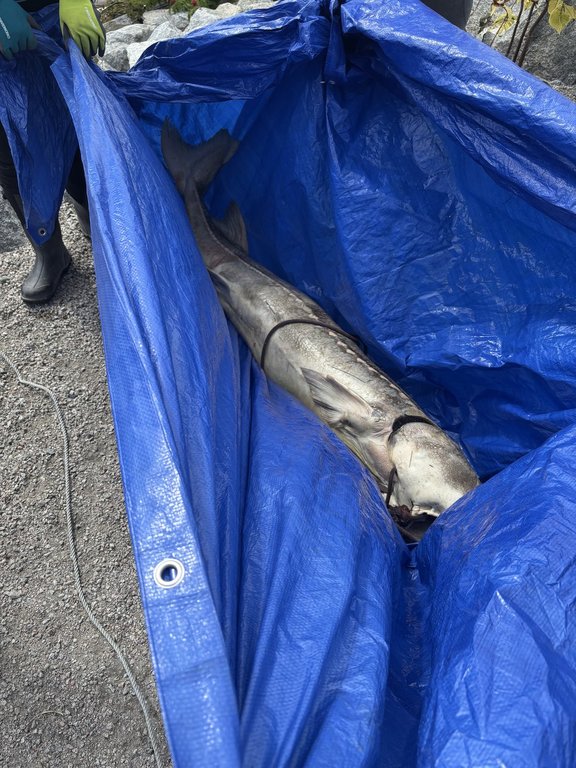
TSAWWASSEN – It took four people to haul the carcass of a sturgeon off the banks of the Fraser River in Richmond, B.C., earlier this month, one of dozens to wash up recently.
The body of the hefty fish about 1.6 metres long was then frozen as part of a research project spearheaded by the Tsawwassen First Nation to help understand why sturgeon are dying and guide conservation efforts.
It’s destined to eventually be floated back down the river, fitted with an electronic tracker, as part of the project.
Kelly Scott, a biologist working for the First Nation, says the fish are like dinosaurs, dating back as far as 200 million years ago, so mortality events are worrisome and raise questions about what is changing in their environment.
“We have gotten multiple reports this year from people who live right on the water in (New Westminster) saying they’ve seen four, five, six sturgeon at a time, like within one day, floating down the river,” she says. “So that’s very concerning.”
British Columbia’s Ministry of Land, Water and Resource Stewardship says there appears to be an increase in sturgeon mortality this year.
But the magnitude of the uptick is hard to evaluate, it says in a statement, because tracking and reporting the deaths has been improving over time.
The province has received reports of 71 sturgeon found dead across B.C. since July, with 65 of those fish in the lower Fraser River.
Of those reports in the lower Fraser, 49 have occurred in the last four weeks.
By comparison, the ministry says there were 42 reported mortalities in the lower Fraser in all of 2024, with 14 reports from that area in 2023 and 35 reports in 2022.
White sturgeon are among the largest and longest-living fish in the world, growing up to six metres in length with a lifespan exceeding 100 years.
The species is significant for First Nations, including Tsawwassen, who harvested sturgeon for food as well as cultural purposes, Scott says.
B.C. prohibited the harvest of sturgeon in 1994 and First Nations across the province voluntarily stopped harvesting them at the same time.
But there is still catch-and-release angling in the lower Fraser River, and the discoveries of dozens of dead sturgeon coincide with a rare recreational opening for sockeye salmon along parts of the Fraser in recent weeks.
However, Scott says numerous factors are at play in sturgeon mortality.
Climate change is among them, she says, as the river heats up, stressing the fish.
“There’s not a lot of areas with large, shady trees that can provide thermal refuge for the fish, and so they don’t necessarily have the same respite they used to have.”
If a sturgeon is already stressed when it is caught in a gill net targeting another species, it could increase the risk of mortality, Scott adds.
The researchers are hoping to identify where sturgeon may be in cooler waters and undertake habitat restoration in those areas, she says.
Propeller strikes by large vessels are also a threat.
One of the sturgeon recently found dead in Richmond had a large gash on its back that could only have been caused by a propeller, Scott says.
The research team from Tsawwassen has been responding to reports of dead sturgeon, making note of any injuries. Their goal is to collect 20 carcasses, though Scott says many have been too decomposed to collect and freeze.
They plan to drift carcasses fitted with telemetry trackers downstream, allowing the researchers to track their movement, she says.
“We want to do it under different conditions, so we would do some upriver, some further down the river, when it’s raining, in the summer, in the winter.”
The project aims to understand where and why sturgeon are dying and assess whether the number of reported deaths reflects the true mortality rate.
Scott says the team is also in touch with a researcher at the University of B.C. in hopes of using environmental genomics, which involves the study of DNA and RNA taken from samples of the underwater environment, to learn about where sturgeon are spending their time in the Fraser River and whether they are under stress.
The statement from the province says it suspects multiple factors collide to cause sturgeon mortality, including disease and warmer waters over the summer.
The Resource Stewardship Ministry says it has not seen any direct evidence that the recent salmon fishery was behind sturgeon deaths.
“It is important to note that natural factors could be contributing to these mortalities, but that doesn’t overshadow the need to investigate other contributors.”
A separate statement from Fisheries and Oceans Canada says water temperatures in the Fraser River exceeded 20 C in the later part of this summer, with the risk of stress and mortality for sturgeon increasing at temperatures over 18 C.
The flurry of fishing activity this year could be related to sturgeon deaths, it says, but it may also account for the higher number of sightings and reports.
Sturgeon are protected under federal species-at-risk legislation across much of the province. The upper Fraser River, upper Columbia River, upper Kootenay River and Nechako River populations have been listed as endangered since 2006.
The Committee on the Status of Endangered Wildlife in Canada has assessed the lower Fraser population as threatened, but it has not been listed for protection.
A specific conservation licence is required for catch-and-release fishing for sturgeon in the lower Fraser.

A provincial guideline document for angling sturgeon says extra care should be taken to minimize impacts on the fish.
Sturgeon should never be lifted out of the water, it says, as they are at risk of internal injuries due to their weight, and they should be released quickly.
“Sturgeon played too long may not recover,” the guidelines say.
In 2021, B.C. began a process to develop a plan for managing white sturgeon in the entire Fraser River basin. It involves a steering committee co-led by provincial and First Nations representatives, with input from the Fisheries Department.
This report by The Canadian Press was first published Sept. 21, 2025.