Lice concerns rise as children return to school. Here’s what parents can do
Advertisement
Read this article for free:
or
Already have an account? Log in here »
To continue reading, please subscribe:

Digital Subscription
One year of digital access for only $205*
- Enjoy unlimited reading on winnipegfreepress.com
- Read the E-Edition, our digital replica newspaper
- Access News Break, our award-winning app
- Play interactive puzzles
*First annual payment billed as $205.00 + GST for one year. This annual subscription will automatically renew at $233.00 + GST every 52 weeks (10% off the regular annual price of $259.35). Offer available to new and qualified returning subscribers only. Cancel any time.
To continue reading, please subscribe:
Add Free Press access to your Brandon Sun subscription for only an additional
$1 for the first 4 weeks*
- Enjoy unlimited reading on winnipegfreepress.com
- Read the E-Edition, our digital replica newspaper
- Access News Break, our award-winning app
- Play interactive puzzles
*Your next Brandon Sun subscription payment will increase by $1.00 and you will be charged $17.95 plus GST for four weeks. After four weeks, your payment will increase to $24.95 plus GST every four weeks.
Read unlimited articles for free today:
or
Already have an account? Log in here »
Hey there, time traveller!
This article was published 24/09/2025 (379 days ago), so information in it may no longer be current.
Children have returned to school and are bringing home stories about the things they learned and the friends they made. But some parents are concerned they could also be bringing home a tiny nuisance — lice.
Though schools are not the only place transmission occurs, the Centers for Disease Control and Prevention says head lice infestations in the U.S. are most common among preschool and elementary-age children.
Since the middle of August when students began returning to school, more people have searched Google for information about the blood-sucking parasites and are seeking answers to common questions about how to prevent and treat infestations, according to Google Trends. The CDC estimates there are up to 12 million head lice infestations annually in the U.S. infecting children between 3 to 11 years old.
Experts say there is a lot of misinformation about lice. Here are the experts’ answers to commonly asked questions:
How do you know if your child has lice?
Head lice are parasitic insects that feed on human blood, but they are difficult to find because they are very small, move quickly and avoid light. The hallmark symptom that indicates there might be an infestation is new and onset itching of the scalp, said Dr. Danilo C. Del Campo, a dermatologist in Chicago and a fellow of the American Academy of Dermatology.
The eggs, commonly called nits, can be yellow, brown or tan and look like tiny seeds, but when hatched will appear clear, experts say. An infestation can often be confused with dandruff or seborrheic dermatitis.
Becky Boudreau, a head lice technician in New Hampshire, says because lice are most active at night, parents may notice their children scratching more then or not sleeping well. She said it may take longer to recognize a lice infestation in children who have a high pain tolerance or are less reactive to insect bites.
There is no set number of lice that would classify as an infestation, either you have lice, or you don’t, experts say.
What are my treatment options?
Treatments to get rid of the insects include medication and specialists who use different methods to manually remove the eggs and adult lice. Depending on the age and temperament of the child, access to clinics or technicians, the cost and the severity of the infestation, including any sensitivities, will determine the most appropriate treatment option.
Many people hire nit pickers or visit clinics because they don’t want to handle the insects, Boudreau said.
“It is still successful, but it is time consuming,” said Boudreau, who became a head lice technician about six years ago after her child had an infestation.
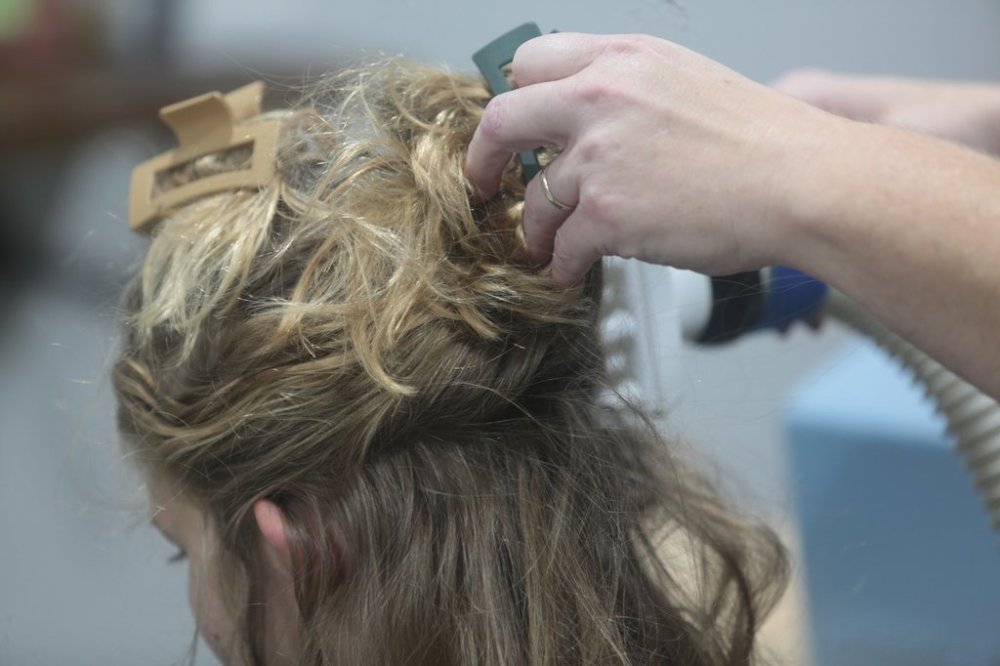
Dr. Krista Lauer, national medical director for Lice Clinics of America, says their clinics have become another option. They use an FDA-cleared medical device that uses a combination of airflow temperature, speed and direction to kill lice and their eggs. Technicians consider children’s heat sensitivity or restlessness, but for the treatment to be successful, they must use the device in a specific pattern before combing out the dead debris and using a washable topical substance, she said.
Boudreau, who uses shampoo, olive oil and a special comb to assist in combing out the insects, says many of the over-the-counter kits “are designed to fail” and often require multiple uses for this reason. Guidelines from the American Academy of Dermatology Association recommend retreating for any product that can be bought without a prescription, and that no approved method can kill lice and their eggs during the first treatment.
As long as people are using products, like shampoos, as indicated on their labels they should be OK, said Del Campo, who is board certified by the American Board of Dermatology. He emphasized that many of these products have been tested and approved by the Food and Drug Administration. Some of those products include benzyl alcohol lotion which only kills lice and not the eggs, ivermectin lotion, malathion lotion, and lindane shampoo which can be toxic if used incorrectly.
But he said many dermatologists don’t jump to using the lice combs or other procedure-based treatments because it often takes a lot of time and energy for parents, requires multiple applications and is not consistent across hair types. Instead, he said there are “effective over-the-counter medications that require no prescription, require no doctor guidance and are a wonderful first step for parents.”
There is no scientific evidence that home remedies like smothering hair with oil, mayonnaise or something occlusive can kill lice or their eggs, experts say.
What can you do to manage an infestation?
Adult lice can live for about 30 days on their hosts’ heads. However, experts say they will die within two days if they fall off a person and cannot feed. Their eggs can take up to nine days to hatch and from there another seven days to mature into adult lice.
Lice cannot hop, jump or fly and are mostly spread through head-to-head contact where the parasites can crawl from one host to another, experts say.
The CDC suggests machine wash and dry clothing, don’t use infected hair products, furniture or toys, and clean where infested people were. But their guidance also says it is less likely that lice could be spread through used products.
“Most of the jobs I get called to are in my families’ homes and I can’t get these bugs home quick enough from a job to take their pictures or study them because they die so quickly without the heat and blood from their hosts,” Boudreau said.
Can my child go to school with lice?

Students with head lice infestation do not need to be sent home early from school, the CDC says. Students can go home at the end of the day and return to class once beginning treatment. Experts say successful treatments will kill crawling lice but that nits might still be present.
Del Campo said parents need to be advocates for their children because there are many outdated school policies forcing them to miss more school than they need to, including requiring all eggs to be removed before returning to class, which he says is not necessary.
“Lice are not dangerous. They don’t spread disease. There’s no medical reason to remove a child immediately from a classroom,” he said. “By the time lice are noticed, they’ve often been present for weeks — not days or even hours.”
He says it is likely that adults have some level of trauma from dealing with lice when they were children and when there were fewer effective treatments, and misconceptions about the parasites often add to the stigma and accompanying embarrassment affected people might feel.
“What people went through and are carrying with them is understandably miserable, but it is very different today,” he said, adding that lice are not associated with hygiene, disease or economic status.