Canada’s first non-beating heart transplant could lead to shorter wait lists: UHN

Advertisement

Advertise with us

TORONTO - A Toronto hospital says it transplanted a heart that stopped beating last month in a Canadian first that has the potential to substantially shorten the long wait for a donor.

Read this article for free:


or

Already have an account? Log in here »

To continue reading, please subscribe:

Subscribe and receive a limited-edition Free Press branded hat or tote.

Digital Subscription

One year of digital access for only $205*

  • Enjoy unlimited reading on winnipegfreepress.com
  • Read the E-Edition, our digital replica newspaper
  • Access News Break, our award-winning app
  • Play interactive puzzles

*First annual payment billed as $205.00 + GST for one year. This annual subscription will automatically renew at $233.00 + GST every 52 weeks (10% off the regular annual price of $259.35). Offer available to new and qualified returning subscribers only. Cancel any time.

To continue reading, please subscribe:

Add Free Press access to your Brandon Sun subscription for only an additional

$1 for the first 4 weeks*

  • Enjoy unlimited reading on winnipegfreepress.com
  • Read the E-Edition, our digital replica newspaper
  • Access News Break, our award-winning app
  • Play interactive puzzles
Start now

*Your next Brandon Sun subscription payment will increase by $1.00 and you will be charged $17.95 plus GST for four weeks. After four weeks, your payment will increase to $24.95 plus GST every four weeks.

Hey there, time traveller!
This article was published 11/10/2025 (351 days ago), so information in it may no longer be current.

TORONTO – A Toronto hospital says it transplanted a heart that stopped beating last month in a Canadian first that has the potential to substantially shorten the long wait for a donor.

University Health Network says the procedure could grow the national donor pool by 30 per cent if the practice is expanded across the country.

That’s the case in some parts of Europe and Australia, where the practice was adopted a decade ago.
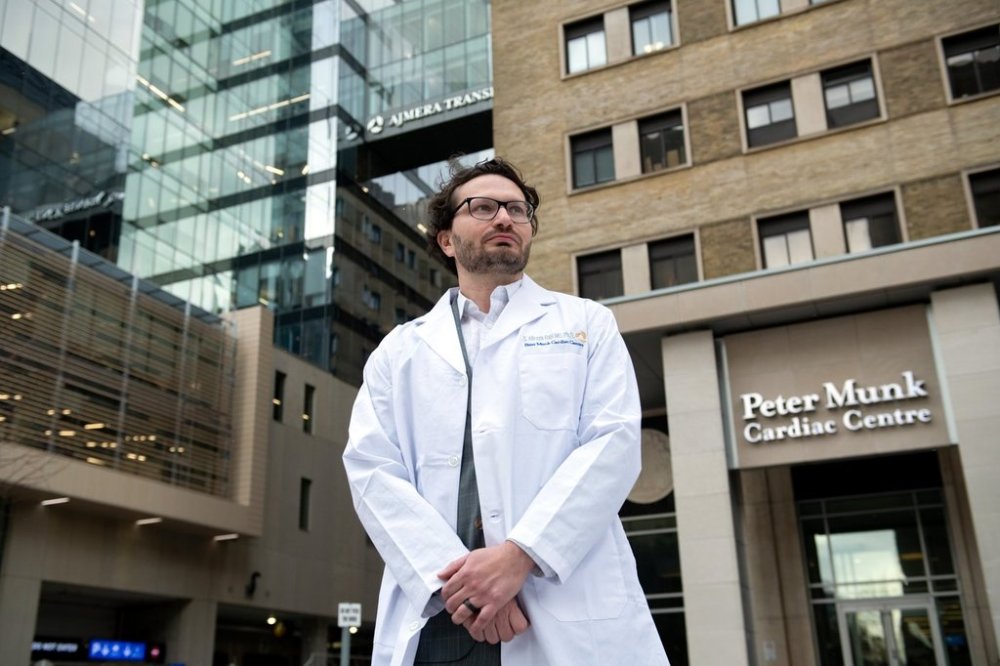
Dr. Seyed Alireza Rabi, shown in this undated handout photo, led a multidisciplinary team at University Health Network, in Toronto, that performed the first Canadian death by circulatory criteria (DCC) heart transplant in September 2025. THE CANADIAN PRESS/Handout - UHN Foundation (Mandatory Credit)

Dr. Seyed Alireza Rabi led the September surgery in Toronto after having been part of one of the first transplants with a non-beating heart in the United States in 2019.

He was recruited from Massachusetts General Hospital, where he performed heart transplants of this nature upward of 50 times, but Rabi said he still finds it a miracle every time a donor’s heart starts beating inside another person.

Here’s how it works:

Typically, heart transplants are performed when a donor is considered brain dead but their heart is still beating. The surgeon removes the donor heart, cools it and puts it in a special preservative solution. It can be out of the body for about four hours if it’s on ice, and even longer with temperature-controlling technology.

The process is similar with the transplant performed at UHN last month – called a donation after death by circulatory criteria (DCC) heart transplant – but the donor’s condition is different.

The patient has basic brain function, such as very limited reflexes, but there is no prospect of neurological recovery. If the family decides to take their loved one off of life support, they would be considered a candidate, only approached by a transplant team after that decision has been made so as not to influence it.

Once the donor dies, Rabi said his team has one hour to transfer the heart from donor to recipient. Beyond that hour, it would no longer be considered viable.

His surgical team quickly wheels the donor into the operating room, cuts open their chest and removes their heart. They flush it in a protective solution and control the organ’s temperature. During that window, the heart is still warm, even though it’s no longer receiving oxygen or nutrients from the body.

Rabi then shifts to the other side of the operating room and attaches the donor heart to a lung and heart machine that’s already connected to the recipient. Blood and oxygen flow into the heart and it starts beating, even before it’s sewn into the body.

But before that happens, Rabi said there is a brief period of nerve-racking uncertainty as he waits for the heart to wake up in a new body.

“Here is a heart that you’re taking out of a person. It stops beating, it’s cold, it’s at four to 10 degrees Celsius. You’re bringing it back, you’re putting it in, sewing it into a new person. It’s exposed to a whole new environment, a new blood flow. And now, you’re hoping that it will start beating again, and not just beating, but beating to a point where it can support another person,” Rabi said.

The hospital said the recipient in this case is recovering well.

Here’s why it’s needed:

UHN’s surgeon-in-chief Dr. Thomas Forbes said there are currently more than 175 people on the wait list for heart transplants in Canada.

“What this innovation provides is basically an increase in the number of hearts that are available for donation … unfortunately, there is a shortage of organs to save these patients with end-stage heart failure.”

Quebec researchers found the average wait time for a heart transplant in the province was 342 days in 2022, and as many as one in four adults on the waiting list in Canada either die or become ineligible because their health deteriorates.

Data from the Canadian Institute for Health Information shows 13 people died while waiting for a heart transplant in 2024.

Over the next year, Forbes said UHN is hoping to perform 10 to 15 additional heart transplants with this method.

“We want to monitor, obviously very closely, the outcomes and the benefit for the patients, the importance of appropriate patient selection, both on the donor and the recipient side. And I think year over year there will be slow growth.”

This report by The Canadian Press was first published Oct. 11, 2025.

Canadian Press health coverage receives support through a partnership with the Canadian Medical Association. CP is solely responsible for this content.


Report Error Submit a Tip

More Stories

How confusing; seems there’s more than one candidate in Hanover named Shayne Barkman

Dan Lett 5 minute read Preview

How confusing; seems there’s more than one candidate in Hanover named Shayne Barkman

Dan Lett 5 minute read Thursday, Sep. 24, 2026

It’s not entirely clear when or why Hanover trustee Shayne Barkman became one of Manitoba’s best-known anti-LGBTTQ+ crusaders.

Back in 2022, when he ran as a candidate for Hanover school board for the first time, there was nary a hint that socially conservative culture wars were going to be a large part of his identity as an elected official.

In a Steinbach Online profile published before the 2022 municipal elections, Barkman highlighted his background as a successful farmer. He said he was entering politics to be a “listening ear” who could promote understanding.

“I would love to kind of just be a voice of reason amongst all the problems coming down the pipe,” Barkman said

Read
Thursday, Sep. 24, 2026

New series terrific addition to RWB repertoire

Holly Harris 5 minute read Preview

New series terrific addition to RWB repertoire

Holly Harris 5 minute read 2:01 AM CDT

‘See the music, hear the dance,” is a famous quote from quintessential ballet influencer George Balanchine, whose pithy bons mots have defined much of American classical dance since the legendary Russian-born choreographer first blazed a trail with the New York City Ballet.

Local balletomanes were given a golden opportunity to experience both up-close-and-personal Thursday when the Royal Winnipeg Ballet officially kicked off its 87th season with its newly minted Studio Series, which runs until Sunday.

The brainchild of the company’s artistic director, Christopher Stowell, the series features an abridged “concert version” of Balanchine’s seminal Who Cares?, set to a playlist of catchy George Gershwin tunes that make up the backbone of the Great American Songbook.

The Studio Series is the latest initiative taken by Stowell as he settles into his arguably still new position. Some of those endeavours will invariably stumble; others will hit their mark. This venture belongs in the latter category, bringing a 500-plus-year-old art form, often perceived as rarified, to audience members who may be hesitant, shy or just plain intimidated to visit the cavernous Centennial Concert Hall.

Read
2:01 AM CDT

Flammable gas culprit of 2024 Transcona home explosion: police

Malak Abas 2 minute read Preview

Flammable gas culprit of 2024 Transcona home explosion: police

Malak Abas 2 minute read Yesterday at 4:45 PM CDT

Flammable gas is believed to be the cause of a 2024 house explosion in Transcona that damaged neighbouring homes and displaced residents.

“As a result of the investigation and upon Crown review, the explosion is believed to be an isolated incident,” Winnipeg Police Service Const. Dani McKinnon said in an email Friday afternoon.

“There are no public safety concerns connected to this incident, and no criminal charges have been laid.”

The sudden blast happened in a bungalow on Camrose Bay on June 26, 2024. It levelled the home and caused significant damage to 22 other houses. At the time, it was described as “catastrophic” by the fire chief at the scene.

Read
Yesterday at 4:45 PM CDT

Two U.S. presidents, and America’s decline

Editorial 4 minute read Preview

Two U.S. presidents, and America’s decline

Editorial 4 minute read Yesterday at 2:00 AM CDT

“Let us have faith that right makes might, and in that faith, let us, to the end, dare to do our duty as we understand it.” — Abraham Lincoln in his Cooper Union address, given in New York City in 1860.

Read
Yesterday at 2:00 AM CDT

Portage Avenue stabbing victim staggered into nearby store for help

Morgan Modjeski and Malak Abas 4 minute read Preview

Portage Avenue stabbing victim staggered into nearby store for help

Morgan Modjeski and Malak Abas 4 minute read Updated: Yesterday at 5:09 PM CDT

A 46-year-old man stabbed on Portage Avenue Wednesday afternoon is in hospital after staggering, bloodied, into a nearby dollar store.

Police said the man was confronted by several people on the 300 block of Portage shortly before 6 p.m. and was stabbed with an unknown weapon. He was helped by people inside the store until police and paramedics arrived.

The man was rushed to hospital in unstable condition but was later upgraded to stable, the Winnipeg Police Service said.

WPS Const. Claude Chancy said Friday that police were still attempting to speak with the victim, and it was not yet clear if the attack was random. No arrests have been made.

Read
Updated: Yesterday at 5:09 PM CDT

Husband of rival sex club owner accused in attempted bathhouse bombing

Morgan Modjeski 4 minute read Preview

Husband of rival sex club owner accused in attempted bathhouse bombing

Morgan Modjeski 4 minute read Thursday, Sep. 24, 2026

A Winnipeg bathhouse owner says he was shocked to learn the man accused of planting a pipe bomb outside his business is married to the owner of a competing sex and lifestyle club.

Christopher Gregoire, who recently took ownership of AQ Sauna, said a live pipe bomb was found by a “heroic patron” outside the club, formerly known as Aquarius Bath House, in the early morning hours of Sept. 11.

On Thursday, the Winnipeg Police Service announced Erik Lymen Olson, 59, was facing multiple charges in the incident. Olson is the husband of Adonis Men’s Spa owner Doug Pomanski.

“This is wild,” Gregoire said after learning of the charges.

Read
Thursday, Sep. 24, 2026