What are parents to do as doctors clash with Trump administration over vaccines?
Advertisement
Read this article for free:
or
Already have an account? Log in here »
To continue reading, please subscribe:
Digital Subscription
One year of digital access for only $1.44 a week*
- Enjoy unlimited reading on winnipegfreepress.com
- Read the E-Edition, our digital replica newspaper
- Access News Break, our award-winning app
- Play interactive puzzles
*Billed as $5.77 plus GST every four weeks. After 52 weeks, price increases to the regular rate of $19.95 plus GST every four weeks. Offer available to new and qualified returning subscribers only. Cancel any time.
To continue reading, please subscribe:
Add Free Press access to your Brandon Sun subscription for only an additional
$1 for the first 4 weeks*
- Enjoy unlimited reading on winnipegfreepress.com
- Read the E-Edition, our digital replica newspaper
- Access News Break, our award-winning app
- Play interactive puzzles
*Your next Brandon Sun subscription payment will increase by $1.00 and you will be charged $17.95 plus GST for four weeks. After four weeks, your payment will increase to $24.95 plus GST every four weeks.
Read unlimited articles for free today:
or
Already have an account? Log in here »
Hey there, time traveller!
This article was published 09/12/2025 (313 days ago), so information in it may no longer be current.
It’s normal for parents, or anyone, to have questions about vaccinations — but what happens if your pediatrician urges a shot that’s under attack by the Trump administration?
That’s getting more likely: The nation’s leading doctors groups are in an unprecedented standoff with federal health officials who have attacked long-used, lifesaving vaccines.
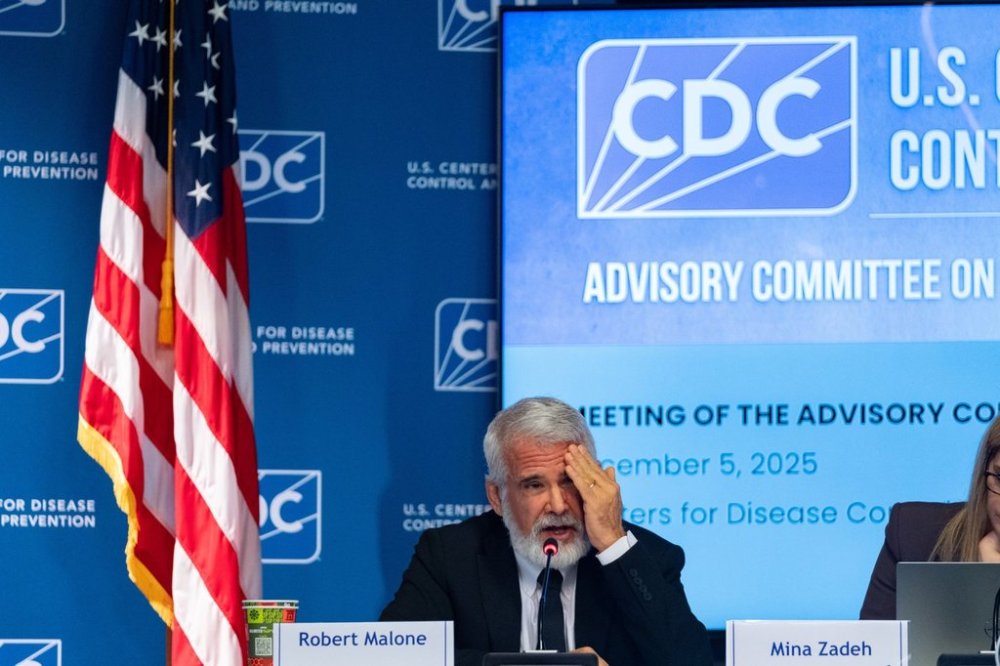
The revolt by pediatricians, obstetricians, family physicians, infectious disease experts and internists came to a head when an advisory panel handpicked by Health Secretary Robert F. Kennedy Jr. urged an end to routine newborn vaccination against hepatitis B, a virus that can cause liver failure or liver cancer.
That vaccine saves lives, helped child infections plummet and has been given safely to tens of millions of children in the U.S. alone, say the American Academy of Pediatrics and other doctors groups that vowed Tuesday to keep recommending it.
But that’s not the only difference. That Advisory Committee on Immunization Practices now is examining possible changes to the entire childhood vaccination schedule, questioning certain ingredients and how many doses youngsters receive.
Pushing back, the American Academy of Pediatrics has issued its own recommendations for youngsters. Other medical groups — plus some city and state public health departments that have banded together — also are issuing their own advice on certain vaccines, which largely mirrors pre-2025 federal guidance.
“We owe our patients a consistent message informed by evidence and lived experience, not messages biased by political imperative,” Dr. Ronald Nahass, president of the Infectious Diseases Society of America, told reporters Tuesday.
But Nahass acknowledged the inevitable consumer confusion, recounting a relative calling him last weekend for advice about hepatitis B vaccination for her new grandbaby.
“Most Americans don’t have a Cousin Ronnie to call. They are left alone with fear and mistrust,” he said, urging parents to talk with their doctors about vaccines.
New guidelines without new data concern doctors
Hepatitis B isn’t the only vaccine challenge. Kennedy’s health department recently changed a Centers for Disease Control and Prevention webpage to contradict the longtime scientific conclusion that vaccines don’t cause autism. Federal agencies also moved to restrict COVID-19 vaccinations this fall, and are planning policy changes that could restrict future flu and coronavirus shots.
But when it comes to vaccine advice, “for decades, ACIP was the gold standard,” said Dr. Jake Scott, an infectious disease physician and Stanford University researcher.
The panel once routinely enlisted specialists in specific diseases for long deliberations of the latest science and safety data, resulting in recommendations typically adopted not only by the CDC but by the medical field at large, he said.
Last week’s meeting of Kennedy’s panel, which includes vaccine skeptics, marked a radical departure. CDC specialists weren’t allowed to present data on hepatitis B, the childhood vaccine schedule or questions about vaccine ingredients. Few of the committee members have public health experience, and some expressed confusion about the panel’s proposals.
At one point, a doctor called in to say the panel was misrepresenting her study’s findings. And the panel’s chairman wondered why one dose of yellow fever vaccine protected him during a trip to Africa when U.S. children get three doses of hepatitis B vaccine. The hepatitis B vaccine is designed to protect children for life from a virus they can encounter anywhere, not just on a trip abroad. And other scientists noted it was carefully studied for years to prove the three-dose course offers decades of immunity — evidence that a single dose simply doesn’t have.
“If they’ve got new data, I’m all for it — let’s see it and have a conversation,” said Dr. Kelly Gebo, an infectious disease specialist and public health dean at George Washington University, who watched for that. “I did not see any new data,” so she’s not changing her vaccine advice.
Committee members argued that most babies’ risk of hepatitis B infection is very low and that earlier research on infant shot safety was inadequate.
Especially unusual was a presentation from a lawyer who voiced doubt about studies that proved benefits of multiple childhood vaccines and promoted discredited research pointing to harms.
“I don’t think at any point in the committee’s history, there was a 90-minute uninterrupted presentation by someone who wasn’t a physician, a scientist, or a public health expert on the topic — let alone someone who, who makes his living in vaccine litigation,” said Jason Schwartz, a vaccine policy expert at Yale University.
By abandoning data and the consensus of front-line doctors, the ACIP is “actively burning down the credibility that made its recommendations so powerful,” added Stanford’s Scott. “Most parents will still follow their pediatricians, and AAP is holding the line here. But the mixed messages are precisely what erode confidence over time.”
Parents already have a choice — they need solid guidance
Trump administration health officials say it’s important to restore choice to parents and to avoid mandates. That’s how the panel’s hepatitis B recommendation was framed — that parents who really want it could get their children vaccinated later.
Parents already have a choice, said Dr. Aaron Milstone of the American Academy of Pediatrics. The government makes population-wide recommendations while families and their doctors tailor choices to each person’s health needs.
But many doctors don’t — or can’t — do their own lengthy scientific review of vaccines and thus had relied on the ACIP and CDC information, Yale’s Schwartz noted.
They “rely on trusted expert voices to help navigate what is, even in the best of times, a complicated landscape regarding the evidence for vaccines and how best to use them,” he said.
That’s a role that the pediatricians and other doctors groups, plus those multistate collaborations, aim to fill with their own guidelines — while acknowledging it will be a huge task.
For now, “ask your questions, bring your concerns and let us talk about them,” said Dr. Sarah Nosal, of the American Academy of Family Physicians, urging anyone with vaccine questions to have an open conversation with their doctor.
___
The Associated Press Health and Science Department receives support from the Howard Hughes Medical Institute’s Science and Educational Media Group. The AP is solely responsible for all content.

Advertisement Advertise With Us
Advertisement Advertise With Us