Millions celebrate Orthodox Christmas on Jan. 7, following ancient traditions

Advertisement

Advertise with us

Millions of people around the world celebrated Orthodox Christmas on Wednesday, nearly two weeks after much of the world marked the holy day.

Read this article for free:


or

Already have an account? Log in here »

To continue reading, please subscribe:

Subscribe and receive a limited-edition Free Press branded hat or tote.

Digital Subscription

One year of digital access for only $205*

  • Enjoy unlimited reading on winnipegfreepress.com
  • Read the E-Edition, our digital replica newspaper
  • Access News Break, our award-winning app
  • Play interactive puzzles

*First annual payment billed as $205.00 + GST for one year. This annual subscription will automatically renew at $233.00 + GST every 52 weeks (10% off the regular annual price of $259.35). Offer available to new and qualified returning subscribers only. Cancel any time.

To continue reading, please subscribe:

Add Free Press access to your Brandon Sun subscription for only an additional

$1 for the first 4 weeks*

  • Enjoy unlimited reading on winnipegfreepress.com
  • Read the E-Edition, our digital replica newspaper
  • Access News Break, our award-winning app
  • Play interactive puzzles
Start now

*Your next Brandon Sun subscription payment will increase by $1.00 and you will be charged $17.95 plus GST for four weeks. After four weeks, your payment will increase to $24.95 plus GST every four weeks.

Hey there, time traveller!
This article was published 07/01/2026 (267 days ago), so information in it may no longer be current.

Millions of people around the world celebrated Orthodox Christmas on Wednesday, nearly two weeks after much of the world marked the holy day.

Certain Eastern Orthodox churches, including those in Russian and other traditions, follow the ancient Julian calendar. It runs 13 days later than the Gregorian calendar, used by Catholic and Protestant churches as well as by much of the secular world for everyday use.

The Ethiopian Orthodox Church and some other Oriental Orthodox churches — which are distinct from Eastern Orthodox but share many traditions — also celebrated Christmas on Wednesday.
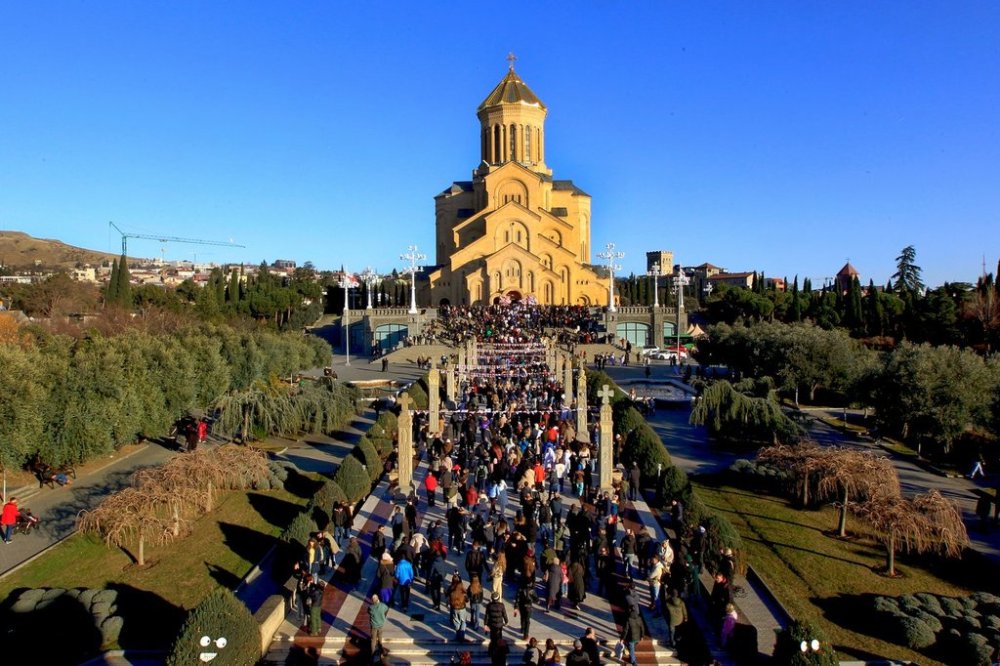
Georgians with national flags take part in a religious procession to the Holy Trinity Cathedral to mark Orthodox Christmas in Tbilisi, Georgia, Wednesday, Jan. 7, 2026. (AP Photo/Shakh Aivazov)

Other Eastern Orthodox, including those in the Greek tradition, celebrate Christmas on the same Dec. 25 date as Catholic and Protestant churches.

The disagreement over when Dec. 25 actually falls

Most Orthodox agree that Dec. 25 is the date of Christmas, or the Feast of the Nativity, as they call it. The question is whether Dec. 25 falls on Dec. 25 or Jan. 7.

That requires a little unpacking.

The ancient church in the Roman Empire set its religious feasts based on the Julian calendar, but after more than a millennium, that calendar had increasingly gotten out of alignment with the solar year.

Sixteenth century Pope Gregory XIII approved a revised, more astronomically precise calendar, which bears his name. It abruptly shifted the calendar several days forward to make up for lost time (literally) and added a more precise calculation of leap years. Protestant churches eventually followed the Catholic lead in adopting the calendar, as did secular governments.

All Eastern Orthodox kept to the old calendar until 1923, when an inter-Orthodox gathering adopted a revised Julian calendar that essentially mirrors the Gregorian. Most (but not all) churches in the Greek Orthodox tradition have adopted this, as have those in Romanian, Bulgarian and other traditions.

But the Russian Orthodox Church, the largest communion in Eastern Orthodoxy, has stayed on the old calendar, observing Christmas on Jan. 7 on the new calendar, as have Serbian, Georgian and some other Orthodox. Some Orthodox in Ukraine have begun to observe Christmas on Dec. 25, while others have retained the Jan. 7 observance.

One notable exception is the Armenian Orthodox tradition, which observes Christmas on Jan. 6.

Orthodox Christmas in North America

In the United States, observances vary. Churches in the Greek and Antiochian traditions observed Christmas on Dec. 25. Some churches in the Slavic tradition, including Serbian and smaller Russian churches, observe it on Jan. 7.

Eastern Orthodox observe Christmas with worship and ritual

Traditions vary, but typically the big worship service is the night before. In Serbian Orthodox churches, worship often begins with a short outdoor ceremony involving the burning of an oak branch or young oak tree, accompanied by a full-throated proclamation of the birth of Christ.

___

Associated Press religion coverage receives support through the AP’s collaboration with The Conversation US, with funding from Lilly Endowment Inc. The AP is solely responsible for this content.

Report Error Submit a Tip

The Free Press acknowledges the financial support it receives from members of the city’s faith community, which makes our coverage of religion possible.

More Stories

‘We’ll stand for the children’: crowds gather for Orange Shirt Day in Winnipeg

Matthew Frank 5 minute read Preview

‘We’ll stand for the children’: crowds gather for Orange Shirt Day in Winnipeg

Matthew Frank 5 minute read Updated: Yesterday at 6:08 PM CDT

A sea of people clad in orange shirts and waving flags marched through downtown Winnipeg to honour those who survived and died in residential schools.

Read
Updated: Yesterday at 6:08 PM CDT

Millions celebrate Orthodox Christmas on Jan. 7, following ancient traditions

Peter Smith, The Associated Press 3 minute read Preview

Millions celebrate Orthodox Christmas on Jan. 7, following ancient traditions

Peter Smith, The Associated Press 3 minute read Wednesday, Jan. 7, 2026

Millions of people around the world celebrated Orthodox Christmas on Wednesday, nearly two weeks after much of the world marked the holy day.

Certain Eastern Orthodox churches, including those in Russian and other traditions, follow the ancient Julian calendar. It runs 13 days later than the Gregorian calendar, used by Catholic and Protestant churches as well as by much of the secular world for everyday use.

The Ethiopian Orthodox Church and some other Oriental Orthodox churches — which are distinct from Eastern Orthodox but share many traditions — also celebrated Christmas on Wednesday.

Other Eastern Orthodox, including those in the Greek tradition, celebrate Christmas on the same Dec. 25 date as Catholic and Protestant churches.

Read
Wednesday, Jan. 7, 2026

Who has been invited to the table?

Stephen Borys 6 minute read Preview

Who has been invited to the table?

Stephen Borys 6 minute read 2:01 AM CDT

Last Friday, I spoke at Booth University College’s inaugural Honour and Hope Harvest Dinner in support of Shelter U. I had been asked to speak about the power of art in the community, a subject I have spent much of my professional life thinking about — as a museum director, writer and teacher, and now through my consulting work with Civic Muse.

What continues to interest me is not simply what museums, universities and other public institutions do, but whether their work actually matters — whether they make a difference in the lives of the people and communities around them.

Preparing for the evening brought me back to an even more fundamental question: Who has been invited in?

One of my museum mentors used to remind me that institutions often begin the conversation about public engagement too late. Before engagement comes the welcome, and before the welcome comes the invitation. We can create extraordinary buildings, exhibitions and programs and say that everyone is welcome. But unless people believe that these places are also meant for them, many will never cross the threshold.

Read
2:01 AM CDT

Obsessed stalker who shot, killed young woman at bus stop in 1993 dies behind bars at age 74

Erik Pindera 3 minute read Preview

Obsessed stalker who shot, killed young woman at bus stop in 1993 dies behind bars at age 74

Erik Pindera 3 minute read Tuesday, Sep. 29, 2026

A Winnipeg man who stalked a woman for several years before shooting her dead in the street in 1993 has died in Stony Mountain prison.

On Monday, 74-year-old Ronald Edd Bell died of apparent natural causes at the federal prison just north of Winnipeg, the Correctional Service of Canada said.

Bell had been in prison since May 30, 1994, when he was given a life sentence with no chance of parole for 18 years for killing Terry-Lyn Babb, 25, on Jan. 21, 1993.

Bell walked up behind an unsuspecting Babb, who was waiting at a bus stop at Sherbrook Street and Wolseley Avenue, and shot her in the head with a pistol in front of horrified witnesses, says the Free Press report of his sentencing hearing.

Read
Tuesday, Sep. 29, 2026

In a smart-device world, some families keep phone jacked into the wall

Sheldon Birnie 8 minute read Preview

In a smart-device world, some families keep phone jacked into the wall

Sheldon Birnie 8 minute read Tuesday, Sep. 29, 2026

When the phone rings in Kristin Shiach and Jordan Sobkowicz’s Riverview home, their three daughters race to see who can be the first to answer.

“It depends who is closest,” says 13-year-old Emily. “If I’m sitting in my room, I can get to it quickest.”

“That’s because it’s always in your room,” Anna, 10, replies. “You never put it back!”

“Usually, when the phone rings,” explains Sobkowicz, “someone yells really loudly —”

Read
Tuesday, Sep. 29, 2026

As political jockeying begins, don’t forget job No. 1

Editorial 4 minute read Preview

As political jockeying begins, don’t forget job No. 1

Editorial 4 minute read 2:01 AM CDT

The goal, for all parties in a democracy, is to make the best legislation and bring in the strongest policy forward for voters and citizens.

And every party has a role to play in that effort.

Governments set policy and bring forward legislation. Official oppositions challenge that process with the goal of identifying weaknesses or flaws in proposed laws, bringing forward the positions of groups affected by proposed legislative change, and generally are supposed to bring a critical lens to the process in an effort to improve the final result.

Third parties bring forward still further viewpoints and analysis, often from a different political bent, but valuable insight and viewpoints nonetheless.

Read
2:01 AM CDT