Is this man for real? The perils of trying to detect AI use while online dating
Advertisement
Read this article for free:
or
Already have an account? Log in here »
To continue reading, please subscribe:

Digital Subscription
One year of digital access for only $205*
- Enjoy unlimited reading on winnipegfreepress.com
- Read the E-Edition, our digital replica newspaper
- Access News Break, our award-winning app
- Play interactive puzzles
*First annual payment billed as $205.00 + GST for one year. This annual subscription will automatically renew at $233.00 + GST every 52 weeks (10% off the regular annual price of $259.35). Offer available to new and qualified returning subscribers only. Cancel any time.
To continue reading, please subscribe:
Add Free Press access to your Brandon Sun subscription for only an additional
$1 for the first 4 weeks*
- Enjoy unlimited reading on winnipegfreepress.com
- Read the E-Edition, our digital replica newspaper
- Access News Break, our award-winning app
- Play interactive puzzles
*Your next Brandon Sun subscription payment will increase by $1.00 and you will be charged $17.95 plus GST for four weeks. After four weeks, your payment will increase to $24.95 plus GST every four weeks.
Read unlimited articles for free today:
or
Already have an account? Log in here »
Hey there, time traveller!
This article was published 19/02/2026 (231 days ago), so information in it may no longer be current.
Sometimes when Nikita Kokal scrolls through a dating app, she’ll match with someone solely to ask if they used artificial intelligence to craft their profile.
She looks for hallmarks of ChatGPT — em dashes, lists of three items and emotionless writing, for example.
She sees it all the time, she says. People have got used to using AI to help them communicate since the technology is so readily available, and there’s a new crop of AI-powered applications designed specifically to fill out dating profiles and generate conversations.
“I don’t think we should be using AI to write and find our voice, especially in the early days of dating — actually at any stage, really, of dating. For me, I find that to be an absolute non-starter,” she says.
The 32-year-old from Burlington, Ont., says AI-generated conversation starters feel inauthentic and counterproductive.
“We should be using AI for breakthroughs in science and understanding dolphin patterns and accelerating mathematical models,” she says.
Instead, people are using it like a cheat code for interpersonal relationships. She says one man who matched with her asked a question that read “like a robot had sent it.”
She asked him whether he’d used AI to write it, and he told her no.
“And again, he gave me this emotionless response. And then I took the whole thing and I ran it through a ChatGPT checker, and it was like this message was definitely — with 80 per cent confidence — written with AI,” she says.
Christopher Dietzel, a researcher with the Digital Intimacy, Gender & Sexuality Lab at Concordia University, is in the early stages of studying the use of artificial intelligence in dating apps.
“We’re looking first at the features — looking at the AI technology itself to understand how it’s being marketed, the kind of stories that are being sold to the public about the promises of AI in terms of what’s possible, how it might optimize dating, how it may make relationships more efficient or more effective,” he says.
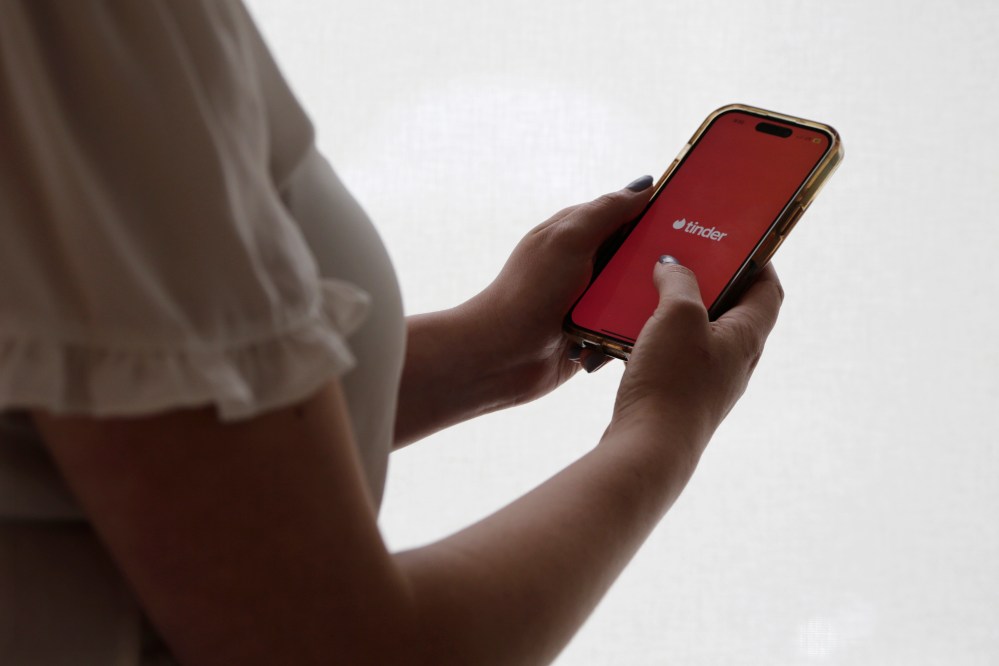
In addition to third-party applications such as RIZZ and Wingman, some brand-name dating apps such as Hinge and Tinder have integrated the technology into their product.
Hinge, for example, uses AI to suggest changes to a user’s profile. It doesn’t tell them what to say, but it might urge a user to “try a small change” or “go a little deeper” with the details they include.
And in the United States, it’s introduced a feature called “Convo Starters,” which looks at a prospective match’s profile and suggests a topic to start the conversation with.
Likewise, Tinder uses AI to recommend people it believes might be compatible with users based on information its gleaned from their profiles and app use. In Australia, the app has introduced a feature that takes it a step further, peeking into users’ camera rolls (with permission) to try to learn even more about them.
And Grindr, a hookup app geared toward gay men, recently introduced a $500-per-month premium tier called Edge, which offers recaps of “meaningful chats and missed connections,” and shares “insights” about other users’ profiles, including what types of people they’re most likely to match with.
While it’s not clear exactly how many people are using these features or the third-party AI apps, Dietzel says their continued existence is evidence that there’s a market for them.
The second phase of his study will involve talking to people who use AI while online dating to understand their experiences.
He’s cautious not to villainize the use of artificial intelligence in general, saying it can have positive applications as well as negative.
“For disabled people, for folks who are neurodivergent, who have physical difficulties, like if they deal with chronic pain, there’s a lot of opportunities here for AI to come in and assist in this experience to make it more enjoyable or easier,” he says.
That might look like AI recommending accessible date locations or flagging a user’s potentially dangerous behaviour targeting marginalized groups.
But when it comes to AI-assisted profiles and conversations, Dietzel is a bit more skeptical.
“What are our expectations with all of this?” he says. “The conversation that you have online might be a little bit faster or you can … have more matches or you can manage more conversations. But then what do you do with that? How does that actually turn into a solid, real, deep relationship?”
Treena Orchard, an anthropology professor at Western University, is skeptical about dating apps in general.
The author of “Sticky, Sexy, Sad: Swipe Culture and the Darker Side of Dating Apps” says dating app companies seem to be using AI to try to solve a problem that dating apps created — so-called swipe fatigue.
“It seems to be a sign that the basic structure of the dating app system and design isn’t working all that well,” she says. “Because why would we need AI if it was already working? So that gives us a clue to the unwillingness in some regards of dating app designers to do more of an overhaul of their design.”
She says the industry is trying to take advantage of “the desire for love” and human connection. While the sheer number of available options on dating apps seems like a feature, she says it can actually make it harder to find a partner — by design, she argues, since the apps rely on users coming back.

Orchard says designers and users alike seem to be treating AI as an easy fix, when what they need is a rethink.
“It’s part of the way that we are seduced by technology,” she says. “Technology is consistently represented as efficient, as fast, as altruistic. Oh, it’ll do the work for you. There’s an app for that. There’s very little critical reflection on, what does this mean for the project of being human when we outsource all of this stuff?”
As for Kokal, the proliferation of AI has changed her habits. She’s now drawn to traits that might have previously been a turnoff, like a strange writing style.
“They put everything in lowercase, the punctuation is weird. And I’m like, oh, I actually respect that. Your writing is unique and different, even though it’s not grammatically correct.”
This report by The Canadian Press was first published Feb. 19, 2026.