Jurors wade through daunting evidence in high-stakes Meta trial about social media risks to children
Advertisement
Read this article for free:
or
Already have an account? Log in here »
To continue reading, please subscribe:

Digital Subscription
One year of digital access for only $205*
- Enjoy unlimited reading on winnipegfreepress.com
- Read the E-Edition, our digital replica newspaper
- Access News Break, our award-winning app
- Play interactive puzzles
*First annual payment billed as $205.00 + GST for one year. This annual subscription will automatically renew at $233.00 + GST every 52 weeks (10% off the regular annual price of $259.35). Offer available to new and qualified returning subscribers only. Cancel any time.
To continue reading, please subscribe:
Add Free Press access to your Brandon Sun subscription for only an additional
$1 for the first 4 weeks*
- Enjoy unlimited reading on winnipegfreepress.com
- Read the E-Edition, our digital replica newspaper
- Access News Break, our award-winning app
- Play interactive puzzles
*Your next Brandon Sun subscription payment will increase by $1.00 and you will be charged $17.95 plus GST for four weeks. After four weeks, your payment will increase to $24.95 plus GST every four weeks.
Read unlimited articles for free today:
or
Already have an account? Log in here »
Hey there, time traveller!
This article was published 19/03/2026 (210 days ago), so information in it may no longer be current.
SANTA FE, N.M. (AP) — A daunting stream of testimony and evidence has been presented in a New Mexico case that explores what the social media conglomerate Meta knew about the effects of its platforms on children.
State prosecutors allege Meta failed to disclose the risks that its platforms pose for children, including mental health problems and sexual exploitation. Meta’s attorneys have said the company has built-in protections for teenagers and weeds out harmful content but the company acknowledges some dangerous content gets past its safety nets.
Attorneys prepared for closing arguments to jurors next week after Meta on Friday closed out its showing of testimony and evidence and the trial completed its sixth week.
If jurors later find that Meta — which owns Instagram, Facebook and WhatsApp — violated New Mexico’s consumer protection laws, prosecutors say sanctions could add up to billions of dollars. Meta, however, says it would seek a different calculation.
The trial that started Feb. 9. is one of the first in a torrent of lawsuits against Meta and comes as school districts and legislators want more restrictions on the use of smartphones in classrooms.
A slated second phase of the trial, possibly in May before a judge with no jury, would determine whether Meta created a public nuisance with its social media platforms and should pay for public programs to fix matters.
Here’s what to know about the possible outcomes of the trial:
A reckoning in courts for social media platforms
Meta is confronting two counts of violating the New Mexico Unfair Trade Practices Act that protects consumers from deceptive or predatory business practices. An additional count was dropped Friday by the judge from a draft of jury instructions.
After closing arguments, jurors will weigh whether Meta knowingly misrepresented the risks on its platforms — by omission or active concealment at the least.
The case could sidestep immunity provisions that protect tech companies from liability for material posted on their social media platforms under Section 230, a 30-year-old provision of the U.S. Communications Decency Act, as well as a First Amendment shield.
In California, a jury already is sequestered in deliberations on whether social media companies should be liable for harms caused to children using their platforms, in one of three bellwether court cases that could set the course for thousands of similar lawsuits.
New Mexico’s case is built on a different foundation — including a state undercover investigation where agents created social media accounts posing as children to document sexual solicitations and the response from Meta.
The lawsuit, filed in 2023 by New Mexico Attorney General Raúl Torrez, also says the dangers of addiction to social media haven’t been fully disclosed or addressed by Meta. Meta hasn’t agreed that social media addiction exists, but executives acknowledge “problematic use” and say they want people to feel good about the time they spend on Meta’s platforms.
Among thousands of pages of documents, the New Mexico trial examines a raft of internal Meta correspondence and reports related to child safety. Jurors also heard testimony from Meta executives, platform engineers, whistleblowers who left the company, psychiatric experts and tech-safety consultants.
The jury also may be influenced by testimony from local public school educators who have struggled with disruptions linked to social media, including the exchange of violent and sexually explicit images, along with sextortion schemes targeting children in New Mexico.
Questions of unconscionable and willful conduct
One count of consumer protection violations alleges that Meta engaged in “unconscionable” trade practices that were grossly unfair.
In opening statements, prosecution attorney Donald Migliori emphasized accusations that Meta targeted social media engagement with children in an unconscionable way as a source of long-term profit while knowing children were at risk of sexual exploitation on social media. Meta disputes that argument by highlighting platform safety features and content filters for teenagers, who are seen by Meta as trendsetters with limited initial purchasing power to satisfy advertisers.
The jury would decide whether the conduct was “willful” and merits civil penalties of up to $5,000 per violation, and may help calculate the number of violations.
Torrez says those penalties could add up, given the number of people in New Mexico using Meta’s platforms. Meta, however, has asked to cap those sanctions at one penalty per misleading statement or fair-trade violation — and not the number of social media views or users.
Nuisance allegations to be decided by judge
State District Judge Bryan Biedscheid is overseeing both phases of the trial. He would decide nuisance allegations as the case advances — and whether the company is on the hook financially to repair damage.
Prosecutors have accused Meta of carelessly creating a marketplace and “breeding ground” for predators who target children for sexual exploitation. They allege Meta’s platforms also undermine the mental health of teenagers in a variety of ways — from sleep deprivation and depression to self-harm.
Attorneys for Meta accuse prosecutors of cherry-picking evidence as well as shoddy investigative work that may have made matters worse.
At trial, Meta executives described robust systems for detecting child sexual abuse material on its platforms and notifying law enforcement — but said the company also cautions users that its enforcement isn’t flawless.
“We believe it’s important to disclose the risks, but to do so in a consistent and rigorous way,” Instagram head Adam Mosseri said, describing a philosophy that extends to blog posts, service agreements and more.
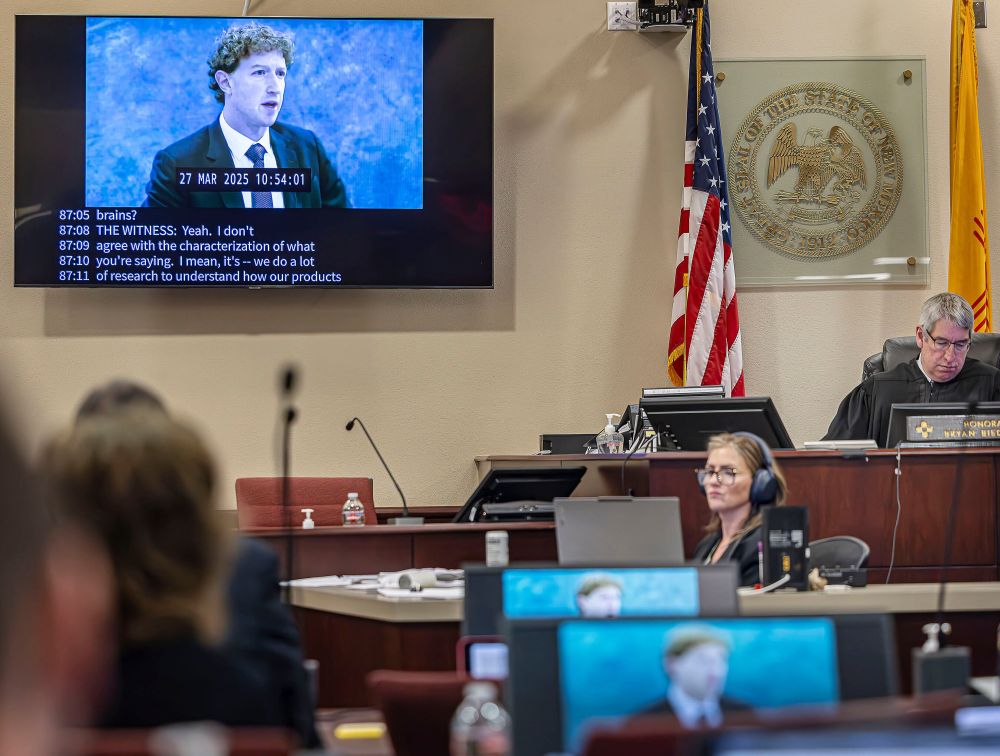
In a video deposition played at trial, Meta CEO Mark Zuckerberg said that “safety is extremely important for the service and having it be something that people trust and want to use over time.” He said Meta in 2017 stopped linking business performance goals directly to the extended amount of time users spend on its platforms.
Torrez says he will request court-ordered relief to make Meta change the way it does business and remedy the harm to children from social media.
“We’re going to have meaningful investments in targeted strategic programming around how you use the internet and how you use social media in ways that are responsible and healthy,” he said on the opening day of the trial.
___
This version corrects that unconscionable trade practices are alleged in the third count of consumer protection violations, not the second and third counts.
Related Articles
New Mexico jury says Meta harms children's mental health and safety, violating state law
Advertisement Advertise With Us
Advertisement Advertise With Us