Empower youth by giving them tools to stay safe online

Advertisement
Read this article for free:
or
Already have an account? Log in here »
To continue reading, please subscribe:

Digital Subscription
One year of digital access for only $205*
- Enjoy unlimited reading on winnipegfreepress.com
- Read the E-Edition, our digital replica newspaper
- Access News Break, our award-winning app
- Play interactive puzzles
*First annual payment billed as $205.00 + GST for one year. This annual subscription will automatically renew at $233.00 + GST every 52 weeks (10% off the regular annual price of $259.35). Offer available to new and qualified returning subscribers only. Cancel any time.
To continue reading, please subscribe:
Add Free Press access to your Brandon Sun subscription for only an additional
$1 for the first 4 weeks*
- Enjoy unlimited reading on winnipegfreepress.com
- Read the E-Edition, our digital replica newspaper
- Access News Break, our award-winning app
- Play interactive puzzles
*Your next Brandon Sun subscription payment will increase by $1.00 and you will be charged $17.95 plus GST for four weeks. After four weeks, your payment will increase to $24.95 plus GST every four weeks.
Read unlimited articles for free today:
or
Already have an account? Log in here »
Do you support banning kids from social media? Do you also post photos of your kids on your Facebook or Instagram?
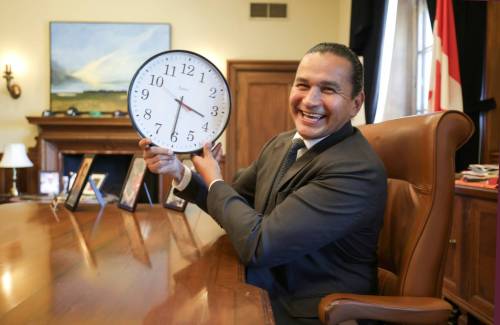
Whenever the topic of banning social media for kids comes up, as it did again this week when Premier Wab Kinew announced that Manitoba will ban youth from using social media and AI chatbots, we run into a wee bit of cognitive dissonance among the adults.
Many of today’s young people had social media presences long before they were old enough to consent to them — not as users, but as content posted by their parents. Instagram is nearly 16 years old; the iPhone nearly 20. A lot of kids have had digital footprints since the sonogram. Their whole lives are online.
So, as young people who are already on social media transition into social media users themselves, we should, as a society, empower them to make informed decisions about how, where and if they want to show up online, not ban them from platforms they use to connect with their peers, express their creativity and learn about the world. Platforms they’ve grown up around and, in many cases, on.
Let’s be very clear. The exploitation of children online is obviously a very real and scary problem, and we should be deeply disturbed by AI chatbots telling kids to hurt themselves or each other. From that stance, placing an age-related ban on social media is appealing because, on its face, seems like a decisive action to protect children against these harms.
But a ban doesn’t make any of these harms go away, and you will still have youth on these platforms.
Enforcement is also a problem. Technically, there are already age limits on social media platforms — you need to be 13, for example, to create an Instagram account — but they are easy to circumvent. And more robust age verification comes with a suite of security concerns.
“To enact the social media bans being proposed around the world requires some system of age verification, which inherently means expanding surveillance technology,” writes technology journalist Taylor Lorenz in the Guardian. “Because algorithmic systems cannot accurately estimate age, verifying a user’s age also requires collecting highly sensitive data or government documents to support the biometric data harvested.”
Gee, what could possibly go wrong? How does that protect kids?
“Kids” wasn’t defined in the initial proposal; now, the province says it will follow Australia’s lead by banning social media for children under the age of 16. But there is no magical age when you blow out the candles on your birthday cake and suddenly know how to be a person online.
Obviously, there’s nuance here: I don’t think eight-year-olds should have their own Instagram accounts. For tweens and teens, however, this is an opportunity to have actual and ongoing conversations about what online life looks like in 2026.
And if we truly want to protect them from online harms, we can do so by providing education, information and guidance.
We’d do well to look at the abject failures of abstinence-only sex education — i.e. young people are still having sex, only now they are wildly uninformed about it so they are less likely to use contraceptives, which leads to an increased risk of STIs and pregnancy — and apply those lessons here.
Recognizing that young people are probably going to use social media, ban or no, here’s what we could do:
We could teach them how to be discerning about what they share about themselves publicly because the internet never forgets.
We could teach them how to make secure accounts and how to keep their information safe online.
We could teach them what to do if some creep slides into their DMs and, crucially, who to tell.
We could teach them how to spot scams and AI slop, echo chambers and conspiracy theories.
For older teens, we could have age-appropriate conversations around sexting and consent, the risks involved, what to do if your nudes get shared, or what to do if someone makes nudes of you using generative AI.
We could take a harm-reduction approach to the subject because social media is indeed addictive, and too much screen time has negative effects on both brain and body.
We could get them thinking critically about the costs and benefits of being on social media or using tools such as ChatGPT.
We could be curious, not judgmental, about their social media use and actually learn what they like about it and don’t.
We could demand that these billionaire-owned platforms do better by their users, to do more to combat exploitation, bullying and the sharing of violent, harmful images.
We could rethink posting images of kids when they aren’t old enough to give the go-ahead, and be mindful of how we use our own screens/social media when we’re around them.
To do all of that, though, society has to think beyond treating online teenagers as problems to be solved or threats to be managed, and little kids as content mines: tiny prop comics whose batty backseat bon mots might make the parents go viral (though I will confess to loving those videos, too).
They are people in the world, and the world includes the internet. They need good adults offline so that they can be safer online.
winnipegfreepress.com/jenzoratti
Jen Zoratti is a columnist and feature writer working in the Arts & Life department, as well as the author of the weekly newsletter NEXT. A National Newspaper Award finalist for arts and entertainment writing, Jen is a graduate of the Creative Communications program at RRC Polytech and was a music writer before joining the Free Press in 2013. Read more about Jen.
Every piece of reporting Jen produces is reviewed by an editing team before it is posted online or published in print – part of the Free Press‘s tradition, since 1872, of producing reliable independent journalism. Read more about Free Press’s history and mandate, and learn how our newsroom operates.
Our newsroom depends on a growing audience of readers to power our journalism. If you are not a paid reader, please consider becoming a subscriber.
Our newsroom depends on its audience of readers to power our journalism. Thank you for your support.
Jen Zoratti is a columnist and feature writer working in the Arts & Life department, as well as the author of the weekly newsletter NEXT. A National Newspaper Award finalist for arts and entertainment writing, Jen is a graduate of the Creative Communications program at RRC Polytech and was a music writer before joining the Free Press in 2013. Read more about Jen.
Every piece of reporting Jen produces is reviewed by an editing team before it is posted online or published in print – part of the Free Press‘s tradition, since 1872, of producing reliable independent journalism. Read more about Free Press’s history and mandate, and learn how our newsroom operates.
Our newsroom depends on a growing audience of readers to power our journalism. If you are not a paid reader, please consider becoming a subscriber.
Our newsroom depends on its audience of readers to power our journalism. Thank you for your support.
Related Articles
Premier has everyone’s attention on and about social media; now it’s time for some careful thought

Advertisement Advertise With Us
Advertisement Advertise With Us