

Premier has everyone’s attention on and about social media; now it’s time for some careful thought

Advertisement
Read this article for free:
or
Already have an account? Log in here »
To continue reading, please subscribe:
Digital Subscription
One year of digital access for only $1.44 a week*
- Enjoy unlimited reading on winnipegfreepress.com
- Read the E-Edition, our digital replica newspaper
- Access News Break, our award-winning app
- Play interactive puzzles
*Billed as $5.77 plus GST every four weeks. After 52 weeks, price increases to the regular rate of $19.95 plus GST every four weeks. Offer available to new and qualified returning subscribers only. Cancel any time.
To continue reading, please subscribe:
Add Free Press access to your Brandon Sun subscription for only an additional
$1 for the first 4 weeks*
- Enjoy unlimited reading on winnipegfreepress.com
- Read the E-Edition, our digital replica newspaper
- Access News Break, our award-winning app
- Play interactive puzzles
*Your next Brandon Sun subscription payment will increase by $1.00 and you will be charged $17.95 plus GST for four weeks. After four weeks, your payment will increase to $24.95 plus GST every four weeks.
Read unlimited articles for free today:
or
Already have an account? Log in here »
At the Canadian Labour Congress national convention last week in Winnipeg, Manitoba Premier Wab Kinew delivered a fiery speech to delegates about the need to restrict access by children to pervasive social media platforms.
Unable to attend the speech? Not to worry — it’s available across all major social media platforms.
Kinew posted highlights of the speech on his Instagram, TikTok and X (formerly Twitter) accounts. So did the CLC, and various unions in attendance at the convention. If you want to see more than highlights, CPAC, the public affairs cable channel, posted the entire speech on its YouTube feed.
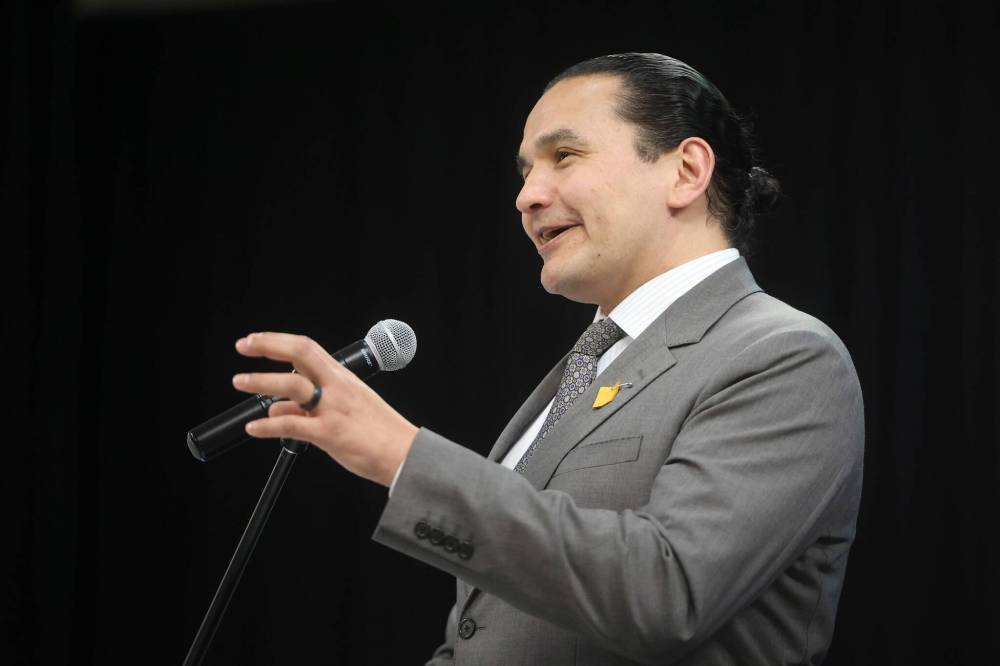
Premier Wab Kinew (Tim Smith / The Brandon Sun files)
Using social media to condemn social media may seem hypocritical. But when you look at the audience Kinew commands across his social media accounts, there is a certain logic. An admittedly perverse logic, but logic all the same.
Kinew, a bona fide national political celebrity, has more than 451,000 followers on Instagram, 118,000 followers on TikTok and 108,000 followers on X. To put that into perspective, Manitoba’s first minister has twice as many Instagram followers as Ontario Premier Doug Ford.
Given the popularity and importance of social media in the lives of most people of all ages, it would be ridiculous to expect Kinew to abandon platforms that give him access to such a huge audience. When Kinew speaks — either live or virtually through his social media reels — people seem to listen.
On the other hand, his heavy reliance on social media does raise other questions. Such as, if social media is a legitimate tool for a political leader to communicate with his constituents, are there other, possibly worthy uses for this technology?
That is essentially the question that Manitoba teachers are asking Kinew now.
After he told a CBC radio program he was thinking about banning YouTube in classrooms, the Manitoba Teachers’ Society released a video assailing the proposal.
MTS president Lillian Klausen said a blanket ban on YouTube in classrooms was a “bad idea” that ignores the fact teachers currently use screened and curated YouTube content as a valid tool of education. “Don’t take away the tools we need to work if you’re not going to be funding (alternatives),” Klausen said.
Klausen explained the use of YouTube is hardly revolutionary; for many decades, it’s been pro forma for teachers to use videos in either VHS format or DVDs.
The concerns raised by MTS are really only the latest in a series of increasingly loud objections and concerns about Kinew’s proposed ban on social media. Nobody is taking issue with the core of his concerns — that certain inherent aspects of social media can be destructive for young minds — but many have raised questions about how Kinew will impose a ban.
Kinew’s proposal started as a vague, aspirational declaration. He and Education Minister Tracy Schmidt have said it might start with a ban in schools. One can extrapolate that a policy such as that would mesh well with the growing movement to have students relinquish their smartphones while in class.
There have also been muddy pledges of some sort of advisory process that will consult and reflect concerns from key groups — including teachers — before any legislation is tabled. Kinew has also floated the idea of a social media commissioner or regulator to push social media companies into taking action on their end to reduce access by children.
It’s fair and appropriate to say that the NDP government has been pretty transparent about the fact that this is not a fully formed idea, and that more research has to be done to establish how to prevent children from accessing social media. However, those admissions have not stopped the premier from continuing to float more vague ideas on top of an exceedingly vague foundational concept.
Kinew has mentioned Australia as a possible model, but a growing body of data has shown the Aussie ban on social media has had very mixed results. As well, there is a growing skepticism among social scientists, psychologists and psychiatrists about whether banning access to social media has any meaningful impact on the mental and physical health of children and youth.
While Kinew is talking about Australia — which relies on protocols to verify the age of social media users — Schmidt has said that age verification likely won’t be part of a Manitoba solution.
It’s all a muddle.

Nobody supports students having unfettered access to unfiltered YouTube content while in class. In fact, many parents would be happy to have their children relinquish their phones at the classroom door to cut down on distractions.
However, wanting to limit the ability of students to watch cat videos — or worse — on YouTube during school hours should not mean that teachers cannot use the platform to present thoughtfully curated videos that augment learning of appropriate subject matter.
The solution here may be for Kinew to say less about a social media ban, while ensuring that what he does say is more precise and informed. And, that the province launch a formal consultation that allows the premier to put forward a concrete, practical plan.
And then, to make sure every one knows what is going on, Kinew should promote it across all of his social media platforms.
dan.lett@freepress.mb.ca
Dan Lett is a columnist for the Free Press, providing opinion and commentary on politics in Winnipeg and beyond. Born and raised in Toronto, Dan joined the Free Press in 1986. Read more about Dan.
Dan’s columns are built on facts and reactions, but offer his personal views through arguments and analysis. The Free Press’ editing team reviews Dan’s columns before they are posted online or published in print — part of the our tradition, since 1872, of producing reliable independent journalism. Read more about Free Press’s history and mandate, and learn how our newsroom operates.
Our newsroom depends on a growing audience of readers to power our journalism. If you are not a paid reader, please consider becoming a subscriber.
Our newsroom depends on its audience of readers to power our journalism. Thank you for your support.
Dan Lett is a columnist for the Free Press, providing opinion and commentary on politics in Winnipeg and beyond. Born and raised in Toronto, Dan joined the Free Press in 1986. Read more about Dan.
Dan’s columns are built on facts and reactions, but offer his personal views through arguments and analysis. The Free Press’ editing team reviews Dan’s columns before they are posted online or published in print — part of the our tradition, since 1872, of producing reliable independent journalism. Read more about Free Press’s history and mandate, and learn how our newsroom operates.
Our newsroom depends on a growing audience of readers to power our journalism. If you are not a paid reader, please consider becoming a subscriber.
Our newsroom depends on its audience of readers to power our journalism. Thank you for your support.
Related Articles
Teachers give Kinew failing grade over proposal to ban YouTube in classrooms










Advertisement Advertise With Us
Advertisement Advertise With Us