‘Not the right time’: Retirees delay downsizing plans as housing market slumps
Advertisement
Read this article for free:
or
Already have an account? Log in here »
To continue reading, please subscribe:

Digital Subscription
One year of digital access for only $205*
- Enjoy unlimited reading on winnipegfreepress.com
- Read the E-Edition, our digital replica newspaper
- Access News Break, our award-winning app
- Play interactive puzzles
*First annual payment billed as $205.00 + GST for one year. This annual subscription will automatically renew at $233.00 + GST every 52 weeks (10% off the regular annual price of $259.35). Offer available to new and qualified returning subscribers only. Cancel any time.
To continue reading, please subscribe:
Add Free Press access to your Brandon Sun subscription for only an additional
$1 for the first 4 weeks*
- Enjoy unlimited reading on winnipegfreepress.com
- Read the E-Edition, our digital replica newspaper
- Access News Break, our award-winning app
- Play interactive puzzles
*Your next Brandon Sun subscription payment will increase by $1.00 and you will be charged $17.95 plus GST for four weeks. After four weeks, your payment will increase to $24.95 plus GST every four weeks.
Read unlimited articles for free today:
or
Already have an account? Log in here »
The kids are moved out and all that extra space in the house just isn’t worth the upkeep.
It’s an opportunity to move somewhere a little more practical, maybe a condo or bungalow, and bank the savings.
For many, that was the ideal retirement plan. But for now, it may not be a realistic one.
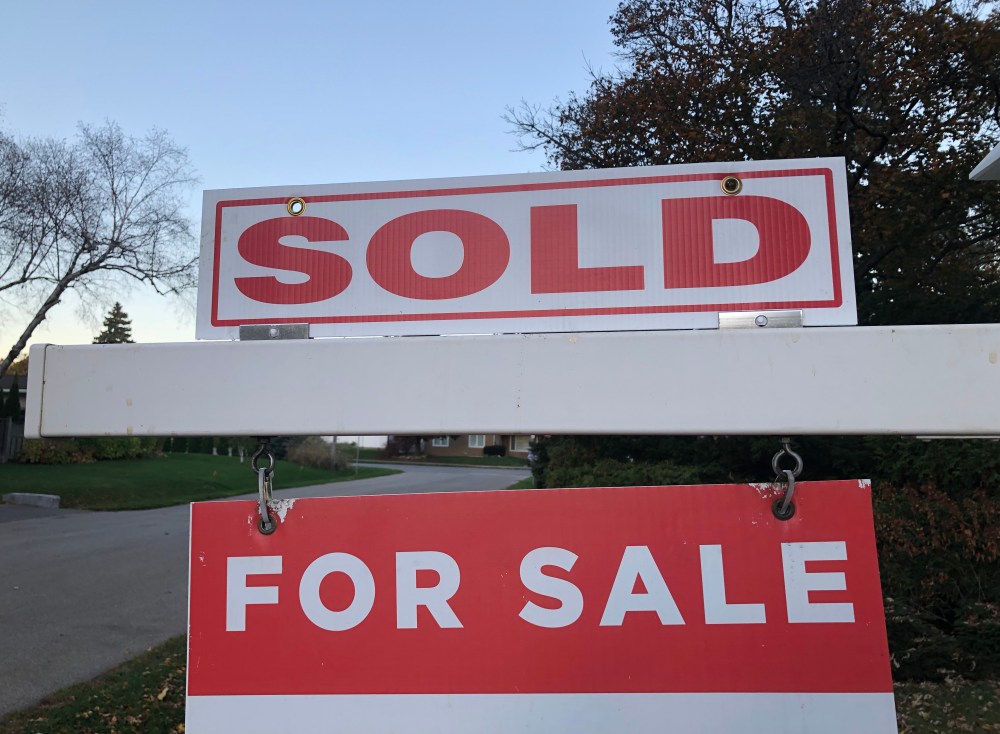
Real estate watchers say plans to downsize are on hold for plenty of retirees as the population contends with challenges such as falling home prices and a lack of choice in the market.
Still, a downsizing wave could be set to unfold gradually as economic confidence improves, according to some forecasts.
“As the population continues to age, we’re seeing this being a bigger conversation,” said Tim Syrianos, a Toronto broker and owner of Re/Max Ultimate Realty Inc.
“This conversation has been going on because people who are living in larger homes, they’re finding it very hard to find a reason to move because they can’t find suitable housing that is smaller.”
Only 10 per cent of Canadians say they’re aiming to move to a smaller home over the next 10 years, according to a Re/Max Canada survey of more than 1,500 adults conducted online from March 30 to April 1.
Among those 65 and older, just 16 per cent intended to downsize in the next decade, while 57 per cent planned to remain in their current home. Seventeen per cent said they planned to rent, while nine per cent were unsure.
Among all those considering downsizing, many expressed concern about their options. Nearly half of all respondents said there was low availability of downsized housing options in their communities, and an additional eight per cent said there was no availability.
Syrianos said that sentiment is one of the consequences of today’s housing shortage, which policymakers and developers are trying to solve. He said that for years, not enough housing was approved to fit the needs of retirees looking for smaller, but still adequate, accommodations.
“It’s been accumulating over the years, construction design not being suitable for long-term needs in the housing market,” he said.
“It’s a lifestyle choice for people to move from a larger home into a space that accommodates them to downsize, but when (developers) were building 450- and 550-square-foot condos, those weren’t really the solution for what we needed.”
Broader economic factors are also playing a role. The Canadian housing market has slowed over the past year as global trade friction has raised concerns about affordability and the labour market.
That has pushed home prices down from post-pandemic peaks, even as house values have still significantly appreciated compared with decades ago when many current retirees entered the market.
“Probably the biggest challenge that we’re seeing right now is really just the fact that home prices are off so much from their 2022 highs,” said Ben McCabe, founder and CEO of Bloom Finance, a Canadian fintech company that helps homeowners access home equity in retirement.
While economic forecasts predict a rebound later this year, a sizable chunk of would-be buyers want to be sure the market is at its lowest before they make their move. For sellers, these circumstances have delayed their plans.
Marco Pedri, a broker with Shoreline Realty, said many retirees he works with have been “cautious if now’s the right time” to move to a smaller living space.
“One of the biggest risks some seniors or older individuals need to consider is that the equity might have shrunk due to the prices of these homes and what they could likely sell the property for in today’s market,” he said.
“What we’re seeing is if a lot of these seniors don’t necessarily need to downsize, then … maybe now’s not the right time to sell.”
The “friction costs” of moving are also a deterrent in the current environment, said McCabe. He estimated that Realtor fees, land transfer taxes, and moving or renovation expenses can absorb up to 15 per cent of home sale proceeds.
But it’s not just soft home prices and moving expenses pushing seniors to stay put, he added.
Given current economic conditions, some are also putting off relocation plans to financially support family members longer than initially anticipated. Three-quarters of seniors indicated that supporting family is cutting into their retirement savings, according to research from Bloom collected last September.
That study surveyed an online sample of 510 Canadians 55 and older who are members of the Angus Reid Forum. Such online surveys, including Re/Max Canada’s research, cannot be assigned a margin of error because they do not randomly sample the population, according to the polling industry’s professional body, the Canadian Research Insights Council.
“A significant cost of living crisis … is impacting all age brackets, but I think has had a disproportionate effect on older Canadians, just because a lot of older Canadians have a fixed amount of retirement savings,” McCabe said.
“(They feel), ‘My downsizing strategy is looking a bit more shaky than it previously was just given where my home price has gone and I’m feeling this, sort of, other financial stressor, which is the requirement to support my younger loved ones.'”
But McCabe said he doesn’t expect the downsizing pause to last. With condo prices falling in cities like Toronto and Vancouver amid an influx of new supply, it could present an attractive opportunity for those who planned to make the leap from a single-family home.
The Re/Max Canada survey suggested a long-term downsizing trend could be on the horizon, driven by Canada’s increasingly aging population. By 2030, nearly 25 per cent of Canada’s population will be over 65, up from close to one-fifth of Canadians, according to a 2024 Statistics Canada report.
“As we enter those years where people are getting older, this need will become even more and more apparent,” said Syrianos.
Pedri said he expects an eventual uptick of seniors looking to “rightsize” their living arrangements to better fit their reality, especially with many not having the “luxury” of waiting for the market to pick up. He said some may simply feel maintenance of the property has become too much for their lifestyle to delay the move any longer.
“I think some people will consider what’s best for them and focus more on a lifestyle approach rather than just strictly the numbers,” he said.
“Although the market dictates that it may not be a good time to sell, you have to listen to your body and what’s right for you.”
This report by The Canadian Press was first published May 3, 2026.