Americans love their iPhones (though sometimes they wish they could live without them)

Advertisement

Advertise with us

SAN FRANCISCO (AP) — The American obsession with the iPhone is complicated, as most love-hate relationships are.

Read this article for free:


or

Already have an account? Log in here »

To continue reading, please subscribe:

Subscribe and receive a limited-edition Free Press branded hat or tote.

Digital Subscription

One year of digital access for only $205*

  • Enjoy unlimited reading on winnipegfreepress.com
  • Read the E-Edition, our digital replica newspaper
  • Access News Break, our award-winning app
  • Play interactive puzzles

*First annual payment billed as $205.00 + GST for one year. This annual subscription will automatically renew at $233.00 + GST every 52 weeks (10% off the regular annual price of $259.35). Offer available to new and qualified returning subscribers only. Cancel any time.

To continue reading, please subscribe:

Add Free Press access to your Brandon Sun subscription for only an additional

$1 for the first 4 weeks*

  • Enjoy unlimited reading on winnipegfreepress.com
  • Read the E-Edition, our digital replica newspaper
  • Access News Break, our award-winning app
  • Play interactive puzzles
Start now

*Your next Brandon Sun subscription payment will increase by $1.00 and you will be charged $17.95 plus GST for four weeks. After four weeks, your payment will increase to $24.95 plus GST every four weeks.

SAN FRANCISCO (AP) — The American obsession with the iPhone is complicated, as most love-hate relationships are.

It sometimes seems like a talisman so magical that we can’t fathom living without all the pleasures and conveniences that it bestows almost anytime or anywhere. The iPhone, and its smartphone brethren, enable pictures that can be posted instantly on social media. We can play a game, watch a video, listen to music, send a text, check email, surf the internet, catch up on on the news, get directions, tap to pay.

Oh — and, every once in a while, we can even make or answer a phone call.
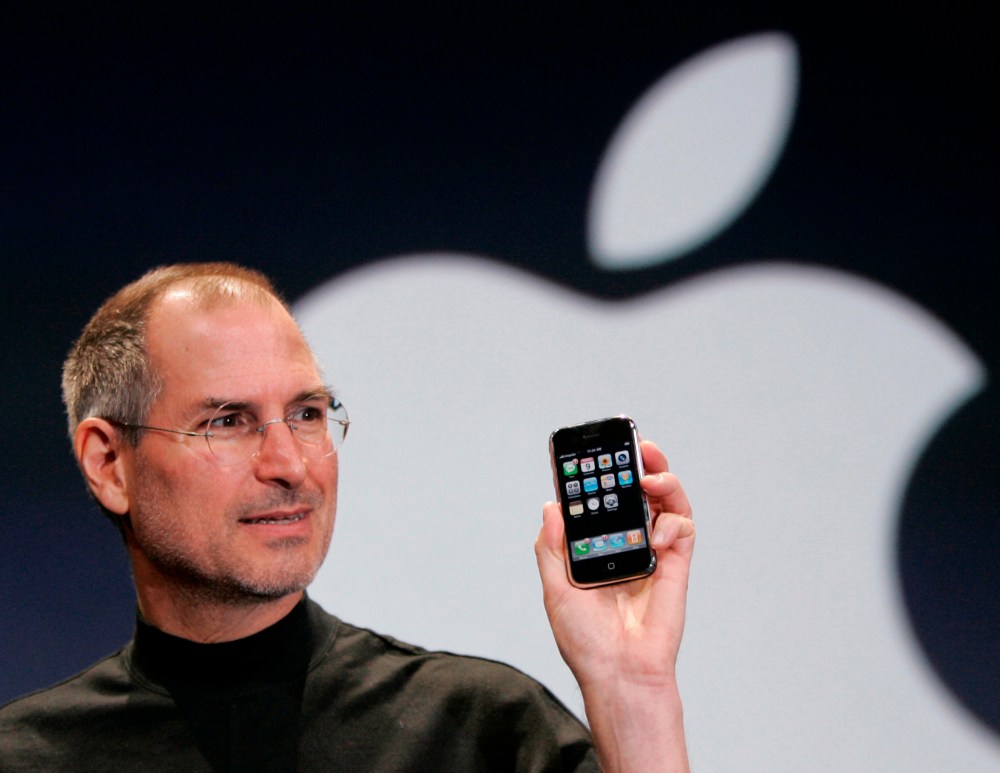
FILE - Apple CEO Steve Jobs holds up an Apple iPhone at the MacWorld Conference in San Francisco on Jan. 9, 2007. (AP Photo/Paul Sakuma, File)

At other times, the iPhone seems like a drug-dealing pusher preying on our weaknesses and worst impulses while deepening our addiction to its endless stream of notifications and alerts that lure us into gazing at its screen as our attention spans become increasingly shorter.

It’s a paradox that is confronting America while the iPhone is still a teenager, inhabiting the same demographic that it may have impacted the most. The device wasn’t even born until 2007, when Apple co-founder Steve Jobs strolled across a stage to promise a mesmerized audience that they were about to see something that would change everything.

And it kind of did. Jobs, as often was the case before his 2011 death, proved to be eerily prescient — so much so that surveys have found a substantial number of people would pick sleeping with their iPhone instead of their lovers, if forced to make a choice.

The challenge now: figuring out if there is a better way to manage our complicated relationship with the iPhone and smartphones running on Google’s Android software in a society that almost requires everyone to possess one. Is there a way to preserve all the benefits while preventing toxic habits? Is it fair to categorize its use alongside that of cigarettes, alcohol and junk food?

For the moment, at least, America seems to be drifting further down a digital river that evokes the closing passage from one of the greatest American novels of all: So we scroll on, boats against the current, borne back ceaselessly into the glowing screen.

___

Michael Liedtke covered technology for The Associated Press for 26 years. Part of a recurring series, “American Objects,” marking the 250th anniversary of the United States. For more American objects, click here. For more stories on the anniversary, click here.


Report Error Submit a Tip

More Stories

Suspension on the horizon for Hellebuyck as pre-season set to start

Ken Wiebe 7 minute read Preview

Suspension on the horizon for Hellebuyck as pre-season set to start

Ken Wiebe 7 minute read Tuesday, Sep. 15, 2026

In this high stakes game of chicken, Kevin Cheveldayoff, Connor Hellebuyck or any of the potential suitors for the Winnipeg Jets franchise netminder appear ready to blink.

Read
Tuesday, Sep. 15, 2026

‘One of a kind’: CEO, philanthropist Doug Harvey dies at 72

Morgan Modjeski 5 minute read Preview

‘One of a kind’: CEO, philanthropist Doug Harvey dies at 72

Morgan Modjeski 5 minute read Updated: Yesterday at 12:57 PM CDT

Doug Harvey, a Winnipeg business titan and philanthropist, has died after battling cancer for more than a decade.

Harvey gave millions of dollars to Winnipeg organizations while he was CEO of DLH Group, a nationwide network of businesses that support heavy duty truck and trailer users.

Loren Remillard, CEO and president of the Winnipeg Chamber of Commerce, said the business community is mourning the loss of the influential businessman who helped shape Winnipeg.

“We are a transportation and logistics hub in Winnipeg and it was partly the result of geography, and a big part because of leaders and visionaries like Doug Harvey,” he said.

Read
Updated: Yesterday at 12:57 PM CDT

‘Parental rights’ issue resurfaces

Maggie Macintosh 5 minute read Preview

‘Parental rights’ issue resurfaces

Maggie Macintosh 5 minute read Yesterday at 2:00 AM CDT

Trustee campaign material that condemns rainbow flags is being met with outrage of all kinds, written complaints and, in one case, a cease-and-desist order.

“Parental rights,” including questions about classroom diversity, equity and inclusion policies, are resurfacing heading into school board elections across Manitoba.

“People are trying to advance their politics and their issues while simultaneously calling teachers ideologues and brainwashers,” said Shannon Moore, an associate professor at the University of Manitoba who studies sexual health education. “And I find that rich.”

Moore said parents have a right to choose independent school or homeschool, but they do not have a right to dictate curriculum that is currently developed using research and mainstream morals.

Read
Yesterday at 2:00 AM CDT

Building Northern Manitoba right

Morris Beardy 4 minute read 2:00 AM CDT

I had the pleasure of attending the recent celebrations welcoming grain shipments back to the Port of Churchill, alongside business leaders, port workers, community members and government partners. We find ourselves at an important and pivotal moment and there is a lot of optimism about Northern Manitoba.

Whether it’s the Port of Churchill Plus, all-weather roads and trade corridors, new mines and exploration, a transmission line to Nunavut or billions going into modernizing our hydro-electric systems, one thing is clear: Northern Manitoba needs to be prepared for a potential boom in development.

Now more than ever, Canada and Manitoba have to get this right.

Prime Minister Carney and Canada’s premiers have met with some of the world’s largest investors to discuss nation-building projects that will shape our country’s future.

Americans love their iPhones (though sometimes they wish they could live without them)

Michael Liedtke, The Associated Press 3 minute read Preview

Americans love their iPhones (though sometimes they wish they could live without them)

Michael Liedtke, The Associated Press 3 minute read Tuesday, May. 12, 2026

SAN FRANCISCO (AP) — The American obsession with the iPhone is complicated, as most love-hate relationships are.

It sometimes seems like a talisman so magical that we can't fathom living without all the pleasures and conveniences that it bestows almost anytime or anywhere. The iPhone, and its smartphone brethren, enable pictures that can be posted instantly on social media. We can play a game, watch a video, listen to music, send a text, check email, surf the internet, catch up on on the news, get directions, tap to pay.

Oh — and, every once in a while, we can even make or answer a phone call.

At other times, the iPhone seems like a drug-dealing pusher preying on our weaknesses and worst impulses while deepening our addiction to its endless stream of notifications and alerts that lure us into gazing at its screen as our attention spans become increasingly shorter.

Read
Tuesday, May. 12, 2026

Space war and other distractions

Gwynne Dyer 5 minute read 2:00 AM CDT

When Troy Meink, the chief of the U.S. Space Force, announces for no obvious reason that the United States “now has on-orbit space-control weapons,” people naturally assume that something is up. Why is Meink admitting the truth now? He’s even boasting about it!

It can’t be to frighten the Chinese or the Russians, because they have long been watching U.S. military activities in space. They regularly monitor the flights of the semi-secret X-37B Orbital Test Vehicle, the re-usable uncrewed spaceplane that the U.S. Space Force launches from Florida but sometimes lands at Vandenberg in California (eight missions so far).

The Chinese can’t complain, because they have their own ‘secret’ spaceplane, and sometimes they even play ‘silly buggers’ in orbit with their American and British counterparts. (‘Silly buggers’ is the old naval game of high-speed manoeuvres of warships in formation, a frequent cause of collisions.)

Reuters reported a year ago on a joint U.S.-British operation in which the U.S. Space Force, working from a base in Colorado, directed an American military satellite to swoop in close to a British satellite just as China’s Shiyan 12-01 satellite passed beneath it. What for? Who knows? They may have done it just because they could.