As clock ticks down for Ontario consumption sites, users fear they won’t survive
Advertisement
Read this article for free:
or
Already have an account? Log in here »
To continue reading, please subscribe:

Digital Subscription
One year of digital access for only $205*
- Enjoy unlimited reading on winnipegfreepress.com
- Read the E-Edition, our digital replica newspaper
- Access News Break, our award-winning app
- Play interactive puzzles
*First annual payment billed as $205.00 + GST for one year. This annual subscription will automatically renew at $233.00 + GST every 52 weeks (10% off the regular annual price of $259.35). Offer available to new and qualified returning subscribers only. Cancel any time.
To continue reading, please subscribe:
Add Free Press access to your Brandon Sun subscription for only an additional
$1 for the first 4 weeks*
- Enjoy unlimited reading on winnipegfreepress.com
- Read the E-Edition, our digital replica newspaper
- Access News Break, our award-winning app
- Play interactive puzzles
*Your next Brandon Sun subscription payment will increase by $1.00 and you will be charged $17.95 plus GST for four weeks. After four weeks, your payment will increase to $24.95 plus GST every four weeks.
Read unlimited articles for free today:
or
Already have an account? Log in here »
TORONTO –
For Riley Bisson, the unassuming one-storey house with a red brick exterior in Toronto’s downtown core is more than just a place to safely use drugs without worrying about dying of an overdose.
The Moss Park supervised consumption site has become a refuge, a family, a walk-in clinic and a community where Bisson spends most days mingling with people who are facing the same challenges, the 50-year-old said.
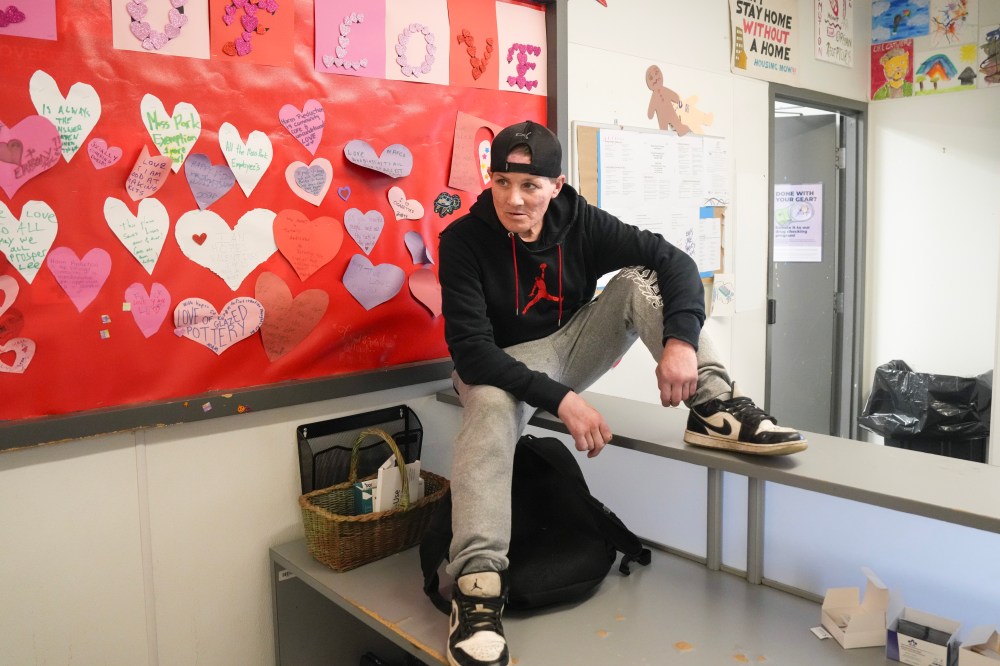
Bisson, who has spent nearly three decades of her life in and out of the correctional system, said she has been able to stay out of trouble since she started visiting the site.
“This place is a prime example of helping people like me not go back to doing the crime or doing the stupidity that I was doing, and I haven’t been back in jail in three years because of this place,” Bisson said in a recent interview in the centre’s kitchen.
“I don’t have to worry about my well-being here because my needs are looked after here.”
Bisson is one of thousands who are set to soon lose access to such services, after the provincial government announced it would stop funding Ontario’s eight remaining publicly funded supervised consumption sites in June.
The move has sparked anger and fear among those who depend on these services, as well as their family members and harm-reduction advocates, who say the closures will lead to more overdose deaths, increase health-care costs and compromise public safety.
On four occasions, Bisson’s life was saved as the site’s staff reversed her overdose, she said. If the centre closes, Bisson said she is certain she’ll end up behind bars, in hospital or dead on the street.
“I’m scared about what I’m going to do, man. I’m … terrified,” she said, in tears. “I’m more scared for everyone in the community now than I’ve ever been.”
In Port Colborne, Ont., a Niagara Region community located about 150 kilometres from Toronto, news of the Moss Park site’s impending closure has left Bisson’s mother devastated.
Rose Bisson said she hoped to deliver a message to Premier Doug Ford: “There are many, many families just like our family that suffer daily with this. We don’t want our family member to die.”
It has been “heartbreaking” for the whole family to be separated from Riley Bisson as she deals with her addiction, her mother said.
“But that doesn’t mean we don’t love her, and we don’t care about her, and we don’t want her in our lives,” she said. “It just means that we don’t have the skills and we don’t have the tools to be able to take care of her the way the safe injection site does.”
The two of them risk losing contact if the site shuts down, since staff keep them in touch through a weekly call, she said.
“They provide, you know, a system where she’s welcomed in the door, she’s not judged in any way, she (is) treated like she’s important and that she matters,” the mother said in a phone interview.
In April of last year, Ford’s government forced the closure of nine other such sites that it deemed too close to schools and daycares.
What has happened since then is worrying, said Gillian Kolla, a public health researcher and assistant professor at the faculty of medicine at Memorial University of Newfoundland. She has received funding from the federal government to study the effect of the changes in Ontario’s harm reduction service delivery in the next four years.
The number of suspected drug toxicities treated by emergency medical services across Ontario jumped from 604 in the first quarter of 2025 to 1,024 in the third, according to data collected by Ontario Drug Policy Research Network.
In Toronto, paramedics received 387 non-fatal suspected opioid overdose calls in March, more than double the number of calls they received in March last year, the month before the sites’ closure, the data show.
In Hamilton, where the only supervised injection site was closed in 2025, paramedics responded to 199 overdose calls in February of this year, the highest-ever monthly count recorded since the city started collecting such data.
There is strong evidence, backed by numbers and analysis in Canada and abroad, that supervised injection sites are reducing overdose deaths, saving the health-care system and the public money, and preventing the transmission of blood-borne diseases such as HIV and hepatitis C, Kolla said.
“Still, despite this, we get reactionary drug policy that does not at all actually fit with the evidence that we have,” she said.
Ontario’s Ministry of Health did not directly respond when asked how much it would to cost to keep the remaining sites open.
Ema Popovic, a spokesperson for Health Minister Sylvia Jones, said the government is spending $560 million to replace “the failed approach of drug injection sites” with its abstinence-based model known as homelessness and addiction recovery treatment, or HART, hubs.
“Instead of giving people tools to use harmful, illegal drugs, our government is helping people break the tragic cycle of drug addiction by making record investments in more mental health and wraparound supports,” she said in a written statement.
She said 28 HART hubs are operational and providing 24-7 services to people with mental health challenges, connecting them with resources such as supportive housing, social, employment and addiction treatment services.
Popovic said data on fatal overdoses indicates the government’s drug policy is moving in the right direction.
Ontario recorded 648 suspected overdose deaths in the first quarter of this year, down from 703 in the same period last year, according to data from the chief coroner’s office. Fatal opioid overdoses reached a high during the COVID-19 pandemic but have generally fallen year over year since then.
Kolla said the HART hub model is going to leave out a significant portion of people with the most “problematic patterns” of drug use, who aren’t in a position to quit and are at high risk of overdose.
“It’s a bit of magic thinking on the part of the Ontario government to think that you’re going to cut harm reduction services like consumption sites, and that’s going to somehow magically push people into treatment that also is not available to folks,” she said.
Supervised consumption sites in Ontario have recorded more than 1.4 million visits between 2020 and November 2025, according to federal data. More than 26,000 overdoses have also been reversed at these sites over the same the period, the data shows.
The Moss Park site, located at Sherbourne Street and Queen Street East, has reversed more than 4,000 overdoses since it was founded in 2018, and costs close to $2 million a year to run, said Sarah Greig, the site’s manager.
Supervised consumption sites were designated essential health services during the COVID-19 pandemic, with the Moss Park location reversing some 800 overdoses in 2020 alone, Greig said.
At first, the site run by the South Riverdale Community Health Centre only provided a supervised injection space and overdose response, she said.
Now, it offers a long list of services, including mental health support, health care, social work, case management and drug testing, in addition to providing food and clothing, Greig said. Medicine to address withdrawal symptoms is also available for those who want to reduce or stop their substance use, she said.
“Every day that people show up here it’s a sign that they are trying and trying to stay alive and trying to cope and work on their wellness,” she said.
Supervised consumption sites and the government’s hubs serve “two different populations,” she said.
“Both deserve access to care and resources and dignity,” she said. “It’s not an either, it’s a both.”
The Moss Park site has seen an average of 25 new clients every month in the past year, Greig said. There were 40 new visitors last month, enough that the site decided it could no longer accept new clients.
The planned closures will worsen the overdose crisis due to a large supply of “unregulated and unpredictable” drugs, Greig said.
“I think there’s going to be dead people littering our streets again.”
Supervised consumption sites have played a significant role in connecting people who are dealing with addiction with the health-care system, advocates say.
That’s how Dr. Katie Dorman, a primary care physician in Toronto, began seeing some of her clients, including Riley Bisson.
People who use substances have historically experienced “systematic exclusion” from health care, and the looming closures will only make it worse, the doctor said, calling the government’s abstinence-based model “problematic.”
“This recovery-oriented culture of care is looking to help a certain person with a certain goal rather than saying ‘come as you are, we’re here to support you,’ which is what I think supervised consumption services do really well,” she said.
“We need to provide health care … whatever their goal is, whatever part of the trajectory they’re on, whether or not they are going to change, ever want to change.”
Shuttering the sites will eliminate spaces where substance users are welcome at a time when fewer and fewer options are available to them, she said. It will also cut off access to crucial harm reduction supplies such as clean needles and pipes as well as services to check the content of drugs, she said.
“People overdose when they don’t know what they’re using and when their drug supply is contaminated,” Dorman said. Treating overdoses then becomes difficult because health professionals can’t be sure what people have used, she said.
At the Moss Park site, visitors have access to a living area, a kitchen and a clinic or exam room.
On a recent visit, about a dozen people occupied the space, some sitting on a couch and chairs in the living room, surrounded by walls decorated with messages scrawled on heart-shaped paper.
“Harm reduction isn’t enabling! It is keeping us alive out of love,” read a note pinned on a red board.
Rodney Wabanosse and his partner, Erin Doherty, sat face to face with a table between them in the supervised injection room as two staff members moved around to help them and others.
Wabanosse, who has an addiction to fentanyl, said he can’t count on his fingers and toes the number of people he’s lost to overdoses.
“I’m lucky to be here … because of this place and because they saved my life a lot of times,” he said before going into the injection room. “You have to have a place like this.”
The mother of his children died of an overdose nearly two years ago, so Wabanosse recently decided to detox and stop using drugs. He is planning to start taking buprenorphine, a medication offered at the site and administered by monthly injection to help reduce opioid cravings and withdrawal symptoms.

The site’s closure will hinder his efforts, he said.
“I don’t want to pass away because I don’t want my kids to have to go through (life) with no parents,” said Wabanosse, who goes by the nickname Mugzy.
His partner, Doherty, lost her husband to an overdose a few years ago. Doherty uses crystal meth and is a regular at the Moss Park site, where she receives social and health services and uses the injection room.
“Mugzy and I have each other,” she said. “Besides that, we only have this place. That’s it.”
This report by The Canadian Press was first published May 15, 2026.