Dressing visitors in ancient China’s imperial splendor is booming in Beijing
Advertisement
Read this article for free:
or
Already have an account? Log in here »
To continue reading, please subscribe:

Digital Subscription
One year of digital access for only $205*
- Enjoy unlimited reading on winnipegfreepress.com
- Read the E-Edition, our digital replica newspaper
- Access News Break, our award-winning app
- Play interactive puzzles
*First annual payment billed as $205.00 + GST for one year. This annual subscription will automatically renew at $233.00 + GST every 52 weeks (10% off the regular annual price of $259.35). Offer available to new and qualified returning subscribers only. Cancel any time.
To continue reading, please subscribe:
Add Free Press access to your Brandon Sun subscription for only an additional
$1 for the first 4 weeks*
- Enjoy unlimited reading on winnipegfreepress.com
- Read the E-Edition, our digital replica newspaper
- Access News Break, our award-winning app
- Play interactive puzzles
*Your next Brandon Sun subscription payment will increase by $1.00 and you will be charged $17.95 plus GST for four weeks. After four weeks, your payment will increase to $24.95 plus GST every four weeks.
Read unlimited articles for free today:
or
Already have an account? Log in here »
BEIJING (AP) — Chen Jiao has a curious job: transforming visitors to resemble empresses from ancient China as young people explore a revival of traditional culture.
She is one of hundreds of makeup artists working at studios in Beijing near the Forbidden City, once home to the emperors of China’s last two dynasties, Ming and Qing.
Every day, visitors arrive to dress in robes richly embroidered with phoenixes and adorn themselves with jade and pearl pendants and gold fingernail guards like those worn in imperial China. Makeup is carefully applied, and their hair is styled and decorated with tassels and hairpins.
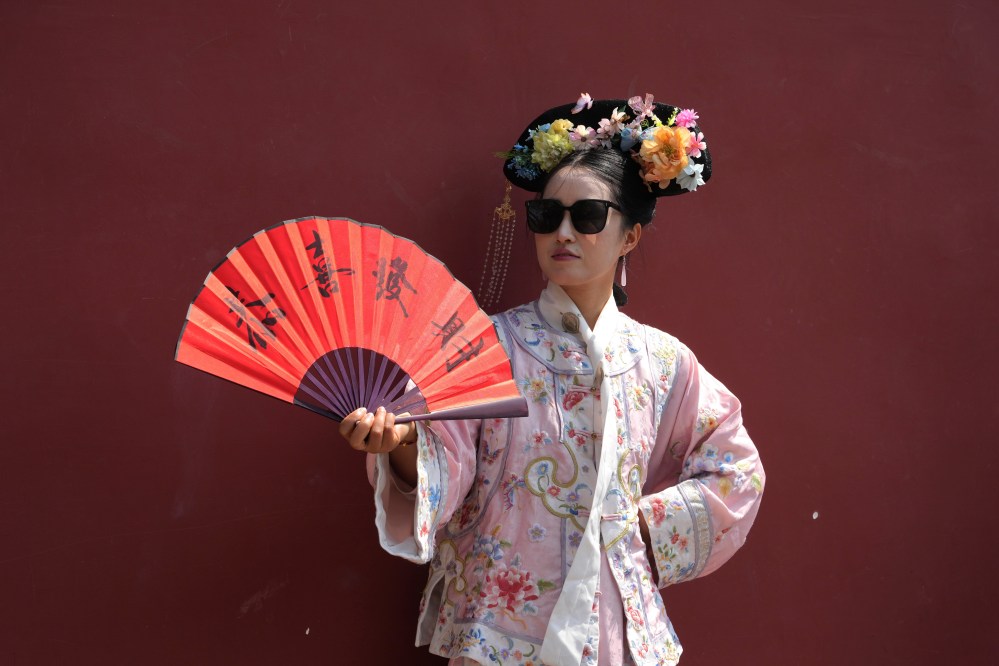
The average cost is 300 yuan ($45), though prices can exceed 1,000 yuan (more than $150).
Once dressed up, people go to the walls and moat surrounding the Forbidden City to pose for photos and videos to share on social media. Blending echoes of ancient times with modernity, some pair their historic costumes with sneakers and sunglasses and drink bubble tea.
“It can get very busy during peak seasons, especially public holidays and weekends,” Chen said.
Recently, she began work at 6 a.m. and transformed around two dozen young women in a single day. There is no off-season for makeup artists, only a brief lull when the Forbidden City closes, she said.
Recent years have seen a trend among young people for immersive experiences in historical Chinese costume, which in Beijing is mainly inspired by the country’s last two dynasties.
The Ming dynasty, which ruled for more than 270 years until 1644, built the Forbidden City and reinforced the Great Wall. The Qing dynasty, ruled by the Manchu people, itself collapsed in 1912, ending more than two millennia of imperial rule.
Chen Xiao is among the tourists who now come for the the styling activities at Beijing’s historical sites.. A college student from the eastern province of Shandong, Chen traveled overnight to the capital during the recent Qingming holiday.
“I feel like if you’re at a specific location, you should wear something that fits the setting,” Chen said, wearing a pink outfit typically associated with a “Gege,” or Qing dynasty princess.
The building where Chen Jiao’s studio is located illustrates the rapid growth. Around 2020, only a handful of costume styling studios operated there. Now there are more than 100, according to local media.
“Young Chinese people have discovered the aesthetic appeal of traditional clothing while learning about China’s rich cultural heritage,” said Cai Zehong, founder of Hanfu Beijing, one of the earliest ancient-costume associations created by enthusiasts to promote traditions and cultures by the majority Han ethnicity.
The long popularity of historical costume dramas in China has contributed to the trend.

“I’ve watched a lot of historical costume dramas,” Chen Xiao said. “I think I’ve definitely been influenced by those shows. Lately, I’ve been quite into Qing dynasty history.
Liu Ruitong, a college student visiting from Hebei province, opted for a black Ming-style costume.
“I think this look feels very elegant and dignified, especially in its color palette. I chose black because it pairs beautifully with the Forbidden City and with traditional Chinese scenery in general.” Liu said.
___
Associated Press video journalist Wu Jia in Beijing contributed to this report.