OB-GYN group makes vaccine recommendations for the first time
Advertisement
Read this article for free:
or
Already have an account? Log in here »
To continue reading, please subscribe:

Digital Subscription
One year of digital access for only $205*
- Enjoy unlimited reading on winnipegfreepress.com
- Read the E-Edition, our digital replica newspaper
- Access News Break, our award-winning app
- Play interactive puzzles
*First annual payment billed as $205.00 + GST for one year. This annual subscription will automatically renew at $233.00 + GST every 52 weeks (10% off the regular annual price of $259.35). Offer available to new and qualified returning subscribers only. Cancel any time.
To continue reading, please subscribe:
Add Free Press access to your Brandon Sun subscription for only an additional
$1 for the first 4 weeks*
- Enjoy unlimited reading on winnipegfreepress.com
- Read the E-Edition, our digital replica newspaper
- Access News Break, our award-winning app
- Play interactive puzzles
*Your next Brandon Sun subscription payment will increase by $1.00 and you will be charged $17.95 plus GST for four weeks. After four weeks, your payment will increase to $24.95 plus GST every four weeks.
Read unlimited articles for free today:
or
Already have an account? Log in here »
A prominent OB-GYN group announced vaccine recommendations on Wednesday that differ from what the U.S. government advises.
The immunization schedule is specifically for pregnant, postpartum and breastfeeding women. It aligns with prior recommendations from the U.S. Centers for Disease Control and Prevention, before changes were made under the Trump administration and Health Secretary Robert F. Kennedy Jr.
Earlier this year, the American College of Obstetricians & Gynecologists withdrew from a CDC advisory committee on vaccines because of those changes, which have spawned legal challenges.
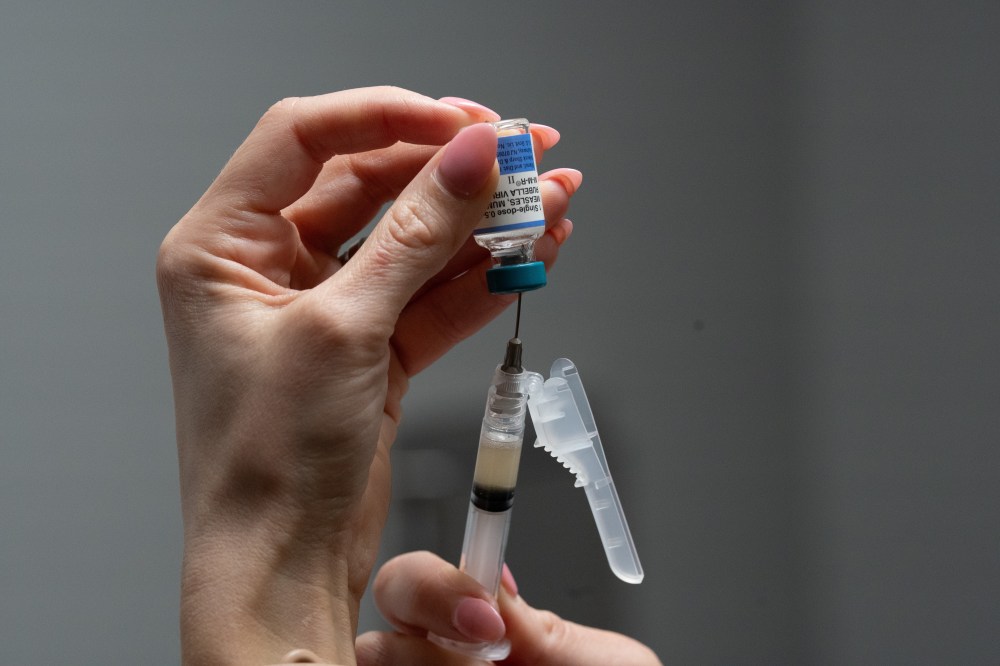
“So now for the first time, ACOG has made the decision to formally release its own immunization schedule to provide and communicate clear evidence-based guidance and to address the growing vaccine misinformation that is circulating,” said Dr. Christopher Zahn, the OB-GYN group’s chief of clinical practice.
The new schedule has been endorsed by 13 other professional and medical societies. Some other groups, such as the American Academy of Pediatrics, have also put out vaccine schedules this year that differ from the CDC’s.
Here’s what you need to know about the OB-GYN group’s advice.
What does the OB-GYN group advise?
Four immunizations are routinely recommended during pregnancy:
— The flu vaccine, which can be taken any trimester, at any time of year, although it’s best to get it in early fall.
— The COVID-19 shot, which can be taken during any trimester at any time of year, although it’s best to receive it as soon as possible during pregnancy.
— A tetanus, diphtheria, and pertussis (Tdap) shot, preferably as early as possible between 27 and 36 weeks.
— A respiratory syncytial virus (RSV) vaccine, between 32 and 36 weeks of pregnancy in your first pregnancy, during September through January in most parts of the U.S. If you had the RSV vaccine during a previous pregnancy, you do not need to get it again, the group says, but your baby should get an antibody shot after birth. Your baby can also get that shot instead of you receiving the maternal vaccine.
Other vaccines –- pneumococcal, meningococcal, hepatitis A and hepatitis B –- may be needed for women with certain risk factors. The group recommends talking with your doctor about them.
Three others are recommended before pregnancy or after birth, protecting against human papillomavirus; measles, mumps and rubella; and chickenpox.
How do these recommendations differ from CDC advice?
The biggest difference involves the COVID-19 vaccine.
Last May, Kennedy announced that COVID-19 vaccines are no longer recommended for healthy pregnant women and children — a move immediately questioned by several public health experts.
Spokespeople from the U.S. Department of Health and Human Services did not immediately respond to a request for comment.
Are health care providers seeing pushback on vaccines?
Yes. Several spoke at an event announcing the new guidelines.

“Vaccine hesitancy is huge in this country right now,” said Carol Hayes of the American College of Nurse Midwives. “Patients come in all the time saying I’ve done my own research, and sadly, they’re doing research and they’re getting information that is not scientifically based.”
Sarah Vaillancourt of the National Association of Nurse Practitioners in Women’s Health said her organization’s members are seeing much the same. Some of the confusion is being fueled by social media, she said.
In such a landscape, she said, it’s “really useful” for the OB-GYN group to provide accurate information for patients.
___
The Associated Press Health and Science Department receives support from the Howard Hughes Medical Institute’s Science and Educational Media Group and the Robert Wood Johnson Foundation. The AP is solely responsible for all content.