Robotic elephants draw crowds and controversy in some of India’s Hindu temples

Advertisement

Advertise with us

CHALAKUDY, India (AP) — The life-size robotic elephants in Prasanth Prakashan's backyard workshop have ears that flap, tails that swish and trunks that squirt water.

Read this article for free:


or

Already have an account? Log in here »

To continue reading, please subscribe:

Subscribe and receive a limited-edition Free Press branded hat or tote.

Digital Subscription

One year of digital access for only $205*

  • Enjoy unlimited reading on winnipegfreepress.com
  • Read the E-Edition, our digital replica newspaper
  • Access News Break, our award-winning app
  • Play interactive puzzles

*First annual payment billed as $205.00 + GST for one year. This annual subscription will automatically renew at $233.00 + GST every 52 weeks (10% off the regular annual price of $259.35). Offer available to new and qualified returning subscribers only. Cancel any time.

To continue reading, please subscribe:

Add Free Press access to your Brandon Sun subscription for only an additional

$1 for the first 4 weeks*

  • Enjoy unlimited reading on winnipegfreepress.com
  • Read the E-Edition, our digital replica newspaper
  • Access News Break, our award-winning app
  • Play interactive puzzles
Start now

*Your next Brandon Sun subscription payment will increase by $1.00 and you will be charged $17.95 plus GST for four weeks. After four weeks, your payment will increase to $24.95 plus GST every four weeks.

CHALAKUDY, India (AP) — The life-size robotic elephants in Prasanth Prakashan’s backyard workshop have ears that flap, tails that swish and trunks that squirt water.

But that’s about all they have in common with their real-life counterparts revered across India as manifestations of the divine. The animatrons, crafted from fiberglass, iron and rubber, are intended to take the place of live elephants in Hindu temples.

The change pleases animal welfare activists but upsets those who passionately believe real elephants are inextricable from the temple rituals and festivals where they are bestowed superstar status.

The animal welfare group PETA and other nonprofits have donated about 40 robotic elephants, costing about $6,000 each, to Indian temples to replace live elephants.

A robotic elephant is much lighter and lacks the fluid grace of the majestic pachyderm. Electric motors move its head and eyeballs. Body parts are pliable in an attempt to make them life-like.

Prakashan, who holds a mechanical engineering degree, knows his elephant is far from the real thing.

“You can’t create an original elephant just as you cannot duplicate a human,” Prakashan said. “But we try to capture the majestic animal’s essence as much as we can.”

One thing his elephants can’t yet do is walk.

“But they will,” Prakashan said, smiling. “I’m working on it.”

Elephants are seen as symbols of divinity

Venerating elephants is not a concept unique to Kerala or Hinduism.
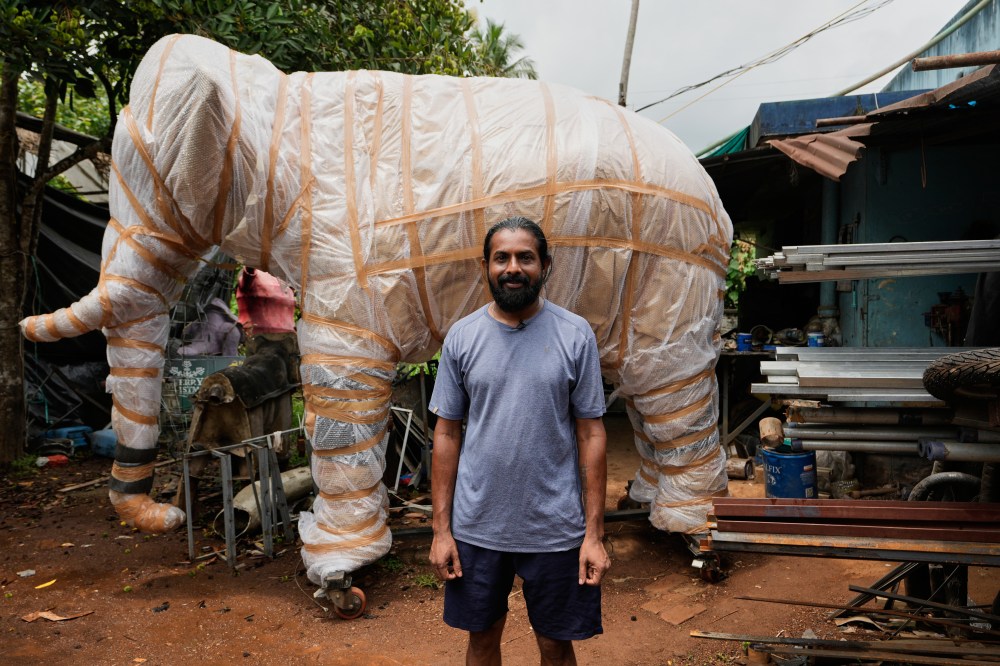
Prasanth Prakashan, a mechanical engineer, poses in front of a robotic elephant at his backyard workshop in Chalakudy, in the southern Indian state of Kerala, Friday, May 22, 2026. (AP Photo/Aijaz Rahi)

Buddhists believe elephants are Buddha-like, symbolizing patience, wisdom and enlightenment. In Kandy, Sri Lanka, 100 decorated elephants parade the streets, the largest carrying the Buddha’s tooth relic in a golden casket.

In Kerala, festivals with live elephants are crowd-pullers. The Thrissur Vadakkunnathan temple’s annual Pooram parade features about 100 elephants adorned in golden headgear and colorful silk caparisons. The elephants are escorted by handlers who fan them with peacock feathers and yak-hair whisks.

About 40 miles (65 kilometers) away, the Guruvayur Sree Krishna Temple houses nearly 50 elephants. The temple also holds an annual elephant race and a feeding ritual where, following prayers, the animals are given rice, ghee, jaggery, fruits and vegetables.

Elsewhere in Kerala, St. George Orthodox Syrian Church in Kunnamkulam and the Pattambi Mosque in Palakkad district routinely feature elephant parades during their festivals.

Some temple elephants are celebrities.

An elephant named Thechikkottukavu Ramachandran has close to 150,000 fans on Facebook. Guruvayur Keshavan, arguably the most celebrated temple elephant who died in 1976, has been memorialized with a life-size statue near the temple he served; his life story has been the subject of a film and a television series.

Andrea Gutierrez, a University of Texas professor who researched captive elephants in South Asia, said Kerala’s temple elephants are male, which poses a problem. Adult males go through musth, a periodic condition that heightens their aggression. It’s a dramatic surge in testosterone — up to 60 times their normal levels.
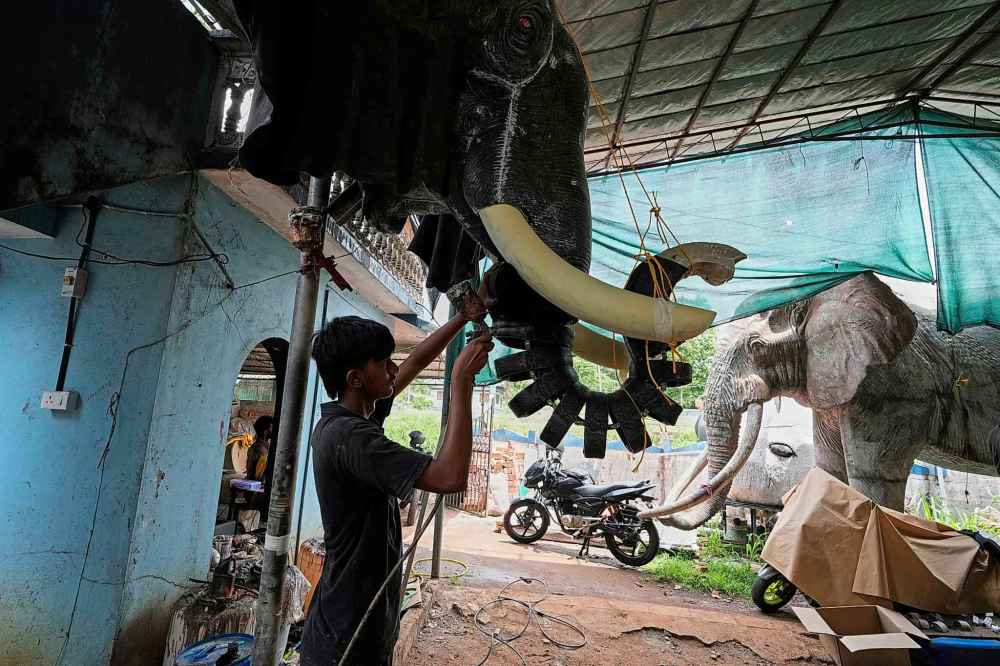
A worker sprays a chemical on the trunk of a robotic elephant at a backyard workshop in Chalakudy, in the southern Indian state of Kerala, Friday, May 22, 2026. (AP Photo/Aijaz Rahi)

“But people want these huge impressive tusks, which almost feels like a military presence,” Gutierrez said.

Despite tighter restrictions on owning and maintaining elephants, nearly 400 animals are still captive in Kerala, out of about 2,500 across India. That count is down by about half since 2010.

Artists embark on quest to make the perfect robot

Khushboo Gupta, vice president of policy at PETA India, said the aesthetic appeal of live elephants doesn’t justify shackling, beating and separating them from their families. Stressed elephants can also be deadly. For example, nine people died in 2024 from elephant rampages at Kerala temple festivals.

“These elephants are forced to stand there for hours in the heat, with large crowds, drums and fireworks,” Gupta said. “Any trigger could cause them to go on a rampage.”

Prakashan, who builds animatronics for malls, parks and carnivals, got PETA’s attention in 2023 with a viral video of robotic elephants at a Dubai festival.

Gupta contacted him and Sooraj Nambiat, another Kochi-based artist who makes elephant sculptures, about making a robotic version for temples. Prakashan’s elephants were immediately in demand.

His first was encased in rubber, but he’s moved on to more durable fiberglass molds. The moving rubber parts are shaped by artists who pay close attention to minute details, from the animal’s wrinkly skin to the veins that pop from its fanning ears. The entire process from mold making to animating the elephant now takes Prakashan and his crew about 15 days.
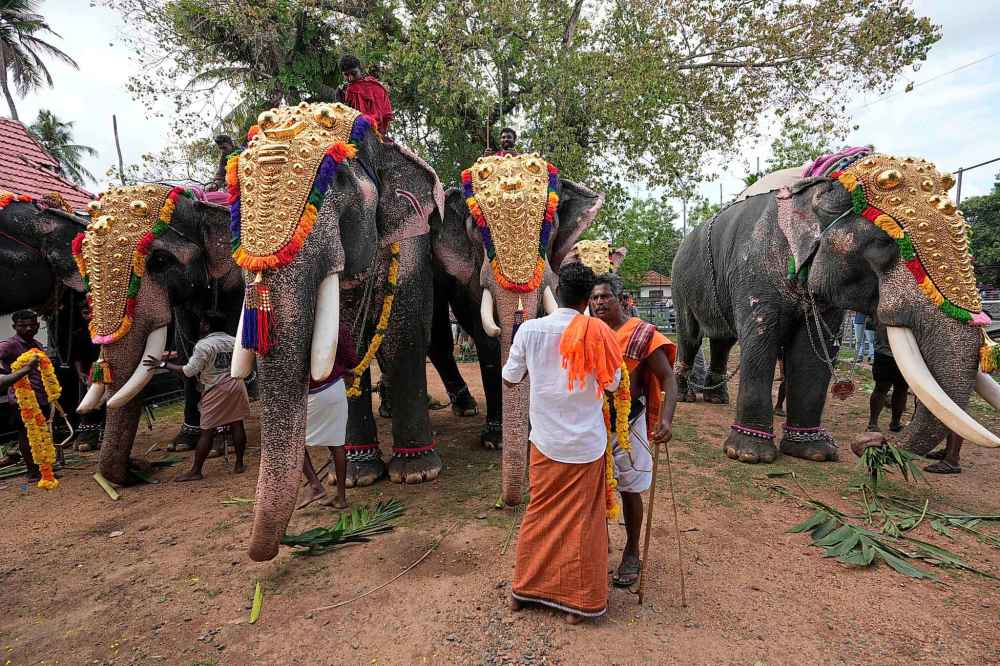
Mahouts prepare live elephants with chained feet for participation in the elephant pageant, or Gajamela, held as part of an annual festival in Thiruvanvandoor, in the southern Indian state of Kerala, Tuesday, May 19, 2026. (AP Photo/Aijaz Rahi)

But being a pioneer comes with challenges.

“It was something we had to figure out on our own,” Prakashan said.

Smaller temples embrace the change

Prakashan’s first robotic elephant, Irinjadapilly Raman, came to the Irinjadapilly Sree Krishna Temple in 2023.

On a recent afternoon outside the temple in central Kerala, Raman stood motionless as two children played, giggling and hugging its trunk.

Rajkumar Namboothiri, the temple’s head priest, said children would never be able to approach a live elephant so freely.

He said tantric texts, which spell out the rules for daily rituals in Kerala temples, don’t require live elephants. He believes the practice came about when elephants were a part of kings’ cavalries and palaces a few centuries ago.
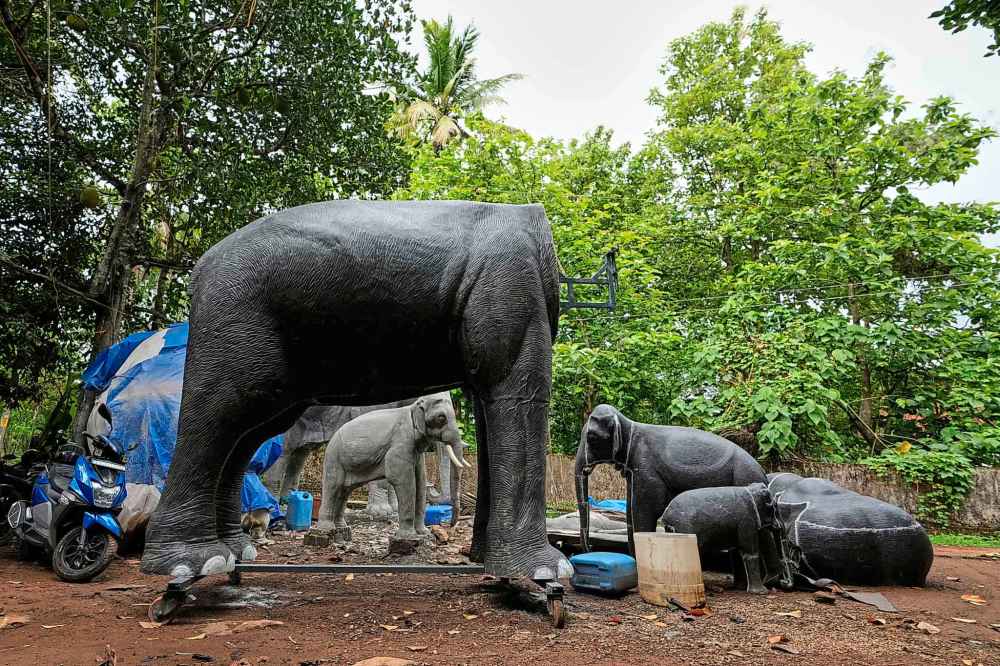
An unfinished robotic elephant stands alongside others at a backyard workshop in Chalakudy, in the southern Indian state of Kerala, Friday, May 22, 2026. (AP Photo/Aijaz Rahi)

“They had trees and forests before,” Namboothiri said. “Now, we have concrete jungles, heat and noise. … Elephants are tortured and abused. It’s not right.”

The animals were also chosen as vehicles for deities during processions because of their height. But, that could be accomplished with portable palanquins and chariots, Namboothiri said.

P.C. Subhash, a temple devotee, said he is in favor of upholding tradition with live elephants in larger temples, but believes robotic elephants are more feasible for smaller temples, given the steep costs, including liability insurance coverage.

“I really hope more people come to accept them,” Subhash said.

K.I. Purushottaman, president of the Cheekamundi Sri Mahavishnu Temple in Thrissur, said their robotic elephant has brought him peace of mind because he and other administrators feared the possibility of a fatal elephant attack.

“With a robotic elephant, we don’t have that fear,” he said. “That’s a big relief.”

Elephant owners and traditionalists resist

Still, many traditionalists don’t believe robotic elephants belong in temples. K. Mahesh rents out his real elephant for festivals about 45 days a year. He believes elephants are holy.
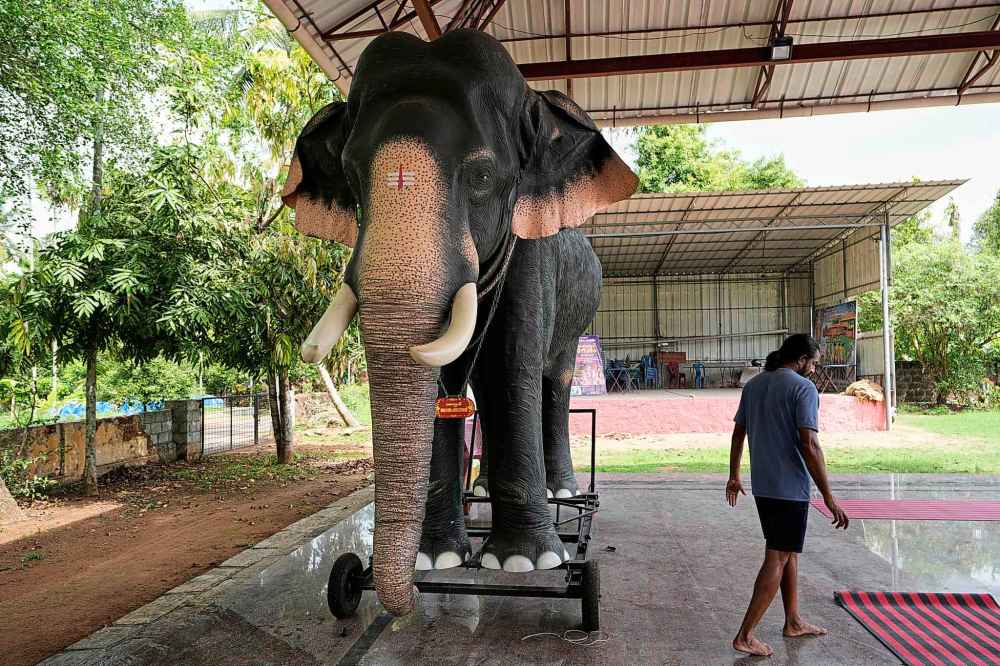
Prasanth Prakashan, a mechanical engineer, walks past a robotic elephant manufactured by him that stands inside the compound of Cheekamundi Sri Mahavishnu Temple in Thrissur, in the southern Indian state of Kerala, Friday, May 22, 2026. (AP Photo/Aijaz Rahi)

“If you don’t believe elephants are sacred, what’s the point of a robotic elephant in a temple?” he asked.

Mahesh has had his elephant for 25 years and says the animal “is like a family member or a pet” who brings joy to all, provided it is treated with care and caution.

Several temple administrators have denounced robotic elephants for rituals and festivals.

Nambiat, the artist, said he can’t attend temple festivals anymore because many resent his work.

“This is my trade. … I’m not out to ruin their tradition,” he said. “But, if we don’t stop treating elephants like commodities, future generations won’t have them.”

P.S. Easa, a Kerala-based wildlife biologist and elephant expert, helped draft the state’s captive elephant regulations. While hard to enforce, they have helped protect elephants to some extent, he said.

“Sadly, there’s a lot of money to be made with elephants,” he said. “It’s not about spirituality or even tradition. It’s religious tourism.”
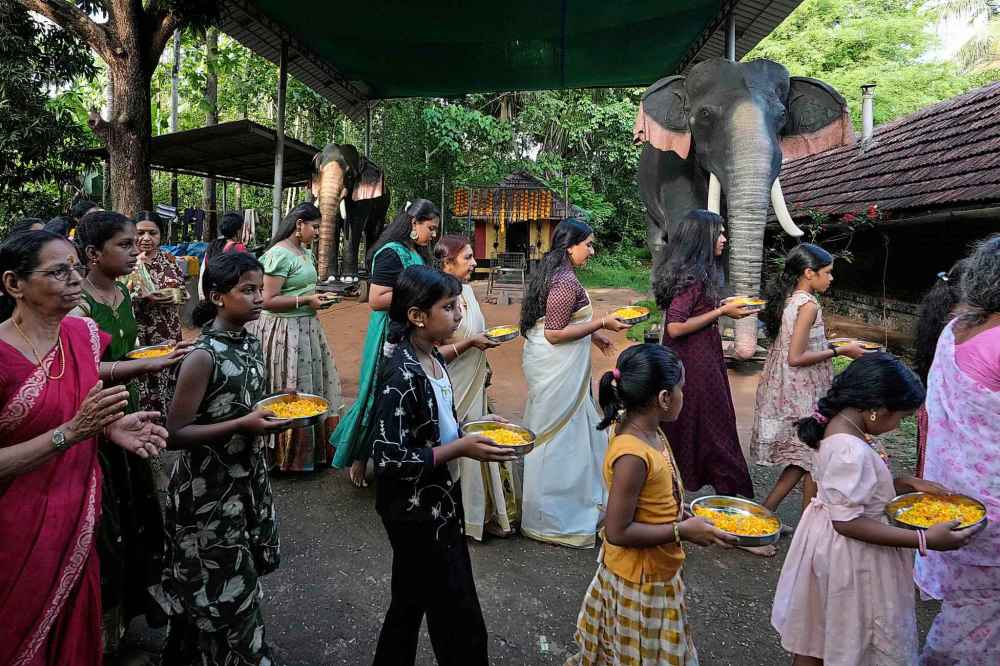
A group of Hindu devotees arrive for prayers, walking past two robotic elephants at Irinjadapilly Sree Krishna Temple in Thrissur, in the southern Indian state of Kerala, Friday, May 22, 2026. (AP Photo/Aijaz Rahi)

Easa is not sure if robotic elephants will be accepted in his lifetime.

“You cannot change centuries-old tradition anytime soon,” he said. “But who knows? Maybe if these robotic elephants can start walking.”

___

Associated Press religion coverage receives support through the AP’s collaboration with The Conversation US, with funding from Lilly Endowment Inc. The AP is solely responsible for this content.

Report Error Submit a Tip

The Free Press acknowledges the financial support it receives from members of the city’s faith community, which makes our coverage of religion possible.
More Stories

Creative powerhouse Perry Rosemond never lost Winnipeg roots

Ben Waldman 7 minute read Preview

Creative powerhouse Perry Rosemond never lost Winnipeg roots

Ben Waldman 7 minute read Yesterday at 6:00 AM CDT

He created King of Kensington, directed the troops in the Royal Canadian Air Farce, and his creative eye was behind the lens for television shows starring Johnny Cash, Tom Jones, Mr. Dress-Up and the Friendly Giant.

He also wrote and developed the Canadian version of Sesame Street during his time as the head of school and preschool programming for CBC in Toronto, and directed a televised special in 2002 for Winnipeg sketch comedy troupe Royal Liechtenstein Theatre Company.

But before his name featured in the credits of some of the most iconic and influential pieces of the Cancon canon, Perry Rosemond was an only child living in a crammed, multi-generational home in Winnipeg’s North End, racing each day to beat the morning bell next door at William Whyte School.

In memoirs that have yet to be published, the late television producer recalled his childhood. “(T)here were 14 of us in the house at 193 Andrews St., and it wasn’t that big of a house,” he writes.

Read
Yesterday at 6:00 AM CDT

Six high school hockey programs ceased operations following new Hockey Manitoba policy

Joshua Frey-Sam 7 minute read Preview

Six high school hockey programs ceased operations following new Hockey Manitoba policy

Joshua Frey-Sam 7 minute read Friday, Oct. 2, 2026

She lived the best of both worlds.

For the last three years, the 17-year-old wore a sweater for two different hockey programs — her high school team and AAA club in the Manitoba Female Hockey League — and was preparing to flourish in both colours again this winter.

Recently, however, the blue-liner was disappointed to learn she is no longer eligible to play her Grade 12 season with her school owing to a new policy imposed by Hockey Manitoba that bans players from participating in the Manitoba Women’s High School Hockey League if they are rostered on a U18 AAA team.

The rule applies to all athletes who play for both Winnipeg-based and rural AAA teams.

Read
Friday, Oct. 2, 2026

Manitoba’s own Summer Howell takes on biggest role yet as Stephen King’s telekinetic teen Carrie

Randall King 7 minute read Preview

Manitoba’s own Summer Howell takes on biggest role yet as Stephen King’s telekinetic teen Carrie

Randall King 7 minute read Friday, Oct. 2, 2026

From the tender age of eight, actress Summer Howell has made her presence known in a series of horror films shot in her home province of Manitoba.

Her first film was Curse of Chucky (2013), director Don Mancini’s continuation of the venerable killer doll series he started (as a screenwriter) in 1988 with Child’s Play.

“Even then, it was obvious she was very talented, intelligent and delightful,” Mancini said of Howell.

Though she has worked in other genres, Howell gravitated to horror repeatedly, with credits in Shawn Linden’s harrowing Hunter Hunter (2020) and the 2023 possession thriller All Fun and Games. Earlier this year, she shot the horror film Sundown in Winnipeg with director Rebekah McKendry, which premièred last week at Beyond Fest in Los Angeles and is headed for a streaming berth on Shudder.

Read
Friday, Oct. 2, 2026

A day on the campaign trail: Winnipeg's mayor, seeking a second term, does double duty

Malak Abas 12 minute read Preview

A day on the campaign trail: Winnipeg's mayor, seeking a second term, does double duty

Malak Abas 12 minute read Friday, Oct. 2, 2026

In the weeks leading up to the civic election, Scott Gillingham has been performing a juggling act: he’s running to be Winnipeg’s 45th mayor, while still serving as its 44th.

“If someone asks me about the campaign, I’m going to answer them. But I think for most people, I’m the mayor of Winnipeg, even if I’m showing up as a candidate,” Gillingham, 58, says. “I try to do all I can to maintain that distinction.”

The Free Press joined Gillingham on a recent rainy September Saturday on the campaign trail, where he served in both roles during an event-laden day. City council’s final meeting before the Oct. 28 election was days earlier.

In Winnipeg, it’s rare for an incumbent to be defeated. But Gillingham knows his win in 2022 wasn’t exactly a landslide — he won with 27.5 per cent of the vote — and he’s been thinking about his second term ever since.

Read
Friday, Oct. 2, 2026

Living the dream

Ken Wiebe 7 minute read Preview

Living the dream

Ken Wiebe 7 minute read Yesterday at 4:48 PM CDT

DETROIT – As Tyrel Bauer took a left turn out of the tunnel from the Winnipeg Jets dressing room and into the stands, he was met with a hearty round of applause from the 25 friends and family members who had made the trek from various points around North America.

Bauer had just realized a childhood dream and the significance of the moment was not lost on some of his biggest supporters.

“It was a special walk, for sure. A special walk,” Bauer said on Saturday afternoon before the Jets departed for a two-game road trip that begins on Sunday in Detroit against the Red Wings. “Those people who came – and many more that weren’t there and were cheering on from afar – they’ve always been there.

“I wanted that for my family, maybe even more than I wanted it for me. They’ve been through thick and thin. I’ve stressed mom out quite a bit over the years doing my job. That meant a lot for them and I’m really happy they could be there for it.”

Read
Yesterday at 4:48 PM CDT

Brandonmeat packer thriving on its own

Abiola Odutola 3 minute read Preview

Brandonmeat packer thriving on its own

Abiola Odutola 3 minute read Yesterday at 2:01 AM CDT

BRANDON — Canada Packers has strengthened its business and laid the foundation for future growth during its first year as an independent company, its president says.

The Brandon-based pork producer, separated from Maple Leaf Foods in October 2025, established its own leadership, strategy, systems, culture and identity while continuing operations across its hog production farms and regional hog barns in southern and eastern Manitoba.

The company’s first year was focused on building a successful standalone business while continuing to serve customers, communities and shareholders, president Dennis Organ said.

“Market conditions over the past year have been more challenging than we anticipated when we became a separate entity,” he said in an email. “Despite that, we continued to execute against our priorities, including increasing processing volumes, maintaining disciplined operations and strengthening the business.”

Read
Yesterday at 2:01 AM CDT