Blueberry First Nations says native plant orchard to help restore B.C. industry sites

Advertisement

Advertise with us

FORT ST. JOHN - A First Nation in British Columbia says a new native plant orchard established in its territory could help reclaim and restore thousands of industrial sites around northeastern B.C.

Read this article for free:


or

Already have an account? Log in here »

To continue reading, please subscribe:

Subscribe and receive a limited-edition Free Press branded hat or tote.

Digital Subscription

One year of digital access for only $205*

  • Enjoy unlimited reading on winnipegfreepress.com
  • Read the E-Edition, our digital replica newspaper
  • Access News Break, our award-winning app
  • Play interactive puzzles

*First annual payment billed as $205.00 + GST for one year. This annual subscription will automatically renew at $233.00 + GST every 52 weeks (10% off the regular annual price of $259.35). Offer available to new and qualified returning subscribers only. Cancel any time.

To continue reading, please subscribe:

Add Free Press access to your Brandon Sun subscription for only an additional

$1 for the first 4 weeks*

  • Enjoy unlimited reading on winnipegfreepress.com
  • Read the E-Edition, our digital replica newspaper
  • Access News Break, our award-winning app
  • Play interactive puzzles
Start now

*Your next Brandon Sun subscription payment will increase by $1.00 and you will be charged $17.95 plus GST for four weeks. After four weeks, your payment will increase to $24.95 plus GST every four weeks.

FORT ST. JOHN – A First Nation in British Columbia says a new native plant orchard established in its territory could help reclaim and restore thousands of industrial sites around northeastern B.C.

The Blueberry First Nations near Fort St. John unveiled the orchard last week, and Chief Sherry Dominic said it will produce native plants for sale to industry partners in the oil and gas sector, as well as Indigenous communities.

The nation says in a statement the garden will eventually have 1.7 million seedlings from a representative supply of grasses, shrubs, wildflowers and trees to reflect various layers of a healthy forest system.
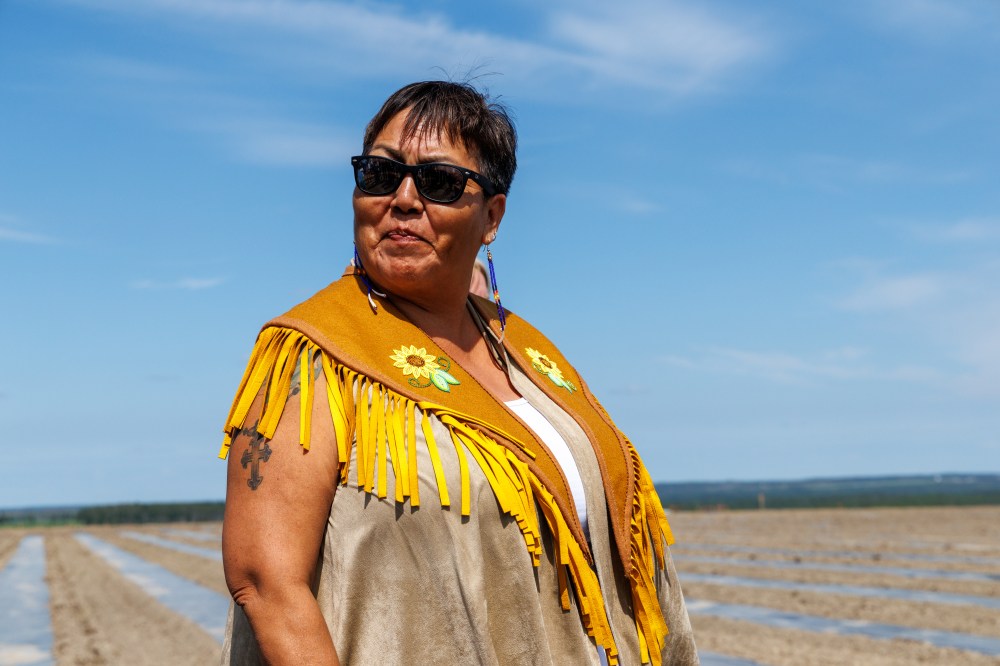
Chief Sherry Dominic of the Blueberry River First Nations, near Fort St. John, B.C., is shown in this handout photo during the unveiling of a new Indigenous-led commercial Native Plant Orchard on Tuesday, July 14, 2026. THE CANADIAN PRESS/Handout — Blueberry River First Nations (Mandatory Credit)

“So, eventually, (the orchard) will be putting the land back to its natural form,” Dominic said in an interview.

A crew of its members have been picking the initial seedlings for the orchard over the past two years, she said.

The plantation grew out of an agreement with the province in 2023, after a court found in 2021 that British Columbia had infringed on local treaty rights due to decades of industrial development.

The nation claimed its territory had an estimated 8,000 abandoned well sites and fully restoring the sites will require about 850 million trees and native plants.

The region has also suffered damage from wildfires, including the 2023 Donnie Creek fire, which is the largest recorded wildfire in B.C.’s history.

Dominic said restoration won’t happen overnight but the launch of the orchard itself marks an important moment.

“This is a huge milestone in Blueberry’s journey toward restoring and healing the land across our traditional territory,” Dominic said.

A background document said about 80 per cent of the 40-hectare facility will be used to grow plants for sale, while the remaining area is reserved for the 500-plus nation members to harvest their own supplies.

The chief said the facility will help her members exercise treaty rights, like picking berries for medicinal purposes, while learning and sharing traditional knowledge.

“This initiative delivers meaningful and long-term benefits to Blueberry members through employment, skills development opportunities and connection to our cultural roots,” Dominic said.

“I look forward to seeing our members harvesting there, and I am excited to witness how this project will upscale restoration across our region, which is sorely needed.”

The northeastern corner of British Columbia is a central hub of the province’s energy sector.

The Blueberry Restoration Society, which was established as part of the 2023 agreement with the province, is contributing $9.5 million toward the restoration project.

Another $200,000 comes from Grandmother’s Greenhouse, a subsidiary of Blueberry River Resources, which the nation owns.

The nation is part of the Treaty 8 Nations, a group that also includes seven other First Nations in B.C.

The treaty itself was signed in 1899 and covers 41 First Nations across northeastern British Columbia, northern Alberta, northwestern Saskatchewan and the southwest portion of the Northwest Territories.

This report by The Canadian Press was first published July 20, 2026.
Report Error Submit a Tip

More Stories

No more playing around, make 30 km/h school zones permanent

Tom Brodbeck 5 minute read Preview

No more playing around, make 30 km/h school zones permanent

Tom Brodbeck 5 minute read Yesterday at 2:07 PM CDT

Winnipeg has already decided that 30 kilometres per hour is the right speed around schools.

It’s time to stop pretending that decision should expire every summer.

The city’s reduced school-zone speed limits returned Tuesday, a full week before the 2026-27 school year begins. They apply on weekdays from 7 a.m. to 5:30 p.m., from Sept. 1 until July 1.

Then, for two months, they disappear.

Read
Yesterday at 2:07 PM CDT

Manitoba’s next power plant already under construction

Colleen Kuruluk 4 minute read 2:00 AM CDT

Across Manitoba, we’re rapidly moving toward a more electrified future, as homes, businesses, industries, and transportation increasingly turn to electricity. This transition offers a significant opportunity to reduce greenhouse gas emissions, but it also requires us to rethink how we plan for and participate in our energy future.

Manitoba Hydro’s 2025 integrated resource plan (IRP), currently under review with the Public Utilities Board, projects that our province will need significant additional capacity over the next decade to meet growing electricity demand. Much of the public discussion following the IRP has focused on how to meet that growing demand and what new generation sources may need to be built.

These are important conversations, but I believe there’s another question that deserves just as much attention.

How much of that growing demand can we address by using energy more efficiently?

Westwood standoff ends with two arrested

Morgan Modjeski and Erik Pindera 3 minute read Preview

Westwood standoff ends with two arrested

Morgan Modjeski and Erik Pindera 3 minute read Updated: Yesterday at 6:29 PM CDT

An hours-long standoff in Westwood came to an end Thursday with Winnipeg police arresting two men and seizing a gun.

Winnipeg Police Service officers were called to Byrd Avenue shortly before 9:30 a.m. after a man was seen walking with what appeared to be a firearm, said police spokesman Const. Claude Chancy.

Officers identified a home connected to the investigation, he said.

Two men were arrested but Chancy could not yet say what they will be charged with. It’s not clear whether either of the men arrested was the male spotted with a gun.

Read
Updated: Yesterday at 6:29 PM CDT

NDP defends involvement of U.S. company in Hydro project

Chris Kitching 5 minute read Preview

NDP defends involvement of U.S. company in Hydro project

Chris Kitching 5 minute read Wednesday, Sep. 2, 2026

A U.S. company that donated to Donald Trump’s 2025 presidential inauguration could build Manitoba Hydro’s proposed $3-billion natural gas turbines, which has drawn criticism from an environmental group amid the NDP government’s pushback to tariffs.

Read
Wednesday, Sep. 2, 2026

Former Gilbert Plains CAO forged doc’s note to get out of court: RCMP

Erik Pindera 4 minute read Preview

Former Gilbert Plains CAO forged doc’s note to get out of court: RCMP

Erik Pindera 4 minute read Updated: Yesterday at 4:10 PM CDT

A former rural municipal official awaiting sentencing for stealing more than $500,000 from community coffers has been accused of forging a fake doctor’s note to get out of attending court.

Amber Fisher, the former chief administrative officer for the Rural Municipality of Gilbert Plains, pleaded guilty to one count of theft over $5,000 last year.

Dauphin RCMP say investigators learned Fisher, 42, had submitted the note indicating she would be unable to attend court for her Sept. 2 sentencing, after she was seriously injured in a vehicle collision on July 22.

Fisher’s lawyer submitted the note to the court and the judge adjourned her sentencing to a later date.

Read
Updated: Yesterday at 4:10 PM CDT

‘Where are they going to go?’: encampment policy blamed for homeless people sleeping outside thrift store

Scott Billeck 5 minute read Preview

‘Where are they going to go?’: encampment policy blamed for homeless people sleeping outside thrift store

Scott Billeck 5 minute read Wednesday, Sep. 2, 2026

The owner of a Portage Avenue thrift shop says the city’s encampment ban has pushed dozens of homeless people from tent communities to spaces near her store.

Susan Lockhart, who runs Just Like New to You at 635 Portage Ave., says anywhere from 25 to 50 people can be found at any given time behind the store and along the back lane stretching between Sherbrook and Furby streets.

“Where are they going to go?” she said Wednesday from her shop. “I was just here on the weekend and I couldn’t get to our back door. There were people everywhere. Mattresses.”

Earlier this week, the city reported 275 people were known to be living in 72 encampments across Winnipeg — down from 100 encampments housing about 700 people last September. The report also noted that 141 sites have been remediated since the city’s encampment policy came into effect in November.

Read
Wednesday, Sep. 2, 2026