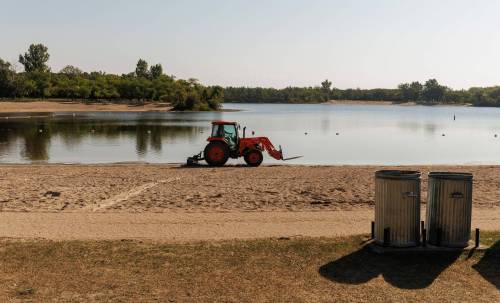
Dry, hot summers are putting Dutch dikes at risk and threatening German river trade
Advertisement
Read this article for free:
or
Already have an account? Log in here »
To continue reading, please subscribe:

Digital Subscription
One year of digital access for only $205*
- Enjoy unlimited reading on winnipegfreepress.com
- Read the E-Edition, our digital replica newspaper
- Access News Break, our award-winning app
- Play interactive puzzles
*First annual payment billed as $205.00 + GST for one year. This annual subscription will automatically renew at $233.00 + GST every 52 weeks (10% off the regular annual price of $259.35). Offer available to new and qualified returning subscribers only. Cancel any time.
To continue reading, please subscribe:
Add Free Press access to your Brandon Sun subscription for only an additional
$1 for the first 4 weeks*
- Enjoy unlimited reading on winnipegfreepress.com
- Read the E-Edition, our digital replica newspaper
- Access News Break, our award-winning app
- Play interactive puzzles
*Your next Brandon Sun subscription payment will increase by $1.00 and you will be charged $17.95 plus GST for four weeks. After four weeks, your payment will increase to $24.95 plus GST every four weeks.
Read unlimited articles for free today:
or
Already have an account? Log in here »
WADDINXVEEN, Netherlands (AP) — Jeroen Wouda and Dirk Boom walk slowly along a Dutch dike, prodding at the bone dry surface with metal rods and scanning the parched grass for patches of green that could give away the location of a leak.
In a scene that brings to mind the fictional Dutch boy who heroically plugs a hole in a dike with his finger, the two men are hunting for cracks in the low-lying Netherlands’ famed water defenses caused a drought that is gripping Europe and has fueled raging wildfires in France and Spain and sent the Danube and Rhine rivers to record low levels.
Unlike the low-tech solution in American author Mary Mapes Dodge’s 19th-century story, modern dike patrols are able to plot possible problems caused by drought in an app and send it to authorities who can then quickly carry our repairs.
In the Netherlands and neighboring Germany cargo ships that ply the Rhine and its offshoots have been forced to carry significantly less freight or risk running aground in shallow navigation channels. Farmers facing restrictions on irrigating their crops are warning of smaller fruit harvests and rising prices this season.
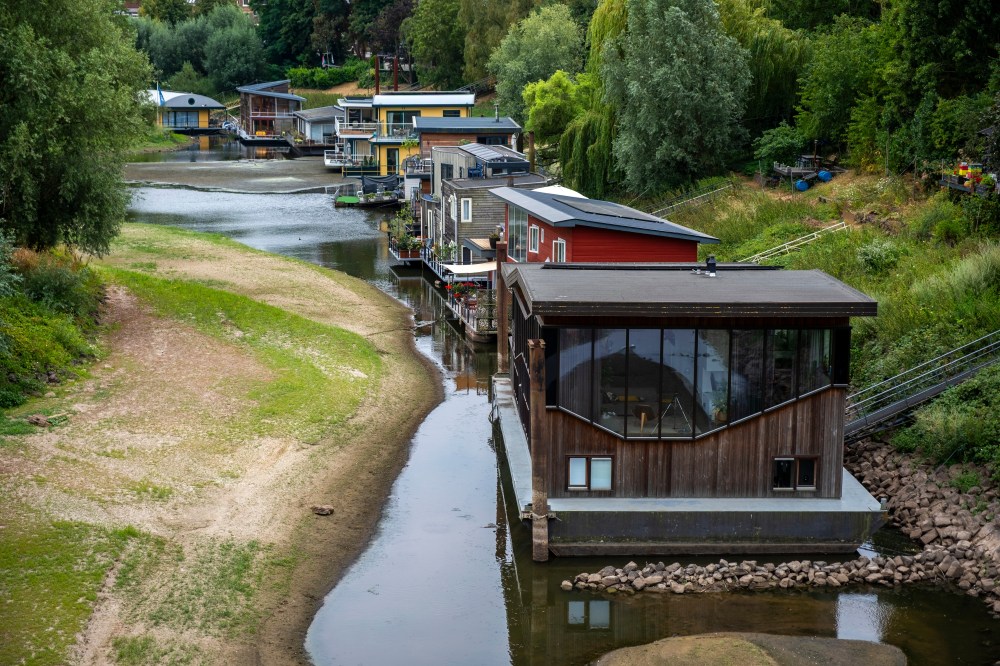
And for some houseboat owners, the drought has left their water-borne homes resting on sandy river bed.
Checking dikes for damage
Peter van Duijvendijk is a flood defense manager at the Schieland en de Krimpenerwaard water corporation, one of 21 such organizations covering the Netherlands that are responsible for issues including flood control.
He has a team of 140 volunteers who are responsible for checking about 100 kilometers (60 miles) of dikes, reporting any problems they find. So far this dry summer there have not discovered any major issues. But they remain alert now and likely into the fall.
The volunteers “are our eyes and ears on the dike,” Van Duijvendijk told The Associated Press.
Like many inland dikes, the barrier in agricultural fields near the small town of Waddinxveen, east of The Hague, is made of peat that needs to be damp to be strong enough to hold back water. It is in one of the lowest points in the Netherlands, some 5 meters (16 feet) below sea level.
“Because it is so dry right now the peat loses moisture, and because of that it becomes weaker,” Van Duijvendijk said. “If that peat becomes weaker, then there is a chance that water will flow through the dike and that waterway will drain into the polder,” referring to reclaimed Dutch land.
Cargo traffic choked by low river levels
Europe’s major rivers face a lack of water flow.
In Cologne, Germany, people walk along parts of the dried-up bed of the Rhine, a river that is a major highway for European freight traffic.
On Saturday, the Rhine’s water level in Cologne dropped below the record low set in October 2018. Marcel Beck, manager of the western German ports of Neuss, Düsseldorf and Cologne at RheinCargo, a port and freight transport company, said the levels are having a “devastating impact” on shipping.
“A ship that would normally carry 2,000 to 2,500 metric tons of cargo can now only transport 400, perhaps 600, metric tons depending on the ship’s design,” he said. “This places an enormous burden on the entire transport chain to reorganize everything in order to still get the goods inland.”
In the eastern Dutch city of Nijmegen, a rusted bicycle and shopping cart are exposed on the dried bed of the Waal — the main Dutch arm of the Rhine — and houseboats are left almost high and dry by receding water.
Frans Schilte has seen the summer periods of low water levels get longer in recent years. They used to last a month, but “now it’s like three months,” he said.
His steel-bottomed boat is now resting on the sandy river bed.
“It’s a little out of level, it’s not a big problem,” said Schilte, who describes the drought as “the negative effect of climate change.”
Water levels are a Dutch dilemma
The Netherlands, about a third of which is below sea level, is involved in a balancing act between preventing winter floods and having enough water for crops and canals in the summer.
“Throughout the year, we have enough water in the Netherlands, there’s no shortage,” said Vince Kaandorp, a groundwater hydrologist at Deltares, an independent Dutch water research institute.
“But, of course, it is not evenly distributed over the seasons,” Kaandorp said. “In the winter we drain it away quickly because we want to keep our feet dry and we don’t want water on the land. How can you ensure that you do that slowly and give water time to sink into the ground?”

Such measures don’t have to be high-tech, Kaandorp said. Adding something as simple as a hedge near a river slows down water and gives it time to seep deep into the ground. Authorities are studying how to turn soil into “sponges” to better hold water throughout the year.
The low-lying parts of the western Netherlands that are reclaimed land suffer increasingly from salinity in droughts, posing problems for farmers who grow fruit and vegetables in the fertile soil. Water authorities trying to maintain adequate supplies of fresh water have banned farmers in some parts of the country from pumping water out of canals to irrigate their crops.
“It is an extremely challenging year for growers,” John Kusters, chair of the Netherlands Fruit Growers’ Organization, said in a statement.
___
Associated Press journalists Ahmad Seir in Nijmegen, Netherlands, Daniel Niemann in Cologne, Germany, and Stefanie Dazio in Berlin contributed to this report.