Federal researchers say small harvesting changes may boost falling lobster catches

Advertisement

Advertise with us

HALIFAX - Federal researchers are studying ways to boost falling lobster populations in the Maritimes as climate change and other issues in recent years have put pressure on catches. 

Read this article for free:


or

Already have an account? Log in here »

To continue reading, please subscribe:

Subscribe and receive a limited-edition Free Press branded hat or tote.

Digital Subscription

One year of digital access for only $205*

  • Enjoy unlimited reading on winnipegfreepress.com
  • Read the E-Edition, our digital replica newspaper
  • Access News Break, our award-winning app
  • Play interactive puzzles

*First annual payment billed as $205.00 + GST for one year. This annual subscription will automatically renew at $233.00 + GST every 52 weeks (10% off the regular annual price of $259.35). Offer available to new and qualified returning subscribers only. Cancel any time.

To continue reading, please subscribe:

Add Free Press access to your Brandon Sun subscription for only an additional

$1 for the first 4 weeks*

  • Enjoy unlimited reading on winnipegfreepress.com
  • Read the E-Edition, our digital replica newspaper
  • Access News Break, our award-winning app
  • Play interactive puzzles
Start now

*Your next Brandon Sun subscription payment will increase by $1.00 and you will be charged $17.95 plus GST for four weeks. After four weeks, your payment will increase to $24.95 plus GST every four weeks.

HALIFAX – Federal researchers are studying ways to boost falling lobster populations in the Maritimes as climate change and other issues in recent years have put pressure on catches. 

A new report from the Fisheries Department says there’s no single measure to boost the sector, but a suite of tweaks to lobster harvesting practices over the short- and long-term could help. It considers shifting fishing seasons to earlier in the year, more protection for egg-bearing females and adjustments to the minimum and maximum sizes, among other changes. 

Adam Cook, a DFO research scientist and co-lead of the report, said the Maritimes lobster population is healthy. He said the work is about starting conversations with industry well before action is needed. 
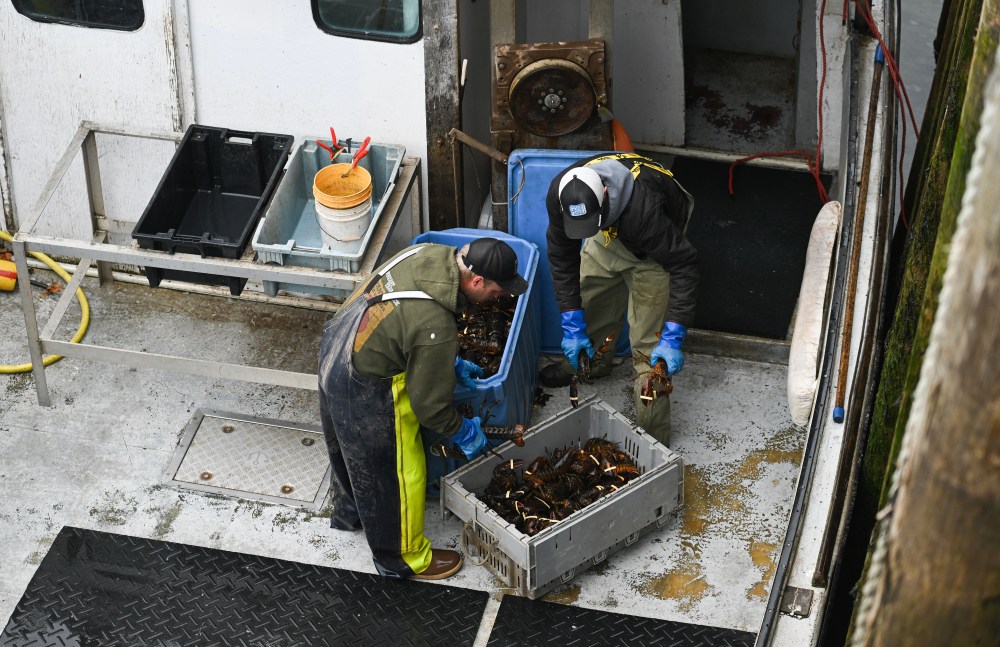
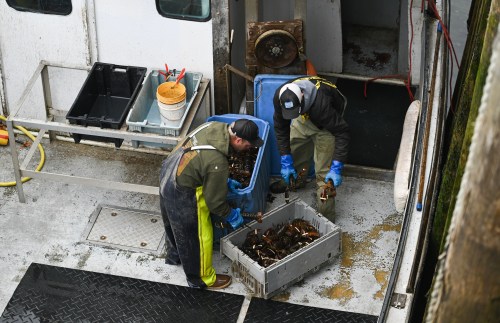
Lobster fishermen unload their catch in Dipper Harbour, New Brunswick on Tuesday, May 6, 2025. THE CANADIAN PRESS/Graham Hughes

“Oftentimes in fisheries, we’re reacting to a bad situation or when things start to collapse,” he said in an interview Tuesday. “Here, we’re trying to provide proactive advice so that everybody can be prepared and have these discussions, essentially before (they) have to.”

Cook said stocks are facing a number of pressures. Climate change is warming ocean waters so lobsters, which prefer cooler temperatures, are gradually moving north with fewer animals in the southern end of the range, typically around Maine and southwest Nova Scotia. Along with human fishing, lobsters are also impacted by changes in the ecosystem such as the state of plankton and predators in their area. 

Lobster fishing seasons are staggered at different times of the year across the Maritimes. The report said some are scheduled around lobster biology, such as avoiding the peak moulting season — when the animals shed their shells and are more vulnerable to injury and death. Meanwhile, it said other seasons are based on tradition. 

The report said adjusting fishing seasons so they start earlier in the year will avoid the warmer months when lobsters are moulting and mating. 

Increasing the maximum size of catchable lobsters could increase the breeding stock, as larger animals “contribute disproportionately to egg production over multiple years,” says the study.

While increasing the minimum size for legal lobster will help in the short term, the report says females can quickly grow past the threshold into a catchable size. That means they usually only see one more moulting before they’re allowed to be caught. 

In the U.S., fishermen are required to cut a small V-shaped notch into the tail of any egg-bearing female lobster and return it to the ocean. While keeping a notched female is illegal in Canada, fishermen in most areas north of the border are not legally required to make a new notch, but can do so on a voluntary basis. The report says notching more females could lead to long-term population growth but success would be highly dependent on implementation. 

“None of the changes you put in place are going to instantaneously help your stock, they’re all going to take a bit of time,” said Cook. 

“When we talk about things that are protecting eggs and larvae, those are going to take eight, 10 years before those larvae can come back to the commercial stock. So it’s never a bad time to be talking about, and thinking about, harvest controls and what makes sense for your fishery.”

Kris Vascotto, executive director of the Nova Scotia Seafood Alliance, participated in the project. He says the measures in the report would likely be welcomed by the sector, especially if they’re tailored to conditions at the local level. Releasing large adult lobsters, for instance, would make sense because there’s a narrow market for them anyway, and they’re difficult to handle. 

“I think, you’re really going to have to look at the individual fisheries to see whether they need it and what measure they actually need because every fishery is different and they’re all in different stages of development,” he said in an interview. “So you know a one-size-fits-all the whole of Atlantic Canada is going to be a challenging one to hit.”

Canada’s lobster fishery had a landed value of $1.97 billion in 2024. Almost half of that, about $962 million, was caught in Nova Scotia. 

New Brunswick lobster was valued at $323 million followed by P.E.I. at $318 million. Quebec lobster was worth $232 million and Newfoundland and Labrador landed about $137 million.

This report by The Canadian Press was first published Aug. 4, 2026.

Report Error Submit a Tip

More Stories

A measure of hope a decade after senseless death, injustice

Niigaan Sinclair 5 minute read Preview

A measure of hope a decade after senseless death, injustice

Niigaan Sinclair 5 minute read Friday, Aug. 7, 2026

I’m a few hundred kilometres from the farm near Biggar, Sask. — the place where 22-year old Colten Boushie from Cree Red Pheasant First Nation was shot and killed by farmer Gerald Stanley precisely 10 years ago.

“You need to remind people about the 10-year anniversary,” a nearby, rural school principal tells me at the education conference I just finished speaking at.

“That death is a wound that continues to bleed in all of us,” a principal from Regina adds. “I hear about it from our students all the time.”

On Aug. 9, 2016, Boushie’s death entered the Canadian consciousness, representing what then-Saskatoon mayor Charlie Clark declared “a defining moment for this community and this country.”

Read
Friday, Aug. 7, 2026

As the world watches, Haiti’s hopes continue to fade

Peter McKenna 5 minute read Preview

As the world watches, Haiti’s hopes continue to fade

Peter McKenna 5 minute read 2:00 AM CDT

I wish that I had something uplifting and positive to say about the circumstances in Haiti today.

Read
2:00 AM CDT

Bombers look to rally vs. Redblacks

Taylor Allen 5 minute read Preview

Bombers look to rally vs. Redblacks

Taylor Allen 5 minute read Yesterday at 6:46 PM CDT

Mike O’Shea is guilty of wearing rose-tinted glasses at times.

There have been situations where a certain player, or the team as a whole, has obviously struggled, and the head coach of the Winnipeg Blue Bombers will downplay the questioning.

But not even O’Shea could take a glass-half-full approach to his team’s most recent performance.

The Bombers, who were on a bye last week, returned to work on Sunday at Fort Garry Lions Field for the first time since suffering an inexcusable 35-19 home loss to the B.C. Lions on July 30.

Read
Yesterday at 6:46 PM CDT

Federal researchers say small harvesting changes may boost falling lobster catches

Devin Stevens, The Canadian Press 4 minute read Preview

Federal researchers say small harvesting changes may boost falling lobster catches

Devin Stevens, The Canadian Press 4 minute read Tuesday, Aug. 4, 2026

HALIFAX - Federal researchers are studying ways to boost falling lobster populations in the Maritimes as climate change and other issues in recent years have put pressure on catches. 

A new report from the Fisheries Department says there’s no single measure to boost the sector, but a suite of tweaks to lobster harvesting practices over the short- and long-term could help. It considers shifting fishing seasons to earlier in the year, more protection for egg-bearing females and adjustments to the minimum and maximum sizes, among other changes. 

Adam Cook, a DFO research scientist and co-lead of the report, said the Maritimes lobster population is healthy. He said the work is about starting conversations with industry well before action is needed. 

“Oftentimes in fisheries, we're reacting to a bad situation or when things start to collapse,” he said in an interview Tuesday. “Here, we're trying to provide proactive advice so that everybody can be prepared and have these discussions, essentially before (they) have to.”

Read
Tuesday, Aug. 4, 2026

Making sure no one has to face cancer alone

AV Kitching 5 minute read Preview

Making sure no one has to face cancer alone

AV Kitching 5 minute read 6:00 AM CDT

From Brenda Stamm’s perspective, every person has a higher calling.

“The way I look at it, you have a purpose in life. You have to give back and that’s what I try to do,” she says.

Stamm, 68, has been volunteering with the Canadian Cancer Society and other cancer-related charities for more than 20 years.

She is familiar face at fundraising events, community campaigns and the breast cancer fundraiser, CIBC Run for the Cure. She helps organize fundraising efforts, collects donations and recruits as well as “coaches” volunteers on how best to raise funds.

Read
6:00 AM CDT

Vibrant Norwood apartment garden a labour of love to honour green thumb’s late partner

David Sanderson 7 minute read Preview

Vibrant Norwood apartment garden a labour of love to honour green thumb’s late partner

David Sanderson 7 minute read Saturday, Aug. 8, 2026

St. Vital resident Rob Duncan can’t pinpoint when he first noticed an award-winning garden blanketing the grounds of a two-storey St. Mary’s Road apartment block, near Coniston Street.

Perhaps he was on his way home from work and caught a glimpse of it out of the corner of his eye. Or maybe he was running errands in the Norwood Flats area and paused to admire the array of annuals, perennials and potted plants that extends from the block’s doorway to the front curb.

What Duncan does know for certain is that after spying the urban oasis, twice fêted in Take Pride Winnipeg’s annual Winnipeg in Bloom competition, he couldn’t unsee it.

“First of all, the pink building really stands out,” Duncan says, referring to the brightly painted California Apartments complex at 268 St. Mary’s Rd. “But then you have the pergola, the rock garden, the flowers and trees… a sea of colour on a very busy street.”

Read
Saturday, Aug. 8, 2026