In Weimar, a festival preserves Yiddish culture while reinventing it
Advertisement
Read this article for free:
or
Already have an account? Log in here »
To continue reading, please subscribe:

Digital Subscription
One year of digital access for only $205*
- Enjoy unlimited reading on winnipegfreepress.com
- Read the E-Edition, our digital replica newspaper
- Access News Break, our award-winning app
- Play interactive puzzles
*First annual payment billed as $205.00 + GST for one year. This annual subscription will automatically renew at $233.00 + GST every 52 weeks (10% off the regular annual price of $259.35). Offer available to new and qualified returning subscribers only. Cancel any time.
To continue reading, please subscribe:
Add Free Press access to your Brandon Sun subscription for only an additional
$1 for the first 4 weeks*
- Enjoy unlimited reading on winnipegfreepress.com
- Read the E-Edition, our digital replica newspaper
- Access News Break, our award-winning app
- Play interactive puzzles
*Your next Brandon Sun subscription payment will increase by $1.00 and you will be charged $17.95 plus GST for four weeks. After four weeks, your payment will increase to $24.95 plus GST every four weeks.
Read unlimited articles for free today:
or
Already have an account? Log in here »
In Weimar, Germany, where the streets once echoed with the notes and ideas of Bach, Liszt and Goethe, another European musical tradition has been reverberating for more than a quarter-century: Yiddish.
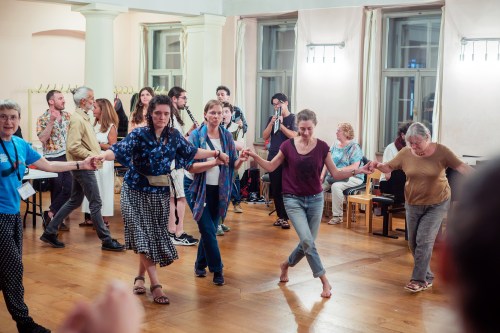
The annual Yiddish Summer Weimar festival brings hundreds of musicians, students and scholars to the city — most famous for the ill-fated republic that preceded Nazi Germany — for workshops, concerts and performances celebrating the language, music and culture of Ashkenazi Jews — a culture the Nazis sought to destroy but that has continued to reinvent itself. Since 1998, the program has both grown alongside and influenced the growth of interest in Yiddish language and culture from a wide swath of society, Jew and gentile, young and old, religious and secular alike.“
From the beginning, (the idea was) to present Yiddish culture as something which is alive, and not something that was entirely destroyed by the Shoah (Holocaust),” said Alan Bern, the founder and artistic director of Yiddish Summer Weimar.
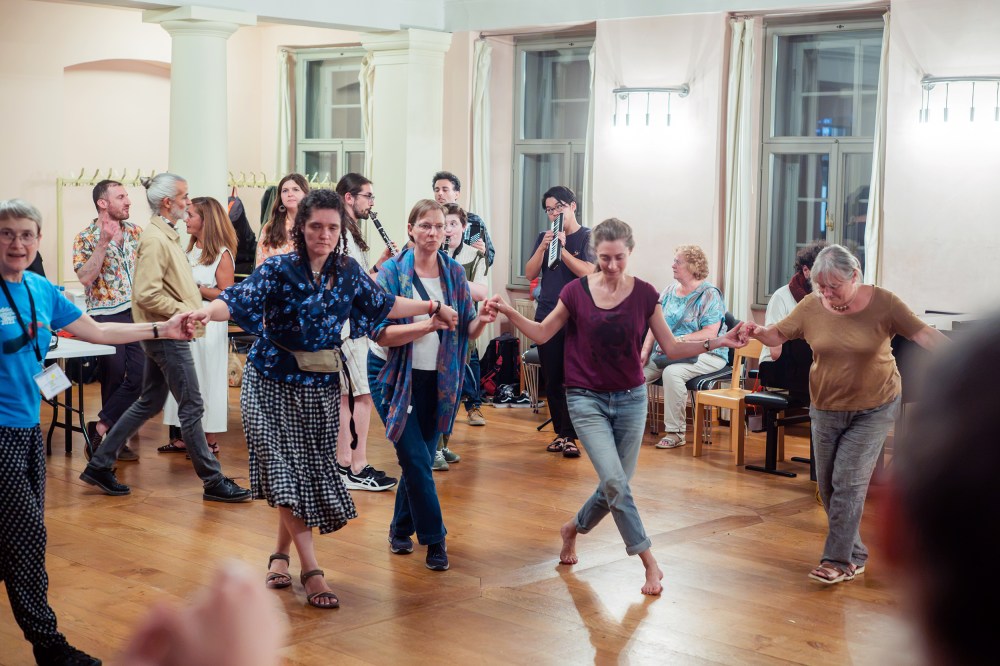
This year the program ran from July 11-Aug. 15, with Aug. 8-15 being the festival week.
___
This content is written and produced by Religion News Service and distributed by The Associated Press. RNS and AP partner on some religion news content. RNS is solely responsible for this story.
___
Before 1939, Yiddish was spoken by well over 11 million people worldwide, including the vast majority of Europe’s Jews. The language is closely related to — but distinct from — German, with a heavy admixture of Hebrew and Aramaic vocabulary, Slavic grammar and other influences.
Stretching back to the 10th century, Yiddish followed Ashkenazi Jewish communities as they migrated from the Rhineland in what is today western Germany to Eastern Europe, into lands such as Poland, Lithuania, Ukraine, Hungary and ultimately on to the new world. Over that millenia, a rich culture of literature, music and thought was created in Yiddish — before its world was largely snuffed out during World War II.
“Jewish culture, Yiddish culture, has a different ‘yichus’ than Western European classical culture,” said Bern, using the Yiddish word for lineage. It came not from the courts of the aristocracy but the masses of the Jewish street, and he believes it’s one of Europe’s great cultural treasures nonetheless.
Since its start, the festival has grown from a weekend workshop with a handful of participants to the largest festival of its kind in Europe, lasting more than a month, with daily workshops drawing hundreds of participants and near-nightly concerts attended by over 10,000 people total, Bern said.
That’s particularly an achievement in Germany, where Yiddish was once almost exclusively associated with the Holocaust.
“We’re not in a constant posture of mourning the past,” Bern said. “We’re also living and creating, so the fact that we’re talking about a living, creative culture, which is not in denial of the past, but also not stuck in the past, was, I think, surprisingly refreshing to people already in 1998, and it still is today.”
Yiddish is undergoing a sort of renaissance in the 21st century. The language remains the primary tongue of growing ultra-orthodox Jewish communities from New York to Israel, creating a demand for print and other forms of media in the Yiddish language.
“We have a huge Hasidic pop culture, a contemporary pop culture, which is growing day by day, and where you see often mixing of different elements,” said Eidel Malowicki, who grew up in a Hasidic family in Vienna and is one of the Yiddish teachers at Yiddish Summer Weimar. “Now you even have Hasidic Rap, and it’s a repertoire that is growing every day. … there’s new comics coming out, new magazines.”
Meanwhile, Yiddish is drawing interest from other sectors of the Jewish community, too, as well as some outside of it. For many young secular Jews, Yiddish has provided a route for connection with their heritage and Jewish identity unaffiliated with Zionism — and its stark support for the Hebrew language — that they have become increasingly disillusioned with.
For Dan Kedem, who came from the Tel Aviv area to volunteer at Yiddish Summer Weimar, Yiddish is “a sort of path of redemption from the reality that I grew up in within Israel,” he said. He described feeling like the Jewish story taught to him in Israel was “linear” and “narrow.”
“So one of the things that I found most fascinating about Yiddish is that exploration of this other Jewish culture, identity and root system of paths and ideas has allowed me to explore my own identity through a much wider lens and open myself to new ideas and new thoughts,” Kedem said.
Opportunities for Yiddish language study have exploded across the world, and a report by the Yiddish academic journal Ingeveb cited over two dozen programs, camps and festivals in the summer of 2026 alone. The popular language-learning app Duolingo reported nearly 300,000 users for its Yiddish language course this year, the majority of whom are under 25, according to a recent report by RNS and NPR.
Bern estimated that at least half of the participants at Yiddish Summer Weimar are not Jewish. For many of them, connecting with the Yiddish language fills a gap in their national histories and European identity.
“The Jewish world, for me, as a German cis male, has always been something like a secret world, something unknown, something maybe a little bit mysterious,” said Michael Panzner, an intercultural consultant from Frankfurt, Germany. “But I know that it’s very relevant for Germany’s and Europe’s history and development over the centuries.”
Growing up, he never knew any Jews in Germany, and when he met some as an adult in North America, he didn’t feel comfortable asking his many questions. In Weimar, he said, he found an opportunity to explore this culture he thought was lost from his country in a non-judgmental environment. He hopes to continue going for many more years.“
I think (Yiddish) is being given way too little attention in today’s cultural life and social life,” he said.
Malowicki agreed, saying many of her students see Yiddish as an “entry ticket into a culture.”
And while Hasidic dialects are by far the most spoken among modern Yiddish speakers, opportunities to learn the Hasidic dialect from native speakers like Malowicki are relatively rare.
“I see it as a chance to create a bridge between worlds that otherwise wouldn’t have a bridge or a connection,” she said. “I think that there’s a lot that we can learn from one another and our different worlds.”
Such experiences are exactly what Bern hoped participants would find in the program.“
I and my colleagues definitely view Yiddish from a transcultural and transnational point of view,” Bern said. “That’s also unusual for people who tend to think of Yiddish as the culture of some isolated shtetl in the East and separate from all other cultures and doesn’t have any links toother cultures.”
To that end they have long worked to involve countries and cultures far outside of Ashkenazi Jewry in the program. In the past that has included youth orchestras from Poland and France, and today the Yam Ensemble, which brings together young musicians from Germany, Greece and Turkey to explore the shared influences and heritage of Mediterranean and Klezmer music.
Of all the places for a festival of Yiddish culture in Europe, Weimar may seem like a strange place.
Unlike Warsaw, Vilnius, Krakow and other cities where there are Yiddish programs and cultural festivals, Weimar is not a great city of Jewish or Yiddish speaking history. But it couldn’t have found a more fitting or important home, Bern stressed.
The city is most associated with two things, European high culture and the rise of fascism. It’s where Adolf Hitler reformed the Nazi Party in 1926. And just as Weimar and the Thuringia region became a hot bed of support for the Nazi Party in the 1920s and 30s, it’s also the largest base today for the far-right Alternative für Deutschland Party, often labeled a Neo-Nazi party.

“It’s very ironic to think that here is a place that has a large Yiddish music festival, maybe one of the biggest in the world, and sold out concerts and everything, and it’s this same environment in which there’s a neo-Nazi movement that is just growing all the time,” Bern said.
As for Weimar’s place in European cultural history, Yiddish isn’t out of place either, Andreas Schmitges, the festival’s curator, said.
“Weimar is a place of what they call German hochkultur (high culture). I mean Goethe, Schiller, Bauhaus, Liszt, everything is hochkultur,” Schmitges told RNS. “To be honest, I think that Yiddish culture is right here in the right place where it belongs because it’s also one of Europe’s hochkulturen (high cultures), so this is a perfect place.
___
Associated Press religion coverage receives support through the AP’s collaboration with The Conversation US, with funding from Lilly Endowment Inc. The AP is solely responsible for this content.
The Free Press acknowledges the financial support it receives from members of the city’s faith community, which makes our coverage of religion possible.