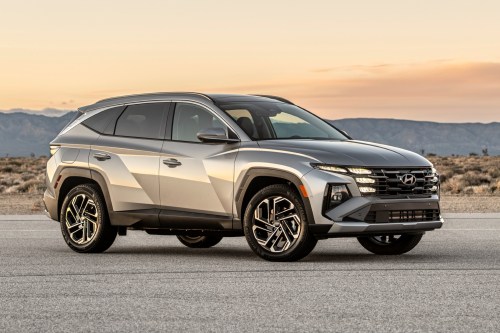
Toyota RAV4 vs. Hyundai Tucson, an Edmunds plug-in hybrid SUV comparison

Advertisement

Advertise with us

If you’re looking to reduce your gas bills but buying an electric vehicle just isn’t for you, the 2026 Hyundai Tucson Plug-in Hybrid or 2026 Toyota RAV4 Plug-in Hybrid might be a smart solution. These are hybrid SUVs that drive like a regular gas-powered hybrid but have a rechargeable battery that lets you drive a short distance on all-electric power first. Frequently charging the battery at home for routine driving can significantly reduce your gasoline use. But which plug-in hybrid version of these popular small SUVs is the better choice? Edmunds’ auto experts tested them both to find out.

Read this article for free:


or

Already have an account? Log in here »

To continue reading, please subscribe:

Subscribe and receive a limited-edition Free Press branded hat or tote.

Digital Subscription

One year of digital access for only $205*

  • Enjoy unlimited reading on winnipegfreepress.com
  • Read the E-Edition, our digital replica newspaper
  • Access News Break, our award-winning app
  • Play interactive puzzles

*First annual payment billed as $205.00 + GST for one year. This annual subscription will automatically renew at $233.00 + GST every 52 weeks (10% off the regular annual price of $259.35). Offer available to new and qualified returning subscribers only. Cancel any time.

To continue reading, please subscribe:

Add Free Press access to your Brandon Sun subscription for only an additional

$1 for the first 4 weeks*

  • Enjoy unlimited reading on winnipegfreepress.com
  • Read the E-Edition, our digital replica newspaper
  • Access News Break, our award-winning app
  • Play interactive puzzles
Start now

*Your next Brandon Sun subscription payment will increase by $1.00 and you will be charged $17.95 plus GST for four weeks. After four weeks, your payment will increase to $24.95 plus GST every four weeks.

If you’re looking to reduce your gas bills but buying an electric vehicle just isn’t for you, the 2026 Hyundai Tucson Plug-in Hybrid or 2026 Toyota RAV4 Plug-in Hybrid might be a smart solution. These are hybrid SUVs that drive like a regular gas-powered hybrid but have a rechargeable battery that lets you drive a short distance on all-electric power first. Frequently charging the battery at home for routine driving can significantly reduce your gasoline use. But which plug-in hybrid version of these popular small SUVs is the better choice? Edmunds’ auto experts tested them both to find out.

Range and Fuel Economy

Toyota estimates that the main RAV4 Plug-in Hybrid trim levels will go up to 54 miles on all-electric power, while the sporty GR Sport trim will go 48 miles. In Edmunds’ testing, a GR Sport went an impressive 58 miles before the battery ran out. After that, the EPA estimates that the RAV4 Plug-in Hybrid will get up to 40 mpg in combined city/highway driving. Edmunds also found this mpg estimate to be accurate in its real-world testing.
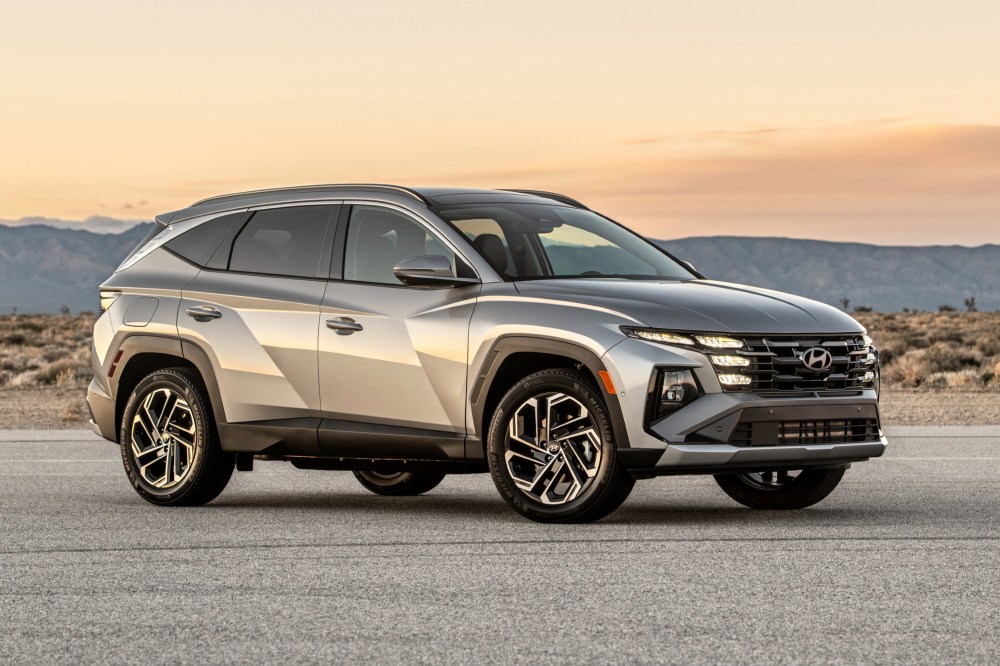
This photo provided by Hyundai shows the the plug-in hybrid 2026 Hyundai Tucson. (Hyundai via AP)

Head-to-head, the Tucson Plug-in Hybrid comes up short on both metrics. The EPA says the vehicle can go 32 miles using all-electric power and then 35 mpg combined afterward. The Tucson Plug-in Hybrid slightly exceeded those estimates in Edmunds’ testing, but it wasn’t enough to overcome the RAV4’s big range and mpg advantage.

Winner: RAV4 Plug-in Hybrid

Passenger comfort and cargo space

While the regular hybrid Tucson has more cargo space than the RAV4, that advantage disappears with the plug-in hybrid. In fact, Toyota offers just a little more: 33.6 cubic feet behind the rear seats versus 31.9 cubic feet. In real-world testing, however, Edmunds found that both SUVs provide large, relatively boxy spaces that make loading luggage and gear easy.

The Tucson’s passenger space advantage is more apparent. The specs show that it has 41.3 inches of rear legroom versus the RAV4’s 37.8 inches. That’s a pretty big gap, and it’s one you’re bound to notice — both for adults and teenagers, as well as kids in child seats. Edmunds’ editors also found the Hyundai’s plush and supportive front seats more comfortable than the too firm and too high RAV4’s. The Tucson’s ride over bumps is more comfortable, too.

Winner: Tucson Plug-in Hybrid

Technology features

Both the Tucson and RAV4 achieved sky-high infotainment scores of 9.7 out of 10 from the Edmunds testing team in terms of usability and connectivity features. The RAV4’s is also a newer and improved system than what’s found in other Toyotas.

That said, the Toyota relies on an internet connection for certain key functions like navigation and voice controls, which means that you’ll need to pay for a subscription after the trial period runs out. The Tucson’s are integrated into the system and don’t require an internet connection, though its navigation search capability isn’t as strong.

The Hyundai comes standard with a large 12.3-inch center touchscreen, whereas the RAV4 offers two sizes: a 10.5-inch unit for less expensive trim levels and a 12.9-inch screen for fancier trims. Overall, the tech you get in these two SUVs is pretty comparable.

Winner: tie

Pricing and value

The base prices for both start just over $42,000 and top out at around $50,000, including destination fees. At that top price, the Tucson is as loaded as it can be. To get up to the Hyundai’s feature content, you still have to add some options to the RAV4 XSE, and that hikes the price beyond $52,000.

The Tucson also has a higher-quality interior with better-looking and -feeling materials throughout. The RAV4 has taken a step back in this regard for this latest generation. Hyundai’s basic and powertrain warranty coverage is also superior to Toyota’s.

Winner: Tucson Plug-in Hybrid

Style and variety

Toyota offers more versions of its plug-in hybrid than Hyundai does. In addition to the SE and XSE, you can get the outdoorsy Woodland and the sharper-handling GR Sport. Basically, you don’t have to sacrifice distinctive style, functionality or driving enjoyment to go with a plug-in hybrid.

By contrast, the Tucson is offered in just two trim levels: SEL and Limited. The gas-only Tucson’s XRT trim isn’t available, and even if it were, it’s more of an off-roady appearance package than the more capable Woodland. If you want something a little cooler than the norm, the RAV4 will be more appealing.

Winner: RAV4 Plug-in Hybrid

Edmunds says

This is a very close call, but ultimately, the RAV4’s significant all-electric range and fuel economy put a big ol’ brick on the scoring scales. The Tucson is more appealing in many ways, but when it comes to the main thing that you’ll want from your plug-in hybrids — saving on gas — the RAV4 carries the day.

_____

This story was provided to The Associated Press by the automotive website Edmunds. James Riswick is a contributor at Edmunds.


Report Error Submit a Tip

More Stories

Six high school hockey programs ceased operations following new Hockey Manitoba policy

Joshua Frey-Sam 7 minute read Preview

Six high school hockey programs ceased operations following new Hockey Manitoba policy

Joshua Frey-Sam 7 minute read Friday, Oct. 2, 2026

She lived the best of both worlds.

For the last three years, the 17-year-old wore a sweater for two different hockey programs — her high school team and AAA club in the Manitoba Female Hockey League — and was preparing to flourish in both colours again this winter.

Recently, however, the blue-liner was disappointed to learn she is no longer eligible to play her Grade 12 season with her school owing to a new policy imposed by Hockey Manitoba that bans players from participating in the Manitoba Women’s High School Hockey League if they are rostered on a U18 AAA team.

The rule applies to all athletes who play for both Winnipeg-based and rural AAA teams.

Read
Friday, Oct. 2, 2026

Thank Manitoba’s teachers by investing in students

Lillian Klausen 5 minute read 2:00 AM CDT

Manitoba’s students are settling into a new school year. Whether you graduated in 1986 or 2006, today’s classrooms look very different from the ones you remember.

Students reflect the changing makeup of our communities — differences in social, emotional, physical and cognitive abilities and socioeconomic stresses are all increasingly present and adding to the complexity of our classrooms.

Meeting these differing individual needs is no easy feat. It requires manageable class sizes, school counsellors, social workers, specialized resource teachers and investment in the systems that can help students thrive. But when those supports aren’t available, students’ needs don’t disappear. Increasingly, it falls to classroom teachers to try to fill the gaps.

When I started working as a teacher more than 30 years ago, we had budgets for resources when we needed them. Today, the needs of students have diversified and increased, but the funding for our public schools is failing to meet them.

Wasteful operations should be held accountable

Barry E. Prentice 5 minute read Preview

Wasteful operations should be held accountable

Barry E. Prentice 5 minute read 2:00 AM CDT

Rising water bills are a top-of-mind issue for residents of Winnipeg going into the fall election. Management of the water and waste system is under question, with citizen’s groups, as well as the Free Press, calling for proper oversight of rates (Time for the PUB to review Winnipeg water rates, Editorial, Sept. 26).

The need to increase rates to build the North End sewage plant is understandable. Siphoning off utility proceeds to make up other tax revenue shortfalls is another matter. But it is not the only questionable practice. If there was Public Utilities Board oversight of Winnipeg’s water and sewer rates, it would certainly be asking why the city is spending more than $3 million annually to operate the 164-kilometre-long, Greater Winnipeg Water District railway (GWWD) on ratepayers’ behalf.

The GWWD has come to the attention of the Railway Relocation Study, led by Lloyd Axworthy. All existing rail lines within the city are under review, as is the feasibility of a new railway bypass.

The GWWD is an example of a railway that has outlived its usefulness and sits on a pocket of land close to downtown that could be converted to higher-value uses.

Read
2:00 AM CDT

Toyota RAV4 vs. Hyundai Tucson, an Edmunds plug-in hybrid SUV comparison

James Riswick Of Edmunds, The Associated Press 5 minute read Preview

Toyota RAV4 vs. Hyundai Tucson, an Edmunds plug-in hybrid SUV comparison

James Riswick Of Edmunds, The Associated Press 5 minute read Wednesday, Sep. 2, 2026

If you’re looking to reduce your gas bills but buying an electric vehicle just isn’t for you, the 2026 Hyundai Tucson Plug-in Hybrid or 2026 Toyota RAV4 Plug-in Hybrid might be a smart solution. These are hybrid SUVs that drive like a regular gas-powered hybrid but have a rechargeable battery that lets you drive a short distance on all-electric power first. Frequently charging the battery at home for routine driving can significantly reduce your gasoline use. But which plug-in hybrid version of these popular small SUVs is the better choice? Edmunds’ auto experts tested them both to find out.

Range and Fuel Economy

Toyota estimates that the main RAV4 Plug-in Hybrid trim levels will go up to 54 miles on all-electric power, while the sporty GR Sport trim will go 48 miles. In Edmunds’ testing, a GR Sport went an impressive 58 miles before the battery ran out. After that, the EPA estimates that the RAV4 Plug-in Hybrid will get up to 40 mpg in combined city/highway driving. Edmunds also found this mpg estimate to be accurate in its real-world testing.

Head-to-head, the Tucson Plug-in Hybrid comes up short on both metrics. The EPA says the vehicle can go 32 miles using all-electric power and then 35 mpg combined afterward. The Tucson Plug-in Hybrid slightly exceeded those estimates in Edmunds’ testing, but it wasn’t enough to overcome the RAV4’s big range and mpg advantage.

Read
Wednesday, Sep. 2, 2026

’Disgusting’ posters being investigated by police

Morgan Modjeski 4 minute read Saturday, Oct. 3, 2026

The Winnipeg Police Service major crimes unit is investigating what some have labelled offensive and hateful posters on full-display at a Winnipeg home.

One of the people irked by the display is Gracie Garrett. She’s has lived on Ashburn Street in Winnipeg’s Minto neighbourhood for almost ten years. She’s never felt unsafe in the neighbourhood before, but now, a set of posters plastered on a nearby house are making her feel uneasy.

The five signs, posted facing the street prominently on a front window, contain a slur, refer to Nazis as “heroes” and call Muslims, Christians and other groups “evil.”

Learning of the signs Friday, Garrett said she’ll be reporting the posters to police, as she worries they incite and promote violence.

Jets get first win of new NHL season

1 minute read Updated: Yesterday at 6:25 PM CDT

DETROIT - The Winnipeg Jets have their first victory of the new NHL season.

Stuart Skinner made 33 saves and the visitors struck three times on the power play to skate away with a 3-2 triumph over the Detroit Red Wings on Sunday afternoon.

Kyle Connor led the way with two goals and an assist, while Cole Perfetti had the other tally along with two helpers. Jets defenceman Josh Morrissey chipped in with two assists.

Tyrel Bauer also scored a decisive victory in a fight with Red Wings forward (and Winnipeg native) Keegan Kolesar.