Families’ interest in their kids’ education is falling around the globe as scores drop, test shows
Advertisement
Read this article for free:
or
Already have an account? Log in here »
To continue reading, please subscribe:

Digital Subscription
One year of digital access for only $205*
- Enjoy unlimited reading on winnipegfreepress.com
- Read the E-Edition, our digital replica newspaper
- Access News Break, our award-winning app
- Play interactive puzzles
*First annual payment billed as $205.00 + GST for one year. This annual subscription will automatically renew at $233.00 + GST every 52 weeks (10% off the regular annual price of $259.35). Offer available to new and qualified returning subscribers only. Cancel any time.
To continue reading, please subscribe:
Add Free Press access to your Brandon Sun subscription for only an additional
$1 for the first 4 weeks*
- Enjoy unlimited reading on winnipegfreepress.com
- Read the E-Edition, our digital replica newspaper
- Access News Break, our award-winning app
- Play interactive puzzles
*Your next Brandon Sun subscription payment will increase by $1.00 and you will be charged $17.95 plus GST for four weeks. After four weeks, your payment will increase to $24.95 plus GST every four weeks.
Read unlimited articles for free today:
or
Already have an account? Log in here »
Families’ interest in their kids’ education is falling in many high-income countries as school systems struggle with plunging test scores, according to newly released results from a standardized test taken by 15-year-olds around the world.
Over 760,000 teenagers in dozens of countries took the Programme for International Student Assessment last year. Results released Tuesday show average scores in math, reading and science are all at their lowest point in PISA history among highly developed economies. That includes continued declines in reading and math scores in the U.S.
China, Singapore, Taiwan, Japan and South Korea scored the highest marks on the test. Estonia, the United Kingdom and New Zealand also did well.
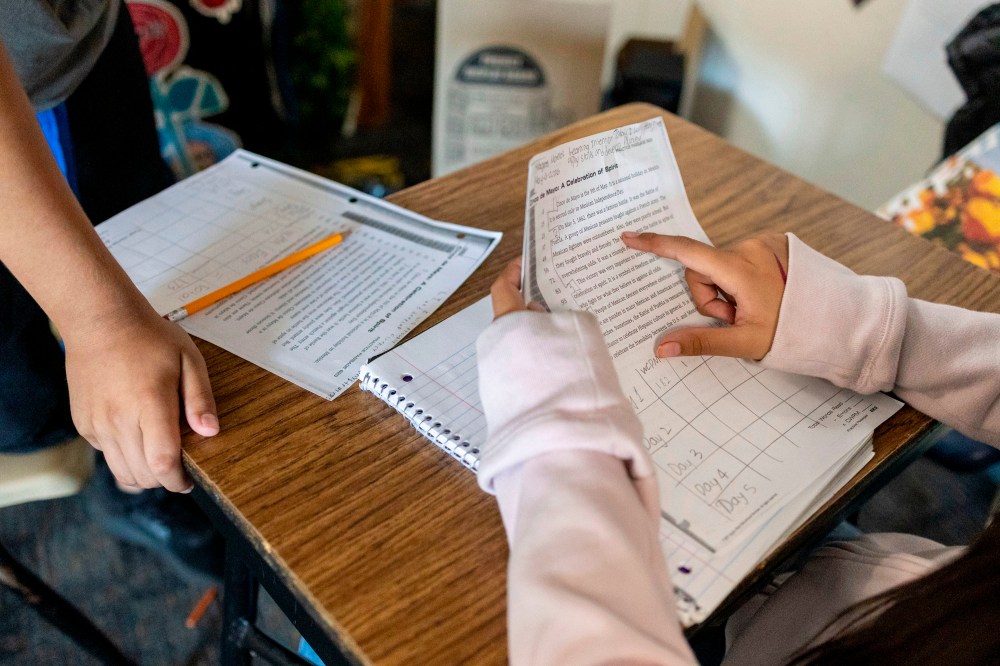
The key to why scores are falling so widely may be found in an accompanying survey taken by students.
Compared with the 2022 results, almost every country saw a drop in families’ support for their kids’ education, especially for boys, as measured by questions about how often parents talk to their kids about their schoolwork or take an interest in their learning.
“Parents see themselves more as a client of the school, not as someone who takes personal interest,” said Andreas Schleicher, director for education and skills for the Organization for Economic Cooperation and Development, which runs the PISA test.
Students who said a family member asks them at least weekly what they did in school that day scored around 35 points higher on the PISA science test — equivalent to over a year and a half of learning — compared with students whose families take less interest. That number includes adjustments for socioeconomic differences.
Digital distraction is another factor. Over a quarter of students in high-income countries complained their classmates got distracted by digital devices in most or every science class. In countries with strong policies controlling the use of cellphones in schools, distraction rates were lower.
There’s undoubtedly a strong association between students using digital devices for leisure and lower test scores, Schleicher said. When tech is used for learning, however, the results are more nuanced.
Countries where high schoolers reported using digital devices for around two to three hours per day in school saw higher test scores, but scores fell once tech use climbed beyond that.
Asian nations dominate in test scores
Asia seems to have found the key to using technology in a way that benefits students. Fewer than 10% of tested students in Japan, Korea and mainland China complained of digital distraction in the classroom. (Only four provinces in China participated in testing, plus Hong Kong and Macao.)
At the same time, Asia had some of the strongest schools in the world, with Japan, Korea, Taiwan, Singapore and the Chinese provinces ranking among the top 10 regions for math, science and reading.
Almost 100% of all children in the Chinese provinces scored at or above baseline for math and reading. In the U.S., it was only 65% in math and 74% in reading.
Experts worry China’s educational dominance over the U.S. has serious political implications.
“To win a technological race, you need the people with the science and the technology and the reading capabilities,” said Tracey Burns, chief of global strategy and research at the National Center for Education and the Economy, a group that researches high-performing education systems.
The U.S. scores for math were equal to the average among OECD countries that administered the test, and the U.S. was ranked in the top 15 countries in the world for science, reading and computational problem-solving, a new category. However, those rankings benefited from other countries’ declines. After all, U.S. teens’ reading and math scores slid to the lowest point since the PISA test was first administered in the early 2000s.
Researchers warned the results must be taken with a grain of salt because the U.S. did not meet standards for having a large enough sample of schools and students that participated in the test.
More AI usage, less learning
Generally, higher use of artificial intelligence was associated with lower test scores. Students who said they never use chatbots performed better than students who did. Almost half of students in developed economies say they use AI chatbots to help them learn at least weekly.
Schleicher pointed to China, Japan, Singapore and Estonia as countries that have succeeded in using AI to support learning without overusing it. He noted that in Asia, in particular, teachers are more empowered to take the lead in designing AI systems for the classroom.
“In the United States, teachers largely implement lessons. In Asia, teachers have a very strong role,” he said.
He remembers seeing one classroom in China where elementary schoolers practiced calligraphy with ink and brushes. The teachers scanned their work and used AI to analyze how their handwriting could improve.
“The classroom, if you made a photograph, would have looked like the 1950’s — students doing calligraphy with ink,” Schleicher said. “But everything was powered by AI.”
___
The Associated Press’ education coverage receives financial support from multiple private foundations. AP is solely responsible for all content. Find AP’s standards for working with philanthropies, a list of supporters and funded coverage areas at AP.org.