These bulbs have evolved to avoid being eaten. You can take advantage of that

Advertisement

Advertise with us

There’s little worse in a gardener’s mind than watching their careful planning and hard work go up in a cloud of teeth, thanks to every four-legged freeloader within chewing distance.

Read this article for free:


or

Already have an account? Log in here »

To continue reading, please subscribe:

Subscribe and receive a limited-edition Free Press branded hat or tote.

Digital Subscription

One year of digital access for only $205*

  • Enjoy unlimited reading on winnipegfreepress.com
  • Read the E-Edition, our digital replica newspaper
  • Access News Break, our award-winning app
  • Play interactive puzzles

*First annual payment billed as $205.00 + GST for one year. This annual subscription will automatically renew at $233.00 + GST every 52 weeks (10% off the regular annual price of $259.35). Offer available to new and qualified returning subscribers only. Cancel any time.

To continue reading, please subscribe:

Add Free Press access to your Brandon Sun subscription for only an additional

$1 for the first 4 weeks*

  • Enjoy unlimited reading on winnipegfreepress.com
  • Read the E-Edition, our digital replica newspaper
  • Access News Break, our award-winning app
  • Play interactive puzzles
Start now

*Your next Brandon Sun subscription payment will increase by $1.00 and you will be charged $17.95 plus GST for four weeks. After four weeks, your payment will increase to $24.95 plus GST every four weeks.

There’s little worse in a gardener’s mind than watching their careful planning and hard work go up in a cloud of teeth, thanks to every four-legged freeloader within chewing distance.

So if you’re planting bulbs this fall, select the rights to avoid planting dinner.

Although no plant is 100% animal-proof, some spring-blooming bulbs have toxic or unpalatable self-defenses that deer, rabbits and rodents tend to avoid.
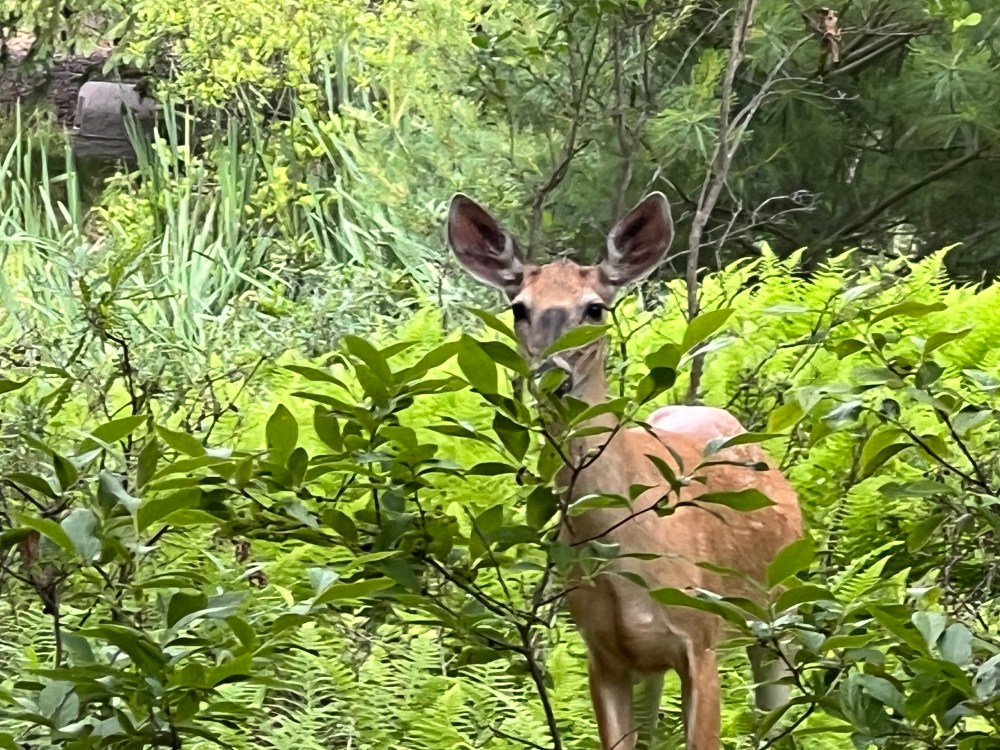
A deer appears in Hawley, Pa., on June 25, 2023. (Jessica Damiano via AP)

Pet owners and parents, however, should exercise caution when deciding to grow these within reach of children or furry family members.

Let’s start with the most offensive bulbs

Crown imperials aren’t referred to as “stink lilies” for nothing. One whiff of the malodorous, tufted, downward-facing, bell-shaped flowers will transport you to a skunk sanctuary — or a sweaty locker room. No self-respecting living thing would deliberately sniff, let alone eat, any part of the plant, which also contains highly toxic steroidal alkaloids.

But don’t let that dissuade you from planting them. The striking plants not only keep rodents away, but they attract pollinators and are exceptionally eye-catching in the spring garden. Just don’t plant them near the front walk.

Alliums are related to onions, and their bulbs’ scent makes no secret of it, so they’re typically left undisturbed. Their flowers have a similar, although milder, fragrance. If rabbits are particularly hungry, they might attempt a nibble, but the bitter sulfur compounds in the bulbs, leaves and stems will send them running. The plants are also toxic.

Similarly, all types of daffodils — from demure jonquils to giant trumpet types — contain bitter, toxic properties that most critters know to avoid.

These bulbs aren’t as offensive but they are off-putting

Although nicely scented to us humans, the strong, sweet perfume emanating from Dutch hyacinth flowers is off-putting to many animals, as is the fruity scent of the unrelated grape hyacinth, which deer and rabbits perceive as musky. Neither is as offensive as pungent alliums, but both hyacinths also contain toxic compounds that cause mouth irritation and stomach upset if bitten or ingested.

Spanish bluebells contain saponins, which smell and taste like soap, as well as poisonous cardiac glycosides.

Snowdrops, Siberian squill, anemone, glory of the snow, winter aconite and star of Bethlehem are smaller, so-called “minor” bulbs with flowers that bloom earlier than the larger bulbs above. But they pack a punch in deterring wildlife browsing, thanks to their unpalatable smell, bitter taste and/or toxic compounds.

Because they have strong defenses, multiply readily and are not kept under control by animals, some of these plants, particularly Siberian squill, Spanish bluebells and star of Bethlehem, can quickly become invasive, so plant with caution.

Mix the offensive bulbs with other bulbs that animals love

All of these plants have spent generations using their natural defenses to avoid being eaten, and you can take advantage of that, too.

If you’d like to plant bulbs that animals love to eat, such as tulips or crocuses, try surrounding them with unpalatable ones. As they exude odors and chemicals to protect themselves, some of those defenses will extend to their bedmates.

___

Jessica Damiano writes weekly gardening columns for The Associated Press. She publishes the Weekly Dirt Newsletter. Sign up here for weekly gardening tips and advice.

___

For more AP gardening stories, go to https://apnews.com/hub/gardening.

Report Error Submit a Tip

More Stories

Jets defenceman spent whole summer working on getting to the next level

Ken Wiebe 8 minute read Preview

Jets defenceman spent whole summer working on getting to the next level

Ken Wiebe 8 minute read Updated: 1:57 PM CDT

Tyrel Bauer makes no apologies for the pugilistic piece of his path.

The Winnipeg Jets defenceman is ready to drop the gloves and throw down when the situation calls for it and he takes great pride in protecting his teammates.

It’s a big part of the reason Bauer will be among the 23 players submitted by the Jets on the opening-day roster on Monday.

“I’ve fought and clawed, both metaphorically and literally and now I just want to show that I can play as well,” Bauer said during a chat with the Free Press during training camp. “(Toughness) is always something that I have, it’s always something in my back pocket and something that I take a lot of pride in doing, for my teammates, for the city and the people who invest in this hockey club. That will never change.

Read
Updated: 1:57 PM CDT

Bombers let another one slip away and face pivotal issue

Taylor Allen 7 minute read Preview

Bombers let another one slip away and face pivotal issue

Taylor Allen 7 minute read Saturday, Sep. 26, 2026

Mike O’Shea summed it up best.

“That one doesn’t feel very good.”

Nor should it.

The Winnipeg Blue Bombers started out hot Friday night, only to run out of gas down the stretch and allow the visiting Toronto Argonauts to steal a 30-28 victory.

Read
Saturday, Sep. 26, 2026

State of the Nations event to highlight Indigenous mining plans

Gabrielle Piché 3 minute read Preview

State of the Nations event to highlight Indigenous mining plans

Gabrielle Piché 3 minute read 7:37 PM CDT

A first-ever conference aims to connect Indigenous leaders with businesses as local mining ambitions grow.

The Manitoba Prospectors and Developers Association expects to rally a half-dozen chiefs to present on their communities’ mineral development projects.

The Nov. 16 event — called the State of the Nations — comes as the province promises to triple critical mineral production.

“We want to see those minerals being developed and being able to be exported,” said Renée Greyeyes, the prospectors association’s chief executive.

Read
7:37 PM CDT

Signs of local neo-Nazi recruiting efforts spark concern

Conrad Sweatman 7 minute read Preview

Signs of local neo-Nazi recruiting efforts spark concern

Conrad Sweatman 7 minute read Saturday, Sep. 26, 2026

A far-right canvassing push in Manitoba this month is raising concerns among Winnipeg residents.

Stickers promoting Nationalist-13, a men’s-only neo-Nazi group also known as NS-13 based primarily in Hamilton, Ont., have appeared in Winnipeg and parts of southern Manitoba. The stickers bear national socialist branding and messages such as “White Man, Fight Back” and “White Community, Political Action, Training and Fitness.”

Winnipeg writer Jess Woolford recently encountered an NS-13 poster on Pembina Highway.

“It was appalling,” Woolford said. “It has the Nazi death heads covering people’s faces. It was pretty disturbing to come across this … I just didn’t expect to see it so blatantly displayed in my neighbourhood.”

Read
Saturday, Sep. 26, 2026

Canada resorting to its tried and true playbook

Niigaan Sinclair 5 minute read Preview

Canada resorting to its tried and true playbook

Niigaan Sinclair 5 minute read 6:00 AM CDT

In 1846, Britain faced an emergency influenced by the Irish famine, so leaders repealed the country’s “Corn Laws” and restrictions on imported food and grain, transitioning to a system of free trade.

This created a crisis in the then Province of Canada, which had relied on British “preferential” status to prop up its agricultural and resource industries.

As a result, Canada looked south for new markets and eventually negotiated a free trade agreement with the United States.

This required land to be acquired and converted for industrial use quickly, so Canada quickly dispatched Commissioner William Robinson to negotiate with Indigenous communities along Lake Huron and Lake Superior for land.

Read
6:00 AM CDT

Ottawa commits $8.1 million for downtown Y redevelopment

Kelly-Anne Riess 2 minute read Preview

Ottawa commits $8.1 million for downtown Y redevelopment

Kelly-Anne Riess 2 minute read 5:58 PM CDT

The federal government is backing a major redevelopment of Winnipeg’s Downtown Y that will expand community programs and update the century-old Vaughan Street building.

On Monday, Ottawa committed $8.1 million toward the Y’s plans to expand newcomer and mental-health programs.

The project will also upgrade elevators, change rooms, aquatics and fitness areas and energy systems. Construction is expected to begin in October, according to the Y’s website.

The YMCA-YWCA is contributing $3.5 million to the project.

Read
5:58 PM CDT