‘Dooming the moose’: Manitoba Cree chief calls for voluntary stop to hunting

Advertisement

Advertise with us

WINNIPEG - The leader of a First Nation in Manitoba is urging all moose hunters to stop hunting in the community's traditional territory due to what she calls dwindling population numbers. 

Read this article for free:


or

Already have an account? Log in here »

To continue reading, please subscribe:

Subscribe and receive a limited-edition Free Press branded hat or tote.

Digital Subscription

One year of digital access for only $205*

  • Enjoy unlimited reading on winnipegfreepress.com
  • Read the E-Edition, our digital replica newspaper
  • Access News Break, our award-winning app
  • Play interactive puzzles

*First annual payment billed as $205.00 + GST for one year. This annual subscription will automatically renew at $233.00 + GST every 52 weeks (10% off the regular annual price of $259.35). Offer available to new and qualified returning subscribers only. Cancel any time.

To continue reading, please subscribe:

Add Free Press access to your Brandon Sun subscription for only an additional

$1 for the first 4 weeks*

  • Enjoy unlimited reading on winnipegfreepress.com
  • Read the E-Edition, our digital replica newspaper
  • Access News Break, our award-winning app
  • Play interactive puzzles
Start now

*Your next Brandon Sun subscription payment will increase by $1.00 and you will be charged $17.95 plus GST for four weeks. After four weeks, your payment will increase to $24.95 plus GST every four weeks.

WINNIPEG – The leader of a First Nation in Manitoba is urging all moose hunters to stop hunting in the community’s traditional territory due to what she calls dwindling population numbers. 

Misipawistik Cree Nation Chief Heidi Cook is advocating for a “voluntary hunting closure” of an approved game hunting area that encompasses a large part of the community along the northwestern shores of Lake Winnipeg. 

Cook is appealing to all hunters, including members of Misipawistik, to prioritize the long-term health of the moose population by halting harvesting in the area beginning Monday, when the season opens. 
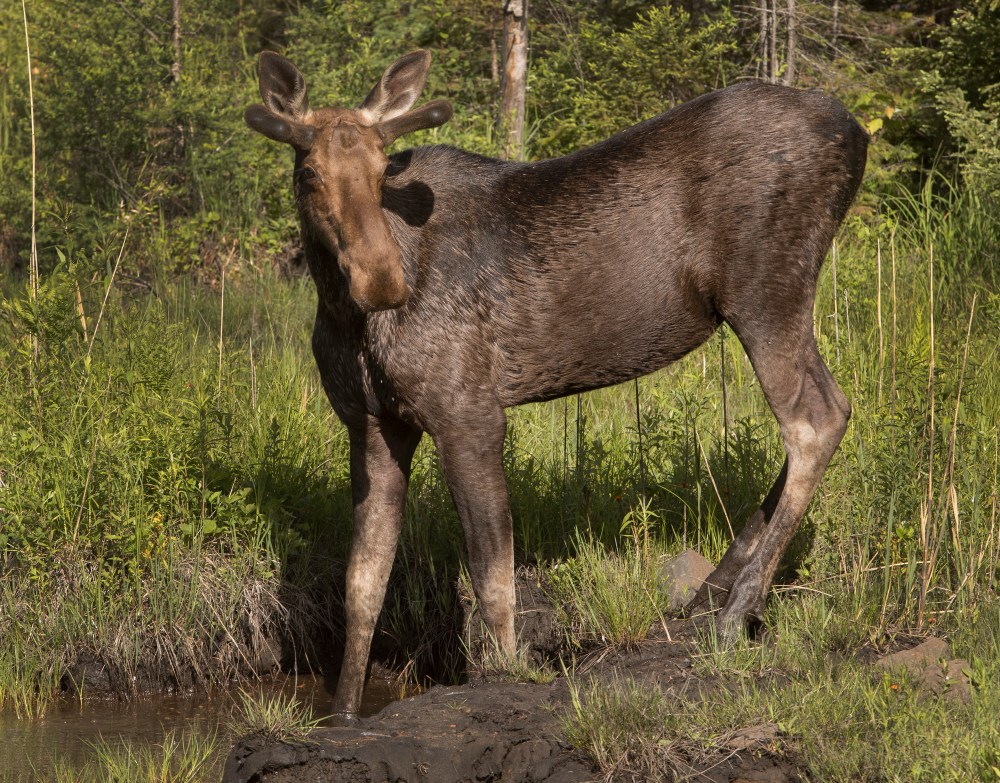
A young bull moose observes visitors along Hwy 60 in Algonquin Park on Saturday, June 12, 2021. THE CANADIAN PRESS/Fred Thornhill

“At this moment in time, the moose population just cannot sustain that harvest. So we’re asking all Manitobans to stand with us in protecting moose and calling on our government to do better,” Cook said in an interview.

“We need to take action, all of us collectively, to protect that moose population so that it can be there for generations of hunters to come. This is our responsibility.”

Cook said information last year from the province, based on an aerial survey, estimated 64 bull moose were in the area.

The government has made 62 bull moose tags available for the same area this year, said the chief.

That doesn’t take into account community hunters, who have treaty rights to hunt on their traditional territory and don’t require government-issued licences or tags.

A provincial spokesperson said in an email Friday that the government’s survey found the moose population remained stable since the last survey in 2013. 

While 62 tags were available this year, the spokesperson said fewer hunters applied and 37 licences were allocated. The government projects a harvest of nine bull moose.

The First Nation disputes the province’s position on the moose population, saying it has observed a sharp drop in the number harvested by members.

Cook said historically the community would harvest up to 19 moose in a season but that hasn’t happened for the past 10 to 15 years. 

A government report detailing the 2013 survey recorded a historic low number of moose for the area. It attributed the low numbers to fires, forestry and mineral exploration, and suggested further disturbances to the animal’s habitat over the following 10 to 20 years. 

The First Nation has been raising concerns with the province for years about the moose, said Cook, but it hasn’t seen much “meaningful change.”

“What our people have been experiencing for a number of years is that it’s almost an involuntary closure. We just don’t have the moose,” she said.

“This is something that is part of our responsibility. We have a right to moose, but we also have a responsibility to protect that moose and make sure that it can survive and be healthy.

“If we continue with the hunt as is, we’re dooming the moose to not being able to be available for future generations.”

Manitoba Keewatinowi Okimakanak, an advocacy group representing some northern First Nations, supports Cook’s call for a voluntary halt to hunting. 

“When First Nations’ leaders raise concerns about the health of a population and the future sustainability of a resource, those concerns must be taken seriously by Manitoba,” Grand Chief Garrison Settee said in a statement.

Cook said areas south of the First Nation have seen total hunting closures because of the way the province has managed the moose population.

In 2024, Misipawistik warned the province its members couldn’t meaningfully hunt for moose in their territory and asked the government to put licences on hold.

The government reduced the number issued and committed to working with the community to determine moose population dynamics and the First Nation’s food needs, but Cook has said that didn’t happen. 

The First Nation took the province to court last year in an attempt to halt moose harvesting in its territory, arguing it infringes on the community’s right to hunt for food and that moose are important for social and ceremonial purposes.

The importance of the animals affects the community in more ways than “just an empty freezer,” added Cook.

“It’s hard, because the moose is such an important cultural species. It’s tied to our relationship with the land, the sharing that happens between families, just the seasonal rhythms of being out and having those moose camps.”

In 2018, Misipawistik developed a land guardian program to track moose in the area. 

Cook said the program has been successful in reducing poaching and animals killed in highway accidents. This hunting season, the guardians will also be tasked with educating hunters about moose population concerns.

The community doesn’t plan to set up blockades or checkpoints to prevent hunting there, Cook said.

It will instead encourage people to reach out to the government and advocate for better moose management. 

“We won’t be stopping anyone from accessing the land. We want to minimize conflict,” she said. “I think the important thing to emphasize is our shared love for moose.”

This report by The Canadian Press was first published Sept. 18, 2026. 

Report Error Submit a Tip

More Stories

Brandonmeat packer thriving on its own

Abiola Odutola 3 minute read Preview

Brandonmeat packer thriving on its own

Abiola Odutola 3 minute read Yesterday at 2:01 AM CDT

BRANDON — Canada Packers has strengthened its business and laid the foundation for future growth during its first year as an independent company, its president says.

The Brandon-based pork producer, separated from Maple Leaf Foods in October 2025, established its own leadership, strategy, systems, culture and identity while continuing operations across its hog production farms and regional hog barns in southern and eastern Manitoba.

The company’s first year was focused on building a successful standalone business while continuing to serve customers, communities and shareholders, president Dennis Organ said.

“Market conditions over the past year have been more challenging than we anticipated when we became a separate entity,” he said in an email. “Despite that, we continued to execute against our priorities, including increasing processing volumes, maintaining disciplined operations and strengthening the business.”

Read
Yesterday at 2:01 AM CDT

Winnipeggers witness unveiling of Japanese Canadian monument in B.C.

Morgan Modjeski 6 minute read Preview

Winnipeggers witness unveiling of Japanese Canadian monument in B.C.

Morgan Modjeski 6 minute read Yesterday at 8:39 PM CDT

As Miki Stewart gathered with her family at the Japanese Cultural Association of Manitoba on Saturday afternoon, she was thinking of her parents, Yoshimaru and Yoshi Abe.

Both Stewart, 80, and her sister Yumi Falk, 81, alongside an older brother, were born in the Tashme internment camp in British Columbia. They were among more than 2,600 Japanese Canadians who were forcefully removed and interred at the camp following the bombing of Pearl Harbour and Canada’s declaration of war on Japan in 1941.

“They didn’t talk much about how they suffered,” Stewart said of her parents. “But they did.”

She was amongst a group of more than 150 people who gathered at the association’s McPhillips headquarters on Saturday afternoon to watch the unveiling of the Japanese Canadian Monument in Victoria B.C.

Read
Yesterday at 8:39 PM CDT

Volunteer pop-up library axed from Manitoba Youth Centre

Matthew Frank 4 minute read Preview

Volunteer pop-up library axed from Manitoba Youth Centre

Matthew Frank 4 minute read Updated: Yesterday at 11:25 AM CDT

Manitoba Corrections has cancelled a pop-up library program at the Manitoba Youth Centre, leaving inmates without librarian services and fewer options to borrow certain books.

The Prison Libraries Committee, part of the non-profit Manitoba Library Association, operated and funded the volunteer program since 2024 before it was shut down by the province last month. The group previously partnered with the province to offer the service because the facility has no dedicated library of its own.

“It is concerning that community members who are incarcerated, especially youth, are losing out on meaningful programming, access to information and rehabilitation efforts, which are offered at no cost to (Manitoba) Corrections. We urge Manitoba Justice to promote more library services and programming, not less,” said a Sept. 24 letter from the non-profit addressed to the justice minister.

Ashley Huot, chair of the Prison Libraries Committee, said she was puzzled when she received an email last month from Manitoba Corrections stating that the pop-up library was no longer needed.

Read
Updated: Yesterday at 11:25 AM CDT

Mayoral candidate Vogiatzakis criticized for living outside Winnipeg

Malak Abas 4 minute read Preview

Mayoral candidate Vogiatzakis criticized for living outside Winnipeg

Malak Abas 4 minute read Friday, Oct. 2, 2026

A mayoral hopeful took heat from other candidates Friday for living outside Winnipeg while running in the civic election.

Mike Vogiatzakis’s primary residence is in the Rural Municipality of St. Andrews, about 25 kilometres north of Winnipeg — a community with its own mayor and councillors.

But the funeral director said he owns a home in Winnipeg where he divides his time, and he would move to the city full-time if elected mayor.

“It doesn’t matter where a person lives. Why are we dividing St. Andrews and Manitoba and Winnipeg? I’ve met the criteria to run for mayor,” Vogiatzakis said Friday morning.

Read
Friday, Oct. 2, 2026

Blown lead spoils Jets opener

Mike McIntyre 7 minute read Preview

Blown lead spoils Jets opener

Mike McIntyre 7 minute read Friday, Oct. 2, 2026

Younger. Faster. Stronger.

They may still be a long ways from a finished product, but it’s safe to say the new-look Winnipeg Jets made a mostly favourable first impression on Friday night in front of a sold-out crowd at Canada Life Centre.

Sure, a 4-3 overtime loss to a hard-nosed Boston Bruins outfit is going to sting a little, especially since the home team was just 98 seconds away from a regulation victory.

But if the Jets can bottle up this kind of energy and effort, they should enjoy plenty of success over the course of the 84-game campaign.

Read
Friday, Oct. 2, 2026

May be whiff of truth to ex’s odour ardour

Maureen Scurfield 5 minute read Yesterday at 2:01 AM CDT

DEAR MISS LONELYHEARTS: I ran into an old boyfriend I used to curl on a team with, and we went for drinks. We’ve been almost eight years apart, and I couldn’t remember why we broke up, as we always had such a great time together.

It wasn’t until the second date — this time on a weekend — that it came back to me, with a jolt. Pee-yew! I remembered he doesn’t use deodorant on weekends. Why? He enjoys his own body odour. I recalled that a bit too late, and it was just as awful as ever! I went home early.

Tonight, he called and I refused him another date. I said, “Think back. You remember why we broke up?” Then he said, “Oh yeah, you hated my no-deodorant weekend policy. Well, guess what? Some women don’t mind!” I said I really doubted that, and that ended the conversation. Miss L., wouldn’t any women find stinky underarms offensive?

— Sensitive Nose, Fort Richmond