Some climb for faith, others for the views. This Chinese sacred mountain draws them all
Advertisement
Read this article for free:
or
Already have an account? Log in here »
To continue reading, please subscribe:

Digital Subscription
One year of digital access for only $205*
- Enjoy unlimited reading on winnipegfreepress.com
- Read the E-Edition, our digital replica newspaper
- Access News Break, our award-winning app
- Play interactive puzzles
*First annual payment billed as $205.00 + GST for one year. This annual subscription will automatically renew at $233.00 + GST every 52 weeks (10% off the regular annual price of $259.35). Offer available to new and qualified returning subscribers only. Cancel any time.
To continue reading, please subscribe:
Add Free Press access to your Brandon Sun subscription for only an additional
$1 for the first 4 weeks*
- Enjoy unlimited reading on winnipegfreepress.com
- Read the E-Edition, our digital replica newspaper
- Access News Break, our award-winning app
- Play interactive puzzles
*Your next Brandon Sun subscription payment will increase by $1.00 and you will be charged $17.95 plus GST for four weeks. After four weeks, your payment will increase to $24.95 plus GST every four weeks.
Read unlimited articles for free today:
or
Already have an account? Log in here »
WUDANG, China (AP) — A banknote clasped between her hands, Liu Haiyan prayed to the protector of the Wudang mountains. The range in central China has long been considered sacred in Taoism.
“I asked him to bless our motherland with favorable weather and to make it even more prosperous,” Liu said while sitting outside the Golden Hall, a Taoist temple at the summit of Tianzhu Peak.
“This place watches over our country,” she added. “We’re Chinese and this is part of our faith.”
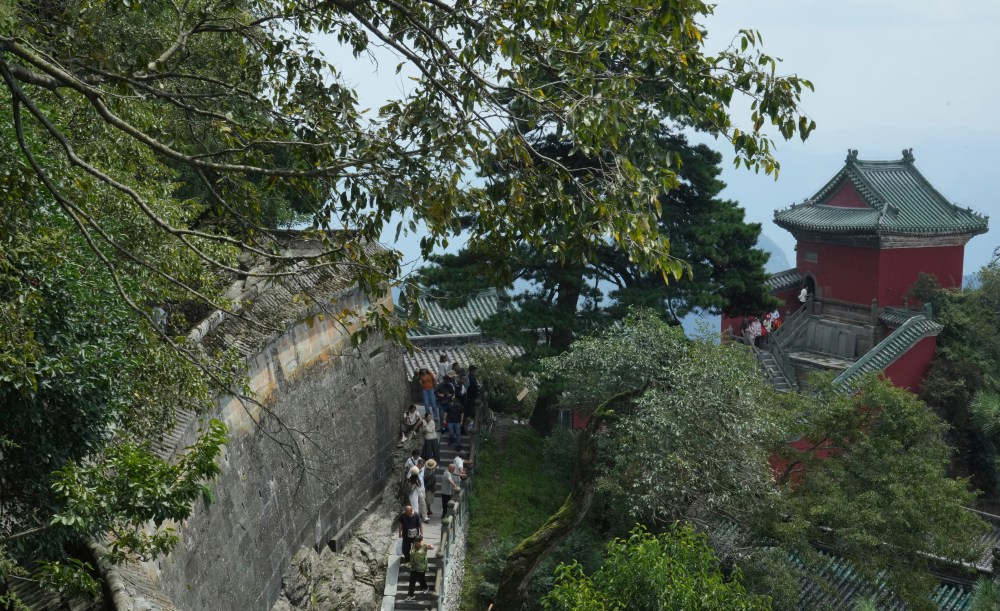
Tourists and pilgrims in a steady stream make their way through Wudang every day. Its scenic peaks, ancient palaces and religious sites drew 14 million visits in 2025, according to government figures.
Wudang’s Taoist buildings date as far back as the 7th century. The complex expanded over centuries through China’s Yuan, Ming and Qing dynasties.
Liu traveled several hundred kilometers (miles) from Hebei province with her daughter, Ji Jiaxin. She also prayed to Wudang’s protector, known as Zhenwu.
“He can guide people toward goodness,” Ji said. “He also watches over all the living things that grow across the land.”
Both women see Wudang as a place of scenic beauty and spiritual significance. Perched at about 1,610 meters (5,280 feet) above sea level, the Golden Hall is a place where they experience a sense of spiritual purification.
“Everyone comes here with a sincere heart,” Liu said. “With sincerity, the divine will respond.”
Philosophy and symbolism are woven into Wudang’s conception
The Wudang mountain range comprises 72 peaks, all thought to converge toward Tianzhu. Its lower slopes are associated with fire, while the deity enshrined at its summit is linked to water.
“Water at the top can moisten the earth, while fire below provides warmth and enables all living things to grow,” said Shu Chenghai, director of social education at Wudang Museum.
The Golden Hall’s construction reflects this symbolism too.
In the traditional Chinese concept of the Five Elements, metal is believed to generate water. And since natural sources can run dry over time, the bronze hall serves as a means to nourish Heaven and Earth.
“It embodies prayers for favorable weather, abundant harvests and peace and prosperity throughout the country,” Shu said.
Generations built their lives around Wudang’s temples
Taoist priests and monks look after the religious sites throughout Wudang. With their hair tied in high buns and dressed in distinctive blue robes, they glide through the temples, talking to visitors and scanning tickets at the entrances.
Their role also connects Wudang’s spiritual life with the communities that call the mountain home.
Cai Hongping was born in the area. Her family settled beside Zixiao Palace, a major Taoist temple complex.
“Some of the elderly Taoist priests there were exceptionally kind and compassionate,” Cai said. “Sometimes they gave us dates, peanuts or fruit.”
Life in the mountains was difficult when Cai was a child. Food and other material goods were scarce, but she remembers the temples as places of happiness and joy.
“I often went with the Taoist priests to identify Chinese medicinal herbs, practiced martial arts with them, and sometimes stole fruit that had been left as offerings,” Cai said.
Her connection to the mountain extended beyond its temples.
Cai’s grandfather was a heritage conservation worker in Wudang, a role focused on preserving and cataloging cultural relics. Her father also made walking sticks for visitors. Cai and other relatives sometimes joined him in gathering medicinal herbs to sell.
“The entire mountain was my childhood,” Cai said. “It has also given me a reverence for life.”
Ming emperors left their mark on Wudang
Wudang’s palaces and temples flourished during the Ming dynasty, when Emperor Zhu Di undertook a major building campaign to align his imperial regime with Taoism.
At its height, the complex included dozens of temples, palaces and monasteries. More than 60 sites survive today.
Wudang’s development coincided with another major project commissioned by Zhu Di: the Forbidden City in Beijing.
“When we say, ‘The Forbidden City was built in the north, and Wudang was developed in the south,’ we mean that these two World Cultural Heritage sites are like twins,” Shu said.
“The two places conveyed a message to the world: one represented Heaven, while the other represented the human realm,” he added.
Wudang’s special connection with Ming dynasty emperors remains visible today.
Along the route taken by tourists and pilgrims are several steles marking ritual proclamations made on behalf of emperors during the first year of each reign.
“An emperor needed to make a ritual proclamation to Zhenwu,” Shu said. “He would declare that he had succeeded to the imperial throne and express his hope for Heaven’s support.”
Visitors still seek meaning in Wudang’s landscape
Long before today’s visitors made their way to Wudang, the mountain drew people seeking solitude and spiritual cultivation.
Shu said its distinctive landscape embodies the traditional Chinese concept of “Dong Tian Fu Di,” or “grotto-heavens and blessed lands” — places traditionally regarded as sacred retreats.
“The idea is that a profound harmony between humanity and nature is not merely something human beings can create,” he added.
Beyond the Golden Hall, visitors encounter other temples and figures associated with different needs, from health and inner balance to martial arts.
Wang Xia recently traveled from Inner Mongolia and visited Taizipo, or Prince Slope, a Taoist temple complex linked to Zhenwu’s legendary early life as a prince.
“The fact that the crown prince once studied here makes it particularly appealing,” Wang said. “I wanted to pray for my child, to wish her academic success and a bright future.”
Her first encounter with Wudang came from books. She read about the Ming dynasty and began to dream about visiting the site herself one day.

“I imagined that coming here would give me the feeling of entering the world of Taoist immortals,” Wang said. “That is what this place feels like: a mountain of immortals.”
___
AP video journalist Wu Jia contributed to this report.
___
Associated Press religion coverage receives support through the AP’s collaboration with The Conversation US, with funding from Lilly Endowment Inc. The AP is solely responsible for this content.
The Free Press acknowledges the financial support it receives from members of the city’s faith community, which makes our coverage of religion possible.