How, when and why to divide garden perennials for better blooming

Advertisement

Advertise with us

If your spring and early-summer perennials are overgrowing their spaces, blooming less, producing smaller flowers or flopping over (possibly with a hole in their centers), they’re telling you they want to be divided.

Read this article for free:


or

Already have an account? Log in here »

To continue reading, please subscribe:

Subscribe and receive a limited-edition Free Press branded hat or tote.

Digital Subscription

One year of digital access for only $205*

  • Enjoy unlimited reading on winnipegfreepress.com
  • Read the E-Edition, our digital replica newspaper
  • Access News Break, our award-winning app
  • Play interactive puzzles

*First annual payment billed as $205.00 + GST for one year. This annual subscription will automatically renew at $233.00 + GST every 52 weeks (10% off the regular annual price of $259.35). Offer available to new and qualified returning subscribers only. Cancel any time.

To continue reading, please subscribe:

Add Free Press access to your Brandon Sun subscription for only an additional

$1 for the first 4 weeks*

  • Enjoy unlimited reading on winnipegfreepress.com
  • Read the E-Edition, our digital replica newspaper
  • Access News Break, our award-winning app
  • Play interactive puzzles
Start now

*Your next Brandon Sun subscription payment will increase by $1.00 and you will be charged $17.95 plus GST for four weeks. After four weeks, your payment will increase to $24.95 plus GST every four weeks.

If your spring and early-summer perennials are overgrowing their spaces, blooming less, producing smaller flowers or flopping over (possibly with a hole in their centers), they’re telling you they want to be divided.

Crowded plants often struggle because they must compete for limited water, nutrients and sunlight, and the diminished airflow between them also increases their risk of contracting mold and fungal diseases.

To avoid their inevitable decline, it’s best to divide them every three to five years. As a bonus, the practice will reward you with free plants for your garden.
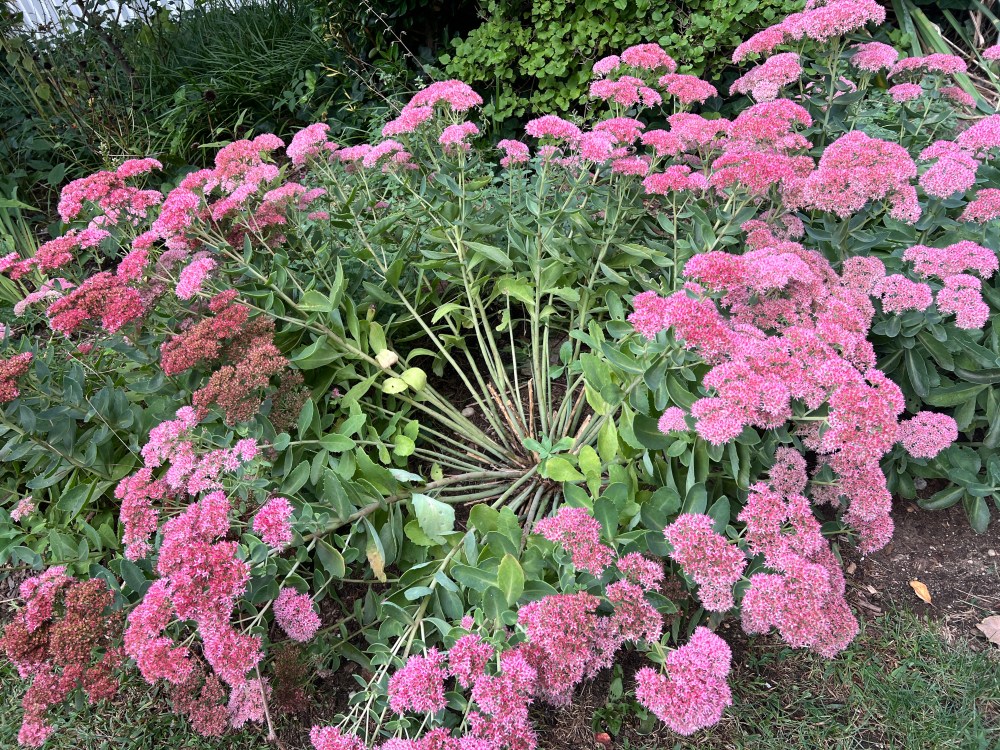
An overgrown sedum with a hole in its center, a telltale sign that a plant is in need of division, appears on Long Island, N. Y., on Sept. 22, 2026, (Jessica Damiano via AP)

Not every perennial, however, appreciates division. Plants with woody crowns or deep taproots, like lavender, Russian sage, butterfly weed and Baptisia, downright resent it.

As a rule of (green) thumb, gardeners should divide late-summer and fall bloomers in the spring, just after they emerge from the ground, and spring- and early-to-mid-summer bloomers in the fall, when the plants no longer need their energy stores for active growth and flower production.

In colder climates, fall divisions should be completed four to six weeks before the ground freezes to allow sufficient time for each replanted segment’s roots to establish before dormancy.

How to do the dividing

Watch the weather report and plan the task for a cool, cloudy day. Water the plant deeply one or two days prior to give it a hydrating boost and moisten the soil.

Cut plants down, if necessary, to better expose their crowns, or the junctures where their top growth meets their roots. That will also make them easier to work with.

Plunge a garden fork into the soil, about a foot away from the base of the plant. You can use a spade instead, but I prefer a fork because it minimizes damage to the root ball.

Apply pressure to the tool’s handle to raise a section of the clump, then remove the fork, step over to the next section of root, and insert and raise it in the same manner. Repeat all around the plant until you have loosened the entire root system and can easily lift it out of the ground.

Gently remove enough soil from the roots to enable you to better see the base of the plant’s shoots.

Small plants with loose roots can often be pulled apart by hand, but this won’t likely be the case if they are already overgrown and crowded, which is why we’re here in the first place.

So, grab a second fork and place it back-to-back with the first into the center of the root clump. Pull the handles in opposite directions toward the outside of the plant until the clump separates into two pieces. Very large clumps can be divided into three or even four plants, as long as each section has healthy roots and at least three strong shoots above it.

Plant immediately

To minimize the roots’ exposure to the dehydrating air, dig holes for your new plants immediately. Better yet, prepare the holes before digging up the plants, if possible.

Make each hole wider than the clump, but only deep enough to ensure the top of the root ball lands at or very slightly above the soil line when planted.

Cover with soil and tamp firmly to remove air pockets, then water well, but don’t fertilize.

Apply a layer of mulch over the bare soil around plants to retain water, discourage weeds and reduce soil temperature fluctuations over winter.

In spring, your new, free plants will begin their second acts as healthier, more vigorous plants with plenty of room to grow.

Until the next time.

___

Jessica Damiano writes weekly gardening columns for The Associated Press. She publishes the Weekly Dirt Newsletter. Sign up here for weekly gardening tips and advice.

___

For more AP gardening stories, go to https://apnews.com/hub/gardening.

Report Error Submit a Tip

More Stories

What’s open, what’s closed, what’s up in Winnipeg on National Day for Truth and Reconciliation Sept. 30, 2026

Free Press staff 4 minute read Preview

What’s open, what’s closed, what’s up in Winnipeg on National Day for Truth and Reconciliation Sept. 30, 2026

Free Press staff 4 minute read Sunday, Sep. 27, 2026

The National Day of Truth and Reconciliation, or Orange Shirt Day, as it's known in Manitoba, happens Sept. 30 with many commemorative community events scheduled.

Read
Sunday, Sep. 27, 2026

Perfumer battling city hall to keep his shop open

Gabrielle Piché 5 minute read Preview

Perfumer battling city hall to keep his shop open

Gabrielle Piché 5 minute read Monday, Sep. 28, 2026

Michael O’Malley has been here before — fighting the City of Winnipeg to keep his business open.

He usually spends his days concocting scents. He’s owned La Parfumerie, a Wolseley shop, since 1993.

Twenty-seven natural perfumes line shelves on 145 Evanson St.’s bottom floor. O’Malley lives above the space.

Now, he’s required to change the home’s zoning or shut out walk-in customers. Either would kill the company, O’Malley said.

Read
Monday, Sep. 28, 2026

Klein vows to freeze water, sewer rate for next two years

Joyanne Pursaga 5 minute read Preview

Klein vows to freeze water, sewer rate for next two years

Joyanne Pursaga 5 minute read Yesterday at 6:09 PM CDT

Mayoral candidate Kevin Klein is promising to cancel a water and sewer rate hike proposed for next year and freeze the fee for two years.

Klein said Winnipeggers are simply paying far too much for the utility.

“I think we have to freeze them right now because we’ve seen (a substantial increase) in the last four years. We are facing some of the most difficult financial times for families right now,” he said.

He would also ask the provincial Public Utilities Board to set Winnipeg’s future water and sewer rates, a power currently held by city council.

Read
Yesterday at 6:09 PM CDT

Canada resorting to its tried and true playbook

Niigaan Sinclair 5 minute read Preview

Canada resorting to its tried and true playbook

Niigaan Sinclair 5 minute read Monday, Sep. 28, 2026

In 1846, Britain faced an emergency influenced by the Irish famine, so leaders repealed the country’s “Corn Laws” and restrictions on imported food and grain, transitioning to a system of free trade.

This created a crisis in the then Province of Canada, which had relied on British “preferential” status to prop up its agricultural and resource industries.

As a result, Canada looked south for new markets and eventually negotiated a free trade agreement with the United States.

This required land to be acquired and converted for industrial use quickly, so Canada quickly dispatched Commissioner William Robinson to negotiate with Indigenous communities along Lake Huron and Lake Superior for land.

Read
Monday, Sep. 28, 2026

In a smart-device world, some families keep phone jacked into the wall

Sheldon Birnie 8 minute read Preview

In a smart-device world, some families keep phone jacked into the wall

Sheldon Birnie 8 minute read Yesterday at 4:20 PM CDT

When the phone rings in Kristin Shiach and Jordan Sobkowicz’s Riverview home, their three daughters race to see who can be the first to answer.

“It depends who is closest,” says 13-year-old Emily. “If I’m sitting in my room, I can get to it quickest.”

“That’s because it’s always in your room,” Anna, 10, replies. “You never put it back!”

“Usually, when the phone rings,” explains Sobkowicz, “someone yells really loudly —”

Read
Yesterday at 4:20 PM CDT

Winnipeg Rifles can still secure post-season berth despite starting season 0-4

Joshua Frey-Sam 5 minute read Preview

Winnipeg Rifles can still secure post-season berth despite starting season 0-4

Joshua Frey-Sam 5 minute read 12:47 PM CDT

The Winnipeg Rifles have a seat at the table, something they would’ve certainly taken a few weeks ago.

A solid three-phase performance in a 25-13 win over the Edmonton Huskies on Sunday kept the junior football club’s playoff hopes alive as the team heads into the final week of the regular season in the Prairie Football Conference.

The path to punching their ticket isn’t easy, however. The Rifles must travel to a perennially difficult environment in Saskatoon to face the Hilltops (4-3) on Sunday (1 p.m.), a contest that only matters if the Huskies beat the Edmonton Wildcats on Saturday.

But after starting the season 0-4, it’s a deal that the Rifles will happily take.

Read
12:47 PM CDT